
When you speak, I guarantee you will be heard
Zacarese & Zalewski P.C.
Protecting Your Rights with a Top Child Support Lawyer in Suffolk County
Call now: 516-660-4354
"He didn't just win my case. He gave me back my future, my peace of mind, and my ability to breathe again."
From the very first conversation, he changed everything. He didn't just see a case, he saw me, and treated me like family. His knowledge of the law was unmatched, but what truly set him apart was his humanity. If you are looking for a lawyer, stop searching right now.


How Child Support Works Under the New York Child Support Standards Act (CSSA)

Under Article 4 of the New York Family Court Act, both parents must help support their children. The court uses a law called the Child Support Standards Act (CSSA). This law creates a basic formula to make sure support amounts are fair and meet the child's daily needs. For a plain-English overview of how these rules work, see the New York State Child Support Standards Act.
The formula figures out the basic support obligation by combining the income of both parents. Next, it looks at who has primary physical custody. The parent who has the child for most of the time is the custodial parent. The other parent is the non-custodial parent, who pays their share of the child's support.
The court uses standard percentages based on how many children you have:
| Number of Children | CSSA Percentage |
|---|---|
| 1 Child | 17% |
| 2 Children | 25% |
| 3 Children | 29% |
| 4 Children | 31% |
| 5 or More Children | At least 35% |
Determining Combined Parental Income and Statutory Percentages
To start, the court determines each parent's gross income. This includes regular paychecks, overtime, bonuses, tips, worker's compensation, and business earnings.
The court then subtracts certain allowable items:
- FICA taxes (Social Security and Medicare)
- Local New York City or Yonkers taxes (if they apply)
- Child support or alimony actually paid for other children or a former spouse under an existing court order
The two adjusted income numbers are added together to find the combined parental income. The court applies the percentage listed above to this combined income. Each parent is responsible for their pro rata share, which is their percentage of the total income.
What if a parent quits a job or claims they make far less than they can actually earn? The judge or Support Magistrate can impute income. That means the court assigns an income amount based on the parent's work history, education, and past earnings.
Navigating the $183,000 Income Cap and Mandatory Add-On Expenses
The state guidelines use an income cap. The standard combined parental income cap is $183,000.
For any income up to $183,000, the court must apply the percentage rules. For any family income above $183,000, the court can decide whether to apply the same percentage or look at specific factors, such as:
- The financial resources of both parents
- The child's health, special needs, or unique talents
- The standard of living the child would have enjoyed if the home remained intact
On top of basic support, New York law requires parents to divide "add-on" expenses based on their share of income.
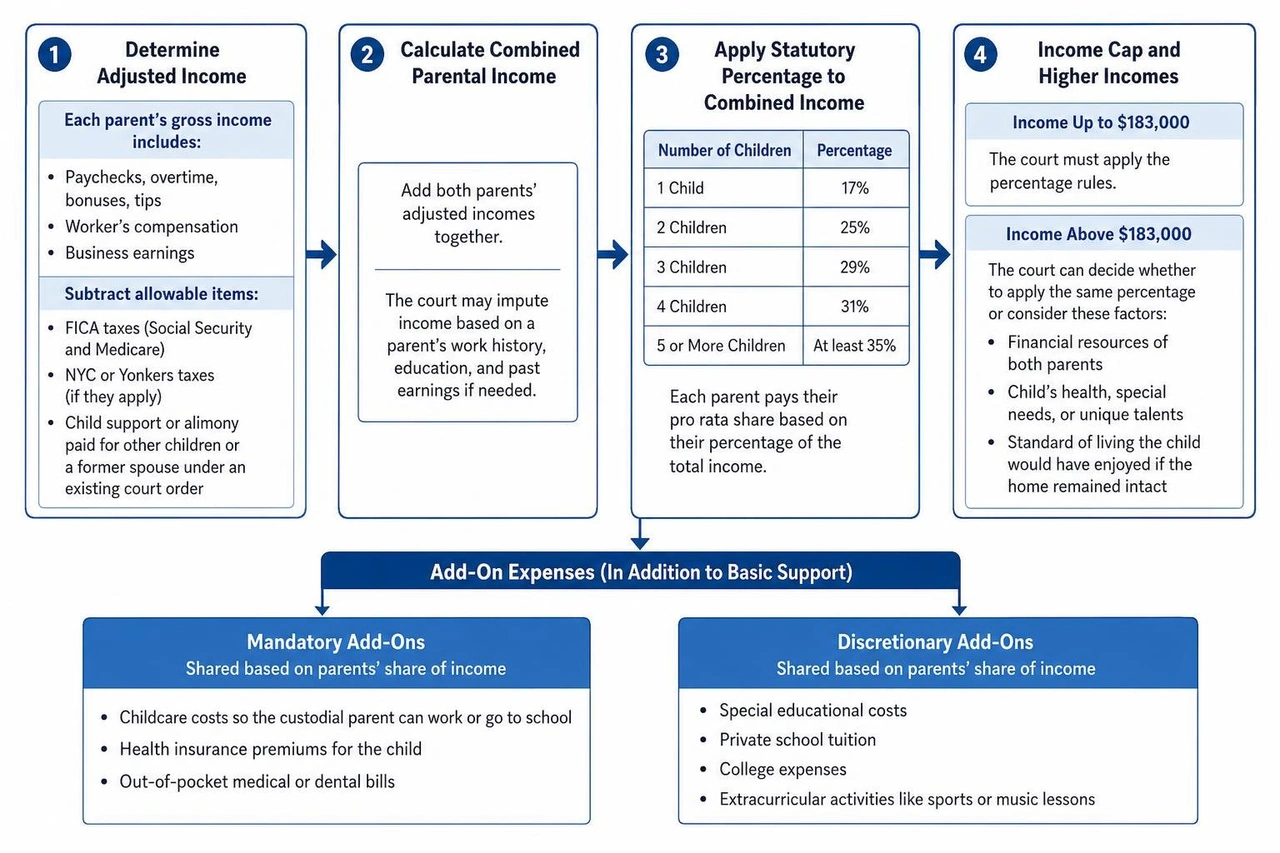
Add-on expenses include:
- Mandatory Add-Ons: Childcare costs so the custodial parent can work or go to school, health insurance premiums for the child, and out-of-pocket medical or dental bills.
- Discretionary Add-Ons: Special educational costs, private school tuition, college expenses, and extracurricular activities like sports or music lessons.
Why You Need an Experienced Child Support Lawyer in Suffolk County

Child support might sound like simple math, but real life is rarely simple. When parents own businesses, work for cash, or try to hide what they make, the standard forms do not tell the whole story.
Steven Zalewski has over 40 years of experience handling thousands of cases in the Suffolk County Family Court system. He is widely recognized as one of the most well-known family court trial lawyers in Suffolk County. Whether your case is heard in Islandia, Central Islip, or Riverhead, having seasoned legal guidance makes all the difference before a Support Magistrate.
A quick word of advice: Please do not rely on AI tools like ChatGPT to write your custody agreements, support plans, or separation paperwork. Generic computer prompts miss critical local rules and human details. A single mistake on a form can cost you thousands of dollars or harm your parental rights for years. You need a real human attorney with true empathy and local knowledge to protect your family's future.
Uncovering Hidden Income and Combating Underemployment
When one parent is self-employed, runs a cash business, or hides perks in company accounts, their reported tax return may not show their true earnings.
An experienced attorney knows how to use legal tools to uncover the truth:
- Demanding full financial discovery, bank records, and credit card receipts
- Subpoenaing 1099 statements, loan applications, and payment apps
- Looking at personal living expenses compared to reported wages
- Showing the court when someone is voluntarily working below their real earning capacity
How a Child Support Lawyer in Suffolk County Protects Your Rights in Family Court
Navigating Article 4 petitions requires deep knowledge of court rules and evidence.
Our team protects you by:
- Presenting clear, accurate financial disclosure forms
- Cross-examining the other party to expose missing income
- Arguing for fair deviations when standard calculations cause extreme hardship
- Making sure add-on expenses are split correctly so you are not left paying more than your fair share
Modifying and Enforcing Child Support Orders in Suffolk County

Life changes over time, and support orders often need updates. However, you cannot change payments on your own. Any change requires a formal petition filed in Family Court.
Qualifying for an Upward or Downward Modification
You can ask the court to adjust an order if you meet any of these standards:
- Major changes in your child's life: Significant changes in living arrangements, medical needs, or custody.
- The 15% Rule: Either parent's gross income has gone up or down by 15% or more since the last order was entered (any reduction must be involuntary and made despite diligent job searches).
- The Three-Year Rule: Three full years have passed since the order was entered, modified, or adjusted.
Enforcement Actions for Unpaid Support and Arrears
If a parent falls behind on court-ordered payments, the law provides strong tools to collect unpaid support (arrears):
- Income Executions: Direct wage garnishment from paychecks.
- Tax Refund Intercepts: Taking state and federal tax refunds.
- License Suspensions: Suspending driver's, professional, or recreational licenses.
- Money Judgments: Placing liens on real estate and seizing bank accounts.
- Contempt of Court: Willful failure to pay can lead to a formal contempt hearing, which carries the risk of up to six months in jail.
Transparent Flat-Fee Legal Representation for Child Support Matters
Legal bills should not be a mystery. Traditional hourly billing often leads to surprise fees and makes parents afraid to call their lawyers. We do things differently.
Steven Zalewski uses an honest, transparent flat-fee model:
- All Court Appearances Included: Your flat fee covers all your appearances before the Support Magistrate, no matter how many court dates your case takes.
- Predictable Costs: You know your exact legal costs before we start any work.
- Payment Plans Available: We offer flexible payment plans to fit your family budget.
- Never Left Behind: Many firms abandon clients mid-case or switch to high hourly rates when things get complicated. Steve never leaves a client behind because they ran out of money.
What the $3,500 Pre-Trial Flat Fee Covers
We handle Article 4 child support cases in Suffolk County Family Court for a fixed pre-trial fee of $3,500.
This fee covers:
- Preparing, filing, or answering your petition
- Gathering and reviewing complete financial disclosures
- Direct communication with your attorney whenever you have questions
- Settlement discussions and negotiations with the other party
- All pre-trial court dates and conferences before the Support Magistrate
Trial Fees, Settlement Refunds, and What to Ask Your Child Support Lawyer in Suffolk County
Most child support cases settle during negotiations or magistrate conferences. But if your case cannot be resolved amicably, it goes to a contested trial.
- The Trial Fee: Our trial fee is a single set fee of $3,500, due 30 days before your scheduled trial date.
- 50% Settlement Refund: If your case settles before the trial phase begins, we provide a 50% refund of the trial fee.
- Third-Party Costs: The flat fee covers all our legal work. Any outside third-party costs (such as formal process server fees) are discussed openly in advance.
Frequently Asked Questions About Child Support in Suffolk County
How long do child support obligations last in New York?
In New York, both parents are legally obligated to support their child until the child turns 21.
Support may end earlier only if the child is legally emancipated before age 21. Emancipation occurs if the child:
- Marries
- Joins the military full-time
- Becomes completely self-supporting through full-time employment
Even if you believe your child is emancipated, you must get an official court order to terminate the support obligation.
Can I stop paying child support if my child moves in with me or turns 18?
No. Never stop or reduce your child support payments on your own or based on a verbal agreement with the other parent.
Informal agreements are not legally binding. If you stop paying without a judge signing a new order, you will build up unpaid arrears that the court cannot erase. If your child moves in with you, file a modification petition in Family Court right away.
What documents should I gather before filing or responding to a child support petition?
To help your lawyer build a strong case, gather these financial documents:
- Recent pay stubs (at least the last four to six pay periods)
- State and federal tax returns with all W-2s and 1099s for the last two to three years
- Proof of health insurance costs for the child
- Childcare invoices, receipts, and canceled checks
- Records of unreimbursed medical, dental, or prescription costs
- Documentation of any special school or activity expenses
Conclusion
Child support decisions have a lasting impact on your family's financial security. Whether you are establishing a new order, adjusting an existing one, or dealing with unpaid arrears, having trusted legal guidance helps you protect your child's well-being and your rights.
For a deeper look at local court procedures, read our Suffolk County Family Court guide to see how our team helps parents navigate every step of the process.
Ready to protect your rights? Contact Zacarese & Zalewski P.C. today for a confidential consultation.
📱 Cell: (516) 660-4354 📧 Email: steve@zandzfamilylawyers.com 🏛 Address: 1601 Veterans Memorial Highway, Suite 500, Islandia, NY 11749
i guarantee you will be heard
Ready to Take the Next Step?
At Zacarese & Zalewski P.C., when something isn’t right, say something—and we’ll do something about it with you.
Our flat-fee structure is clear: one flat fee for pre-trial work, and a trial fee only if your case goes to trial or a hearing. Call now and a professional will return your call quickly; if we miss you, we'll call back the same day.