
When you speak, I guarantee you will be heard
Zacarese & Zalewski P.C.
Child Custody Cases in Maryland: A Complete Parent Guide
Call now: 516-660-4354
"He didn't just win my case. He gave me back my future, my peace of mind, and my ability to breathe again."
From the very first conversation, he changed everything. He didn't just see a case, he saw me, and treated me like family. His knowledge of the law was unmatched, but what truly set him apart was his humanity. If you are looking for a lawyer, stop searching right now.


What Parents Should Know About Custody Cases in Maryland

Custody cases in Maryland are decided by what the court believes is best for the child, not by a rule favoring either parent. Judges look at each parent's ability to care for the child, the child's safety and stability, each parent's relationship with the child, and whether the parents can make decisions and support the child's relationship with the other parent.
Here is the quick overview:
- Legal custody covers major choices about school, medical care, and religion.
- Physical custody covers where the child lives and the parenting-time schedule.
- Parents may share custody, or one parent may have sole legal or physical custody.
- Maryland does not automatically favor mothers or fathers. Both natural parents are generally treated as joint guardians.
- A court can change an existing order only when there has been a material change that affects the child's welfare.
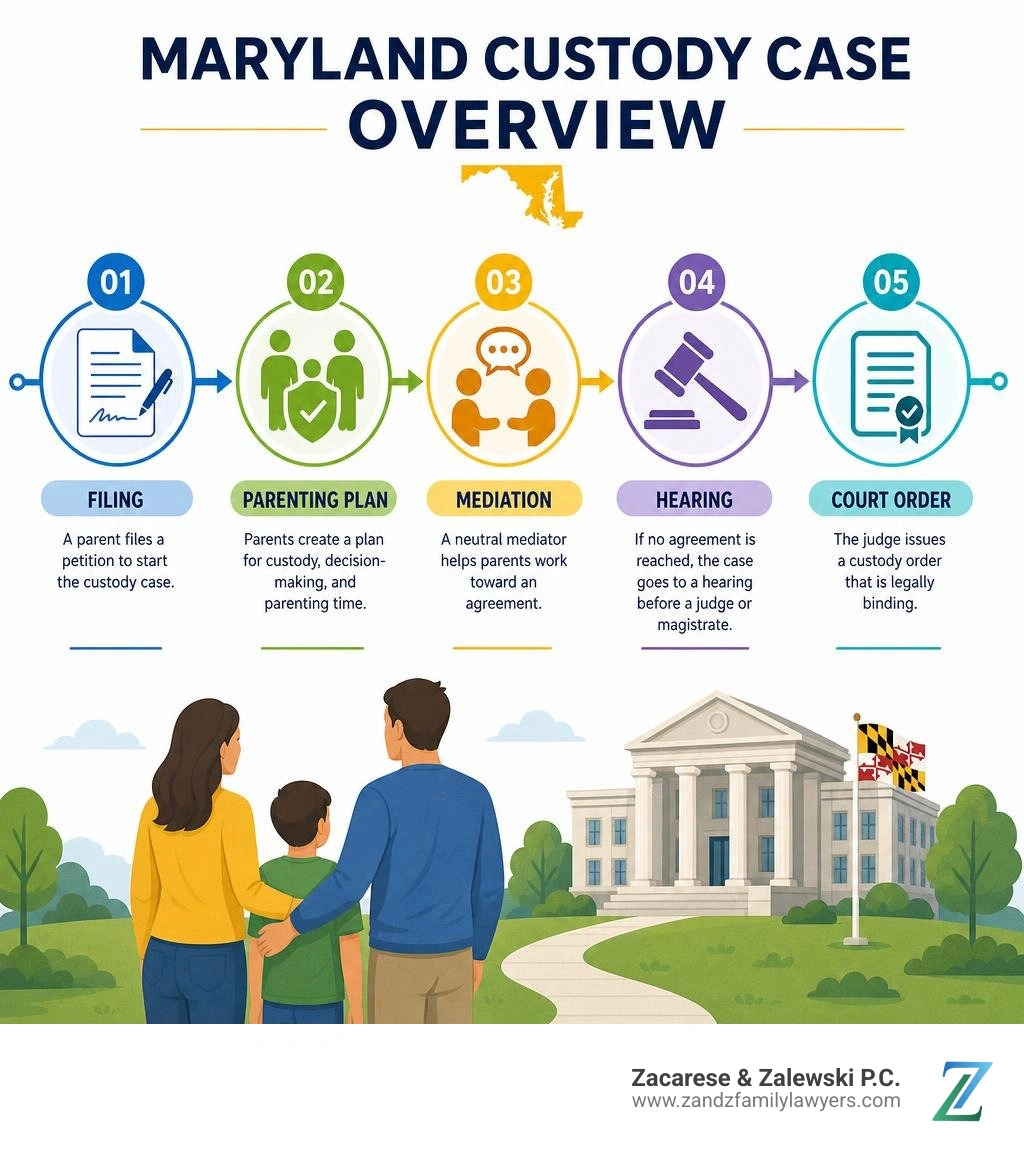
Custody disputes can feel personal, costly, and hard to follow. The process may involve court filings, parenting plans, mediation, temporary orders, and, when parents cannot agree, a hearing before a judge or magistrate.
At Zacarese & Zalewski P.C., Steven Zalewski is one of the most well-known family court trial lawyers in Suffolk County, New York. The firm helps parents with custody, support, CPS/neglect, and related family-law matters using plain-English guidance, fast same-day response, and transparent flat-fee pricing.
Types of Custody in Maryland: Legal vs. Physical
When parents handle custody cases in Maryland, it helps to know that custody breaks down into two main parts: decision-making power and physical daily care.
Courts separate these rights into legal custody and physical custody. A judge can grant joint custody or sole custody for either part. Sometimes, in cases with more than one child, a judge orders split custody where each parent gets primary physical custody of a different child.
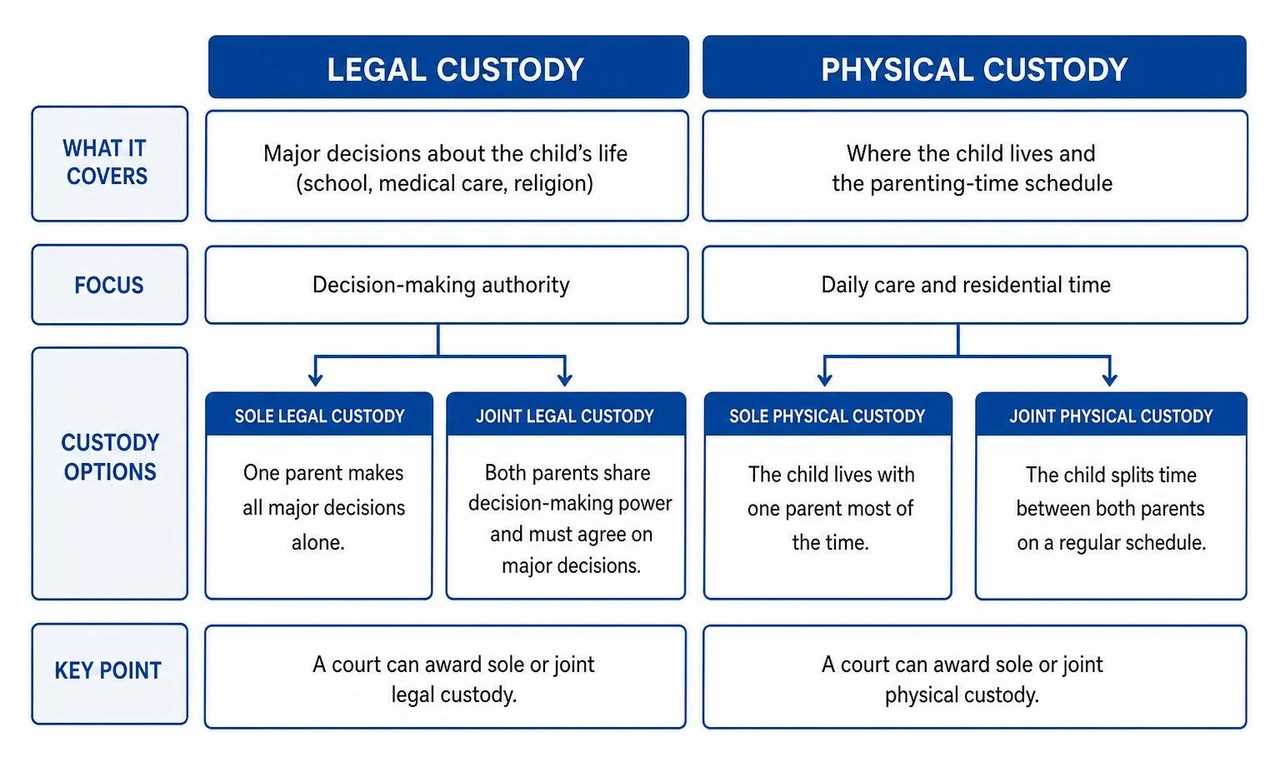
| Custody Type | What It Means | Common Example |
|---|---|---|
| Sole Legal Custody | One parent makes all major decisions alone. | One parent chooses schools, doctors, and religious training. |
| Joint Legal Custody | Both parents share decision-making power. | Parents talk and agree on major choices together. |
| Sole Physical Custody | The child lives with one parent most of the time. | The child lives with Parent A and visits Parent B on weekends. |
| Shared Physical Custody | The child lives with each parent for substantial time. | The child stays at least 35 percent of overnights each year with each parent. |
Legal Custody vs. Physical Custody in Maryland
Legal custody deals with long-term major choices for your child's welfare. These choices include:
- Healthcare decisions, like choosing doctors or elective surgeries.
- Educational decisions, like choosing private or public schools or special education plans.
- Religious upbringing and practice choices.
In a joint legal custody arrangement, both parents must discuss these big decisions in good faith. If parents agree to joint legal custody but worry about getting stuck, the court may give one parent "tie-breaking authority." This means both parents must talk and try hard to reach an agreement first. If they reach an impasse, the parent with tie-breaking power can make the final choice.
Physical custody deals with where the child sleeps, goes to school from, and spends daily time. The parent who has physical custody at any given time handles basic day-to-day decisions, like bedtime, meals, and daily chores.
Understanding Shared Physical Custody Cases in Maryland
In Maryland, shared physical custody has a specific legal meaning. To qualify as shared physical custody, the child must spend at least 35 percent of overnight stays each year with each parent. That equals at least 128 overnights per year for each parent.
Parents often use different weekly arrangements to hit this mark:
- Alternating weeks (week-on, week-off schedules).
- A 2-2-5-5 rotation schedule where children split weekdays and alternate weekends.
- Extended summer break stays combined with alternating weekends.
During early separation, parents can ask for temporary physical access using a pendente lite (temporary) court order. These temporary orders help keep the child's life stable and calm while the case moves forward.
Creating reliable schedules is critical. When parents face complex disputes in court, generic solutions fall short. Some parents mistakenly turn to artificial intelligence tools to write co-parenting agreements. Warning: using AI to draft family law agreements can be dangerous. Generic, robotic forms leave out key local details, ignore complex child access rules, and can ruin a family's financial and emotional future for years. Only a human attorney with local Suffolk County legal insight and empathy can protect a family's future.
How Courts Decide Custody Cases in Maryland: The Best Interest Standard
Maryland courts use a single core test when deciding custody cases in Maryland: the best interests of the child. Under Maryland Code, Family Law § 5-203, both natural parents are considered joint natural guardians of their minor children. Neither parent starts with an advantage.
Judges do not award custody as a reward to a good parent or a punishment to a bad one. Instead, judges carefully weigh how each choice affects the child's safety, physical health, emotional growth, and day-to-day stability.
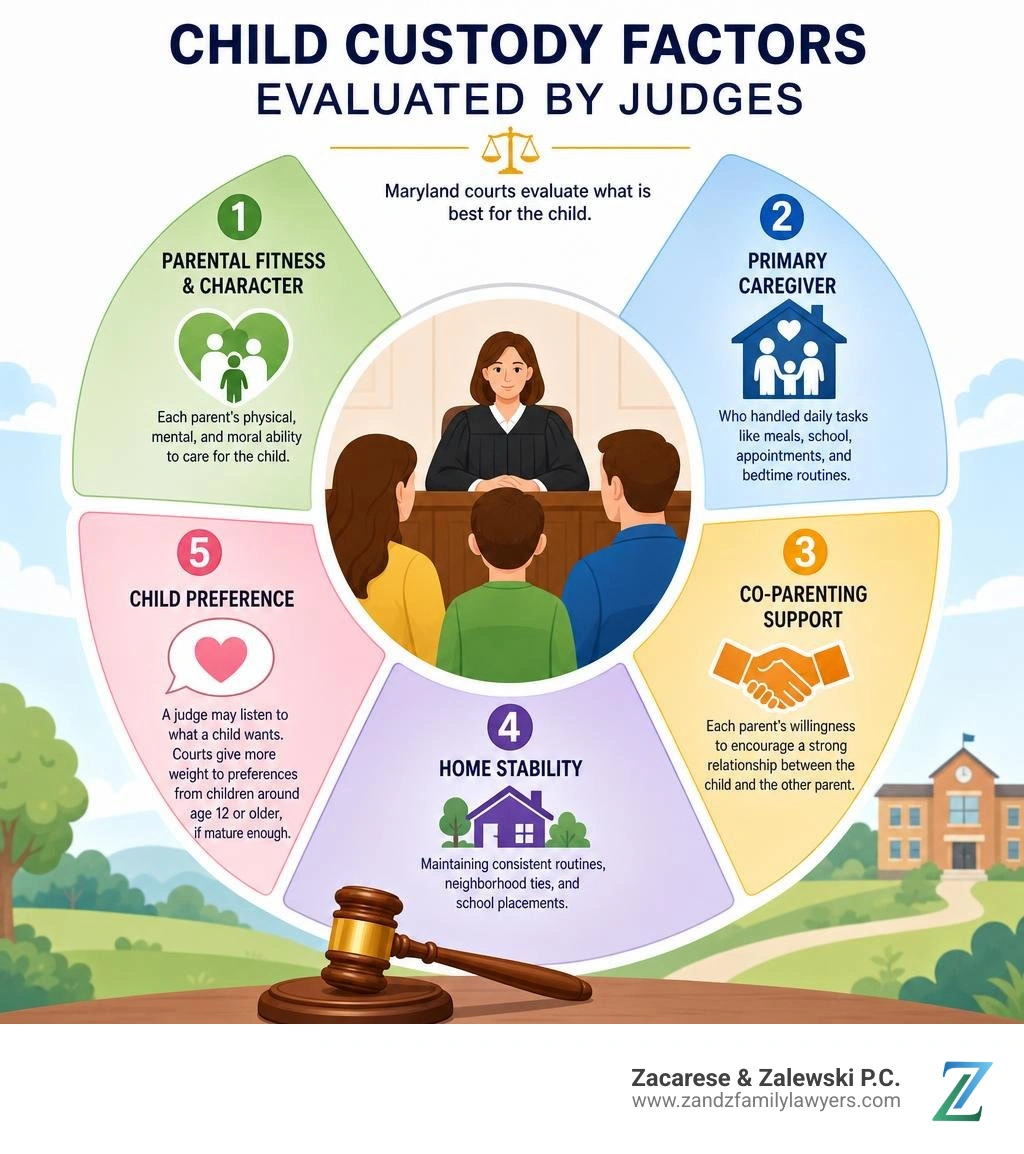
Key Factors Judges Evaluate in Maryland Custody Cases
To figure out what is best for a child, Maryland courts review standard factors established in landmark court decisions (historically known as the Sanders and Taylor factors) alongside codified family law standards:
- Parental Fitness and Character: Each parent's physical, mental, and moral ability to care for the child.
- Primary Caregiver: Who handled daily tasks like cooking, medical visits, school drop-offs, and bedtime routines before the court case.
- Co-Parenting Support: Each parent's willingness to encourage a strong relationship between the child and the other parent.
- Home Stability: Maintaining consistent routines, neighborhood ties, and school placements.
- Child Preference: A judge may listen to what a child wants. Courts pay closer attention to preferences expressed by children around age 12 or older, provided the child is mature enough.
Distance between homes also plays a huge role. If parents live far apart, frequent midweek handoffs can cause heavy transit fatigue for young children. In such matters, courts look closely at travel times to protect the child's daily schedule.
Courts also step in when parents pass away or when non-parents seek custody. A key decision by the Appellate Court of Maryland examined nonparental custody and best interest rules in Cherlie Augustin v. David Duncan, et al., No. 1566, Sept. Term, 2025, and No. 22, Sept. Term, 2026. The court clarified that when both biological parents are deceased, the standard legal presumption favoring biological parents no longer applies. In those rare situations, third parties and relatives compete equally under the child's best interest standard.
Specialized Disputes: Unmarried, Incarcerated, and Non-Parent Custody Claims
Not every custody case follows a basic divorce path:
- Unmarried Parents: When parents were never married, paternity must be established legally before the court grants custody or access rights to the father. Paternity can be established by signing an Affidavit of Parentage or through a court order with DNA testing.
- Incarcerated Parents: An incarcerated parent keeps the legal right to seek access or contact, but physical access is restricted based on safety, prison location, and the child's age.
- Third-Party Custody: Grandparents or other relatives can seek custody against a living parent, but they must show that the biological parents are unfit or that exceptional circumstances exist.
Judges constantly balance family travel, work schedules, and childcare needs. For instance, in a notable case regarding travel and childcare routines, the court held that forcing toddlers to spend hours in heavy commuter traffic for daily handoffs was not in the child's best interest; see the Montgomery County custody ruling on travel and childcare.
Filing, Mediation, and Modifying Orders in Maryland
To open a custody case in Maryland, a parent files a legal Complaint for Custody (Form CC-DR-004) in the Circuit Court for the county where the child or non-filing parent resides.
The standard civil court filing fee is $165. If a parent cannot afford this cost, they can ask the court for a fee waiver. After filing, the papers must be formally delivered through service of process by a third party (such as a sheriff or private process server).
The non-filing parent must respond by filing an Answer (Form CC-DR-050) within specific deadlines:
- 30 days if served inside Maryland.
- 60 days if served in another U.S. state.
- 90 days if served outside the United States.
If no Answer is filed before the deadline passes, the court can issue an Order of Default and grant the custody request without input from the missing party.
Court-Ordered Mediation and Emergency Protections
Maryland courts require parents in custody disputes to submit a Joint Statement or detailed Parenting Plan. If parents cannot agree on a plan, the court usually orders them to complete court-ordered mediation.
- Courts can order up to four hours of initial mediation divided across one or two sessions.
- A mediator may request up to four additional hours if good progress is being made.
- Domestic Abuse Exemption: Victims of domestic violence or coercive control can ask the judge for an exemption from mandatory mediation.
If a child faces an immediate danger of physical abuse or neglect, a parent may take immediate protective steps. If a parent moves a child without a court order to protect them from imminent harm, Maryland law requires that parent to file an emergency custody petition within 96 hours.
How to Modify or Enforce an Existing Custody Order
A court custody order is permanent until the child turns 18, unless modified by the court. To change an existing custody order, you must follow a two-step process:
- Prove that a material change in circumstances has occurred since the last order was issued. A material change is a significant change that directly impacts the child's welfare (such as a major job relocation, sudden illness, or severe change in household stability).
- Show that the requested change matches the child's best interests.
Under Maryland Rule 2-341, parties can freely amend court pleadings before scheduling deadlines or up to 30 days before trial.
When a parent intentionally violates a custody or visitation order, severe legal penalties apply. Under Maryland law:
- Withholding a child under 16 within Maryland for more than 48 hours in violation of an order is a misdemeanor punishable by a fine up to $25 or up to 30 days in jail.
- Removing an abducted child under 16 across state lines is a felony carrying fines between $250 and $1,000, plus 30 days to 1 year in prison.
Navigating these strict court processes requires steady support. While we explain Maryland custody laws here to keep parents informed across state lines, Steven Zalewski is widely known as one of the most effective family court trial lawyers in Suffolk County.
Our firm helps families resolve tough custody issues in Suffolk County Family Court, serving parents in Islandia, Central Islip, Riverhead, and nearby communities.
Unlike firms that charge hourly rates and send unexpected bills every time a case gets complicated—or abandon clients when retainer funds run low—we do things differently. Steven Zalewski uses a clear flat-fee structure:
- A single Pre-Trial Fee that covers every court appearance, filing, negotiation, and meeting leading up to trial, no matter how many times you go to court.
- A set Trial Fee due 30 days before trial if your case goes all the way to a final hearing.
- Flexible payment plans are always available to help keep quality legal protection affordable.
Frequently Asked Questions about Custody Cases in Maryland
Can a 16-year-old child petition for a custody modification in Maryland?
Yes. Under Maryland law, a minor child who is at least 16 years old has legal standing to file a petition in court seeking a change in their own custody arrangement. While the court will listen to the teen's wishes, the judge still applies the best interests of the child standard before granting any official change.
What is the deadline to respond after being served with a custody complaint?
The deadline depends on where you are served. You have 30 days to file an Answer if served within Maryland, 60 days if served in another state, and 90 days if served outside the United States. Failing to respond in time can lead to an Order of Default.
Do Maryland courts favor mothers over fathers in child custody determinations?
No. Maryland courts are strictly gender-neutral. Family Law § 5-203 presumes that both natural parents are joint natural guardians with equal rights. Judges make decisions based on parental fitness, daily care history, and the child's best interests—never on gender.
Conclusion

Understanding custody cases in Maryland gives parents the clarity they need to protect their children's stability and future. Whether you are creating your first parenting plan, entering mediation, or asking the court for a modification, keeping your child's best interests at the center of every choice is the key to success.
If you have questions about protecting your parental rights or navigating court proceedings, learn more about how Zacarese & Zalewski P.C. assists with custody cases. Steven Zalewski is recognized as one of the top family court trial attorneys in Suffolk County, providing trusted, flat-fee guidance for families in Islandia, Central Islip, Riverhead, and surrounding areas.
📱 Cell: (516) 660-4354📧 Email: steve@zandzfamilylawyers.com🏛 Address: 1601 Veterans Memorial Highway, Suite 500, Islandia, NY 11749
i guarantee you will be heard
Ready to Take the Next Step?
At Zacarese & Zalewski P.C., when something isn’t right, say something—and we’ll do something about it with you.
Our flat-fee structure is clear: one flat fee for pre-trial work, and a trial fee only if your case goes to trial or a hearing. Call now and a professional will return your call quickly; if we miss you, we'll call back the same day.