
When you speak, I guarantee you will be heard
Zacarese & Zalewski P.C.
Everything You Must Know About Custody Modification Mediation
Call now: 516-660-4354
"He didn't just win my case. He gave me back my future, my peace of mind, and my ability to breathe again."
From the very first conversation, he changed everything. He didn't just see a case, he saw me, and treated me like family. His knowledge of the law was unmatched, but what truly set him apart was his humanity. If you are looking for a lawyer, stop searching right now.


A Faster, Child-Focused Way to Change a Custody Order

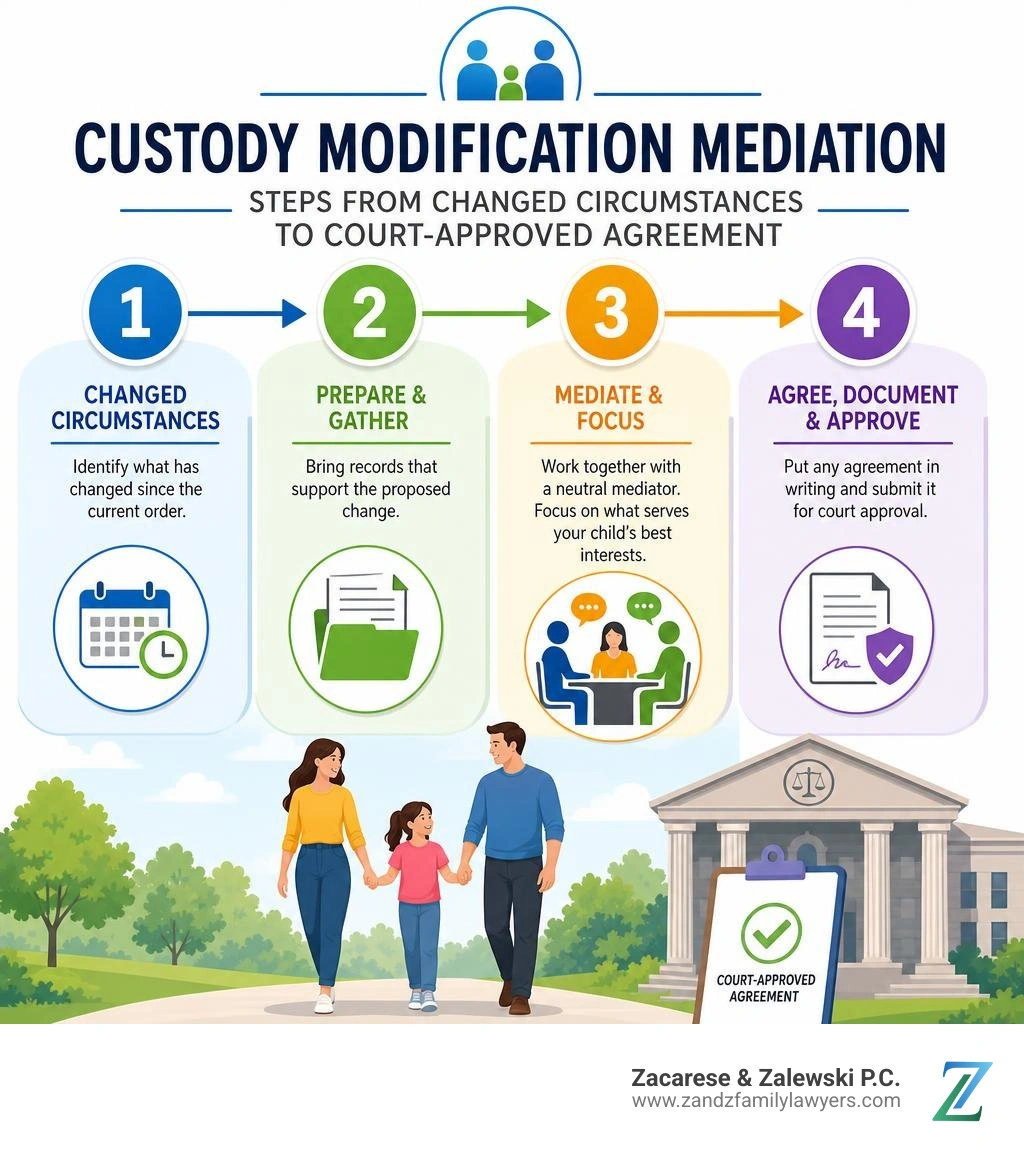
Custody modification mediation gives parents a structured way to update an existing custody or parenting-time order without asking a judge to decide every detail. With a neutral mediator, parents can work toward a new plan for changes such as a move, new work hours, school needs, medical care, holidays, or parenting schedules.
To use mediation well:
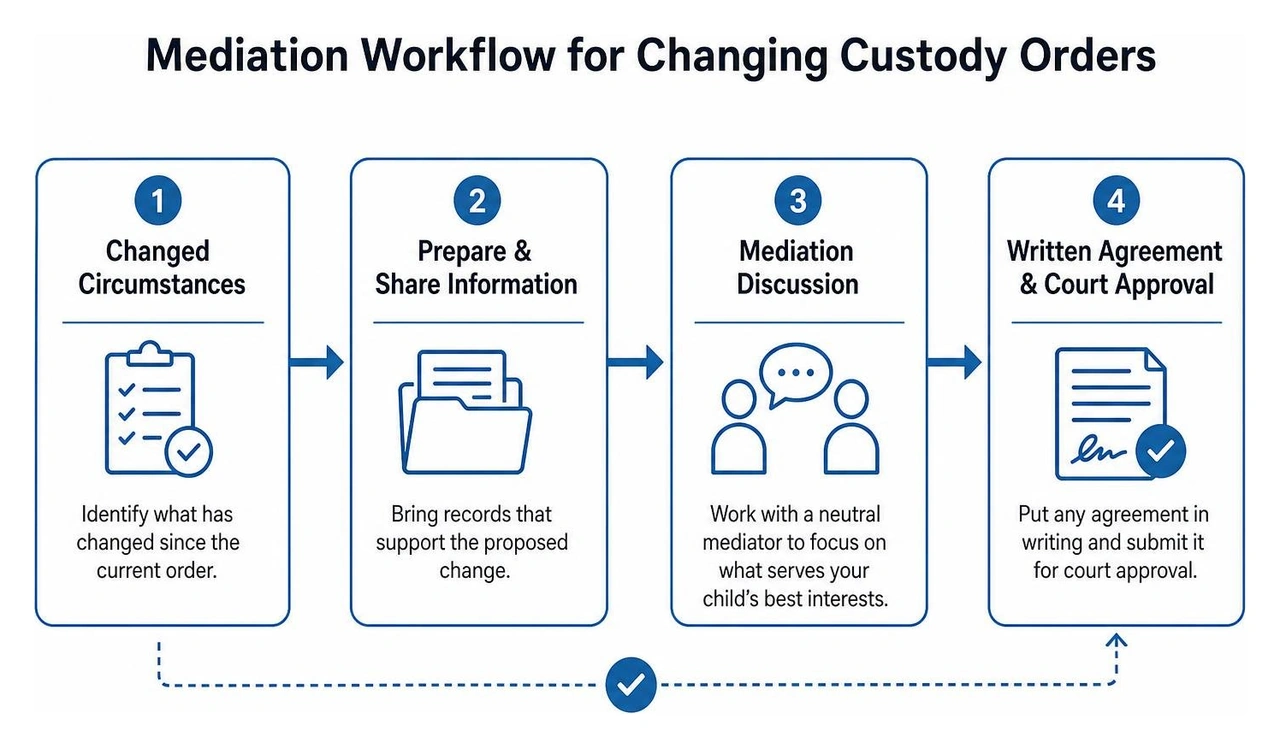
- Identify what has changed since the current order.
- Bring records that support the proposed change.
- Focus on what serves your child's best interests.
- Put any agreement in writing and submit it for court approval.
Life changes after a custody order is entered. Children grow, schedules shift, and a plan that once worked may no longer fit the family. Mediation can help parents find practical answers with less conflict, time, and expense than a full custody trial.
Steven Zalewski, one of the most well-known family court trial lawyers in Suffolk County, helps parents understand both the settlement options and the court process. A mediated agreement can be a strong path forward, but it must be clear, fair, and made into an enforceable court order.
Working with a knowledgeable custody modification lawyer helps ensure that your rights and your child's best interests remain protected throughout the modification process.
Understanding Custody Modifications and the Role of Mediation
Changing a custody order is different from making one for the first time. In an initial divorce or separation, parents often live together or have just separated. In a modification case, parents have lived apart for months or years. They have separate routines and different households. This makes gathering facts tricky, but mediation helps bridge the gap.
Mediation uses a neutral third party called a mediator. The mediator does not take sides or act as a judge. Instead, the mediator helps both parents talk through their issues calmly. In many places, including New York, judges encourage alternative dispute resolution (ADR) before setting a trial date. If you need to know how to request a modification of a custody or support order, understanding the legal basics is your first step.
Legal Grounds: Proving a Material and Substantial Change
You cannot change a court order just because you want a new schedule. The law requires proof of a material and substantial change in circumstances. This means something major has happened that impacts the child's daily life and welfare.
Common reasons for a modification include:
- A parent needs to relocate for work or family support.
- Significant changes in work shifts, such as moving to night hours.
- A child transitions to a new school district or needs special education services.
- Major changes in a child's medical or mental health needs.
- Problems with substance abuse, DWI arrests, or domestic violence.
- Severe parental alienation where one parent blocks contact with the other.
As children grow from toddlers into teenagers, their extracurricular activities and personal needs change. Courts want to see that updating the plan serves the child's best interests.
When Mediation Is Required or Recommended
Many original parenting agreements include a clause requiring parents to try mediation before filing a court petition. Even without this clause, courts often recommend mediation.
In many jurisdictions, courts either require or strongly encourage mediation before setting a contested hearing. For example, family courts often use mediation as an early step in modification disputes to help families reach cooperative resolutions. Mediation allows parents to avoid the stress of an open courtroom battle while working toward a practical solution.
How Custody Modification Mediation Works Step-by-Step

The mediation process follows a clear structure:
- Intake and Agreement: Both parents agree to mediate and pick a qualified mediator.
- Joint Sessions and Caucuses: Parents meet together in joint sessions or sit in separate rooms while the mediator shuttles back and forth (shuttle mediation).
- Information Sharing: Both sides present their schedules, school records, and proposed plans.
- Drafting the Agreement: When parents agree, the mediator writes down the terms in a settlement document.
Some parents also choose virtual mediation via video calls. This helps parents who live far apart or work demanding jobs participate easily.
Key Issues Addressed During Mediation Sessions
Mediation allows parents to customize every part of their parenting plan. The main issues resolved include:
- Legal Custody: Decision-making power for education, healthcare, and religion.
- Physical Custody and Timesharing: Where the child sleeps on weekdays and weekends.
- Holiday and Vacation Schedules: How to split Thanksgiving, winter breaks, and summer vacations.
- Child Support and Medical Expenses: Adjusting support payments, health insurance coverage, and out-of-pocket medical bills.
- Extracurricular Activities: Deciding who pays for sports, music lessons, or tutoring.
It is common for parents in mediation to agree to a 50-50 timesharing split when schedules allow. Sometimes, when custody shifts significantly, the parent receiving primary custody may agree to adjust or forgo certain support terms to reach a final deal.
What Happens When Parents Reach an Agreement vs. Impasse
When parents reach an agreement, the mediator drafts a written document called a stipulation or settlement agreement. Both parents sign it, and their attorneys review it. It is then submitted to the court. Once a judge signs it, it becomes a binding, enforceable court order that carries the full authority of the legal system.
If parents hit an impasse and cannot agree, mediation ends without penalty. The mediator cannot tell the judge what was said during private sessions because mediation is confidential. The case then returns to the court docket for discovery, pre-trial motions, and an evidentiary trial before a judge.
Navigating Costs, Timelines, and Legal Support
Contested court battles are expensive and slow. Parents often spend thousands of dollars on court reporters, depositions, expert witnesses, and trial preparation. A contested court fight in Suffolk County Family Court can drag on for months, leaving families in limbo.
Mediation accelerates the timeline. Most parents resolve their issues in one to three mediation sessions over a few weeks. Knowing how mediation can save time and money in custody disputes helps parents make smart financial choices for their families.
| Factor | Custody Mediation | Contested Court Trial |
|---|---|---|
| Average Timeline | 2 to 6 weeks | 6 to 18+ months |
| Direct Costs | Mediator fees + attorney review | Full trial fees, depositions, experts |
| Privacy | 100% confidential behind closed doors | Public court records and open hearings |
| Decision Maker | The parents retain total control | A family court judge decides |
| Stress Level | Low to moderate collaborative talks | High conflict adversarial courtroom |
At Zacarese & Zalewski P.C., we believe families deserve total financial peace of mind. That is why we offer flat fee modification cases.
Our flat-fee structure is simple and transparent:
- A Pre-Trial Fee that covers all legal work, document drafting, negotiations, and court appearances leading up to trial.
- A set Trial Fee due 30 days before trial if your case cannot be settled out of court.
- Payment plans are always available to help working parents.
We explicitly contrast our flat-fee model with traditional law firms that charge open-ended hourly rates. Traditional firms bill for every phone call and email. When cases get complicated, their bills skyrocket. If a client runs out of money, those firms often abandon them right before court.
Our flat-fee model covers all court appearances, no matter how many times you must appear in court in Islandia, Central Islip, or Riverhead.
Key Benefits of Custody Modification Mediation Over Courtroom Battles
Mediation has an impressive track record. In family law practices with extensive courtroom experience, mediation success rates often reach around 90%.
Key benefits include:
- Reduced Conflict: Cooperative talks protect children from emotional distress.
- Parental Control: You decide your child's schedule rather than leaving it to a judge who does not know your daily routine.
- Privacy: All discussions remain confidential.
- Long-Term Compliance: Parents are far more likely to follow a plan they created themselves.
When Mediation Is Inappropriate for Custody Changes
While mediation works for most families, it is not right for every situation. Mediation is inappropriate when there is:
- A history of domestic violence or physical abuse.
- Active orders of protection between the parents.
- Severe power imbalances where one parent intimidates or coerces the other.
- Unaddressed drug addiction, severe alcoholism, or child neglect.
- A parent actively hiding assets or refusing to share basic information.
In these cases, immediate court intervention and protective orders are necessary to keep children safe.
Strategic Preparation and Legal Representation

Going into mediation unprepared is a huge mistake. Working with an experienced custody modification lawyer ensures your rights and your child's future are protected.
Do not make the dangerous mistake of using artificial intelligence to draft your custody agreements. While AI tools might seem quick and cheap, generic robotic documents miss critical legal details, fail to follow local court rules, and can ruin a family's life for years. Only a human attorney with local Suffolk County legal insight, real-world courtroom experience, and genuine empathy can properly protect your family.
If you need legal help tailored to your community, consulting a modify custody agreement lawyer Suffolk County NY gives you the personal guidance robotic tools cannot provide.
Preparing Your Evidence for Custody Modification Mediation
To make the most of your mediation sessions, bring clear, organized documentation:
- School Records: Report cards, attendance sheets, and teacher notes showing academic progress or behavioral concerns.
- Medical and Therapy Records: Doctor notes, immunization updates, and counseling logs.
- Timesharing Calendars: A detailed calendar showing actual overnight stays versus the original court-ordered schedule.
- Communication Records: Polite, organized printouts of emails or parenting app messages showing scheduling requests and responses.
- Work Schedules: Pay stubs, employer letters, or shift schedules proving changes in work hours.
- Financial Documents: Tax returns, W-2 forms, and updated health insurance cost breakdowns.
The Child's Voice and Role of Legal Counsel
As children mature, their preferences carry more weight. In many states, courts allow older children (often age 12 and up) to express their views regarding where they prefer to live. However, children should never be put in the middle of adult arguments or brought to mediation sessions.
Instead, a child custody lawyer in Suffolk County NY helps present the child's needs calmly and legally. Having independent counsel ensures your agreement is fair, legally sound, and compliant with all local standards. Learn more about procedural strategies in Mediation to Handle Order Modifications: How It Works - Experts In Family Law.
Frequently Asked Questions About Custody Modification Mediation
Can we use mediation if both parents already agree on custody changes?
Yes. Mediation is ideal for uncontested changes. If both parents agree on a new schedule, a mediator or attorney can quickly draft a formal stipulation. This formal document is then submitted to the court for a judge's signature, converting your informal agreement into an enforceable order without a lengthy trial.
How long does custody modification mediation typically take?
Most modification mediations take between one and three sessions, with each session lasting two to three hours. The entire process is usually completed in two to six weeks. This is much faster than litigating in court, which often takes many months.
What happens if the other parent refuses to participate in mediation?
If your original custody order contains a mandatory mediation clause, your attorney can file a motion asking the court to enforce the clause and order mediation. If the other parent still refuses to cooperate, your attorney will file a formal modification petition in court and proceed directly with litigation.
Conclusion: Protecting Your Child's Future with Experienced Guidance
Modifying a custody order does not have to turn into an exhausting courtroom battle. Mediation allows you and your co-parent to create a customized, child-centered schedule that fits your current life. With the right legal support, you can resolve disputes quickly, keep costs under control, and protect your family's emotional health.
Steven Zalewski is recognized as one of the most well-known family court trial lawyers in Suffolk County. At Zacarese & Zalewski P.C., we provide compassionate, straightforward legal guidance backed by our clear, upfront flat-fee model. Whether you are negotiating a new parenting plan through mediation or preparing for a hearing in Suffolk County Family Court, we are here to stand by your side every step of the way.
Take the first step toward resolving your custody cases with confidence today.
📧 Email: steve@zandzfamilylawyers.com🏛 Address: 1601 Veterans Memorial Highway, Suite 500, Islandia, NY 11749
i guarantee you will be heard
Ready to Take the Next Step?
At Zacarese & Zalewski P.C., when something isn’t right, say something—and we’ll do something about it with you.
Our flat-fee structure is clear: one flat fee for pre-trial work, and a trial fee only if your case goes to trial or a hearing. Call now and a professional will return your call quickly; if we miss you, we'll call back the same day.