
When you speak, I guarantee you will be heard
Zacarese & Zalewski P.C.
Family Court Solicitor Fees and Court Filing Costs Explained
Call now: 516-660-4354
"He didn't just win my case. He gave me back my future, my peace of mind, and my ability to breathe again."
From the very first conversation, he changed everything. He didn't just see a case, he saw me, and treated me like family. His knowledge of the law was unmatched, but what truly set him apart was his humanity. If you are looking for a lawyer, stop searching right now.


What do family court solicitor costs include?

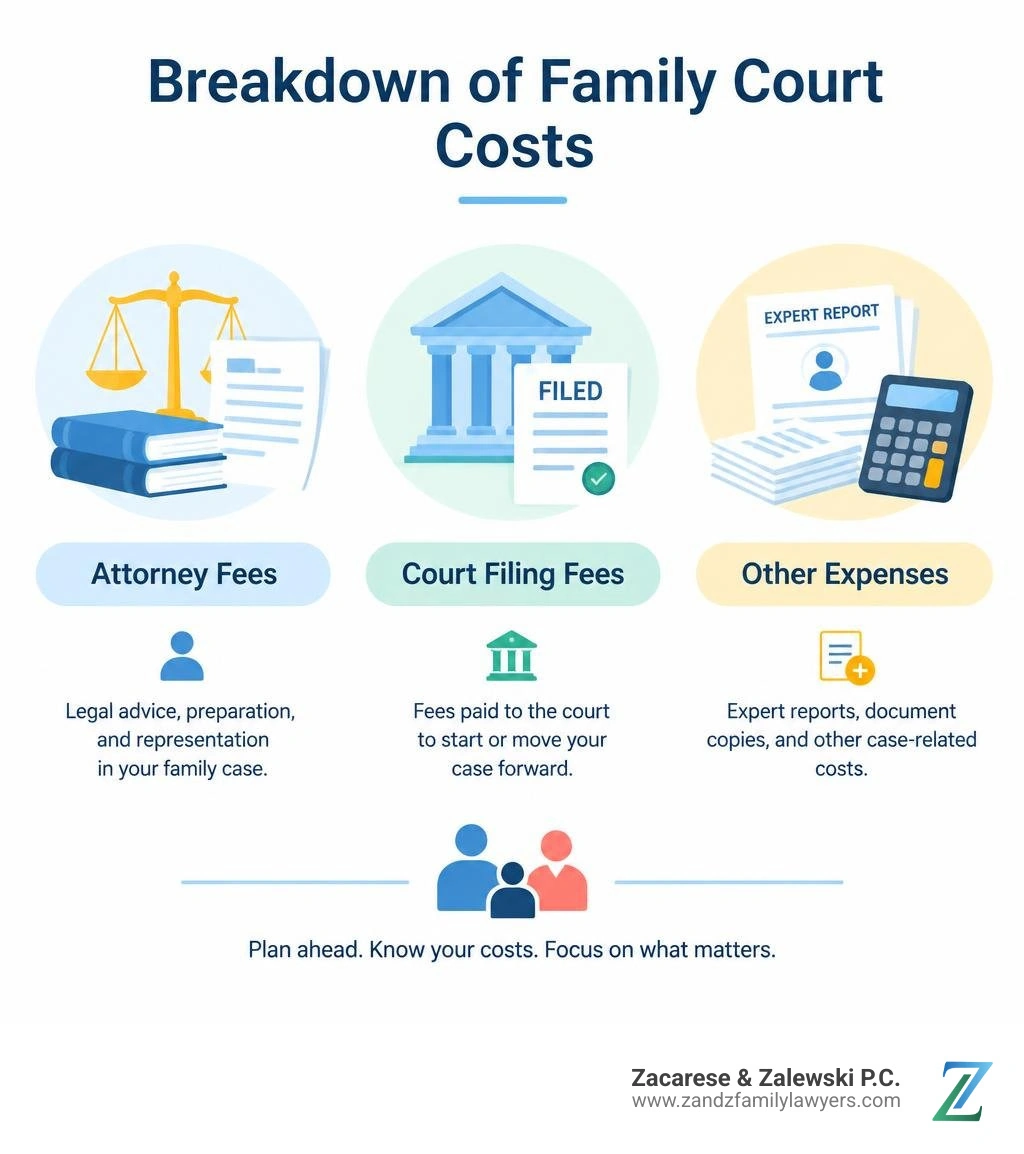
Family court solicitor costs are the fees you pay for legal help. Your total cost may also include court filing fees and expenses such as expert reports. To estimate it, ask for a written quote that says what work is covered, what costs extra, and whether the price is fixed or charged by the hour.
If you are dealing with custody, support, or a CPS matter in Suffolk County, New York, ask about attorney fees, not UK solicitor or court fees. The filing fee depends on the type of case, and a divorce is filed in a different court from a Family Court custody or support case. This guide explains each cost so you can plan before you commit.
Relevant articles related to family court solicitor costs:
Understanding Family Court Solicitor Costs and Fee Structures

When you walk into a family legal dispute, the way your lawyer charges you can make or break your budget. Going to court brings enough stress on its own without worrying about surprise bills in your mailbox every month.
Around the world and across different legal systems, lawyers bill their clients in various ways. In places like England or Australia, international guides often outline family court solicitor costs using statutory scales or strict hourly tiers. In Australia, for example, the statutory rules under Schedule 3 of the Family Law Rules set standard lawyer rates at A$300.31 per hour, with junior counsel charging up to A$491.78 per hour. But here in New York, private family lawyers set their own pricing models. Knowing how these models work helps you choose the right lawyer for your family and your wallet.
| Billing Model | How It Works | Predictability | Risk of Extra Costs |
|---|---|---|---|
| Hourly Billing | Charged for every minute spent (usually in 6-minute blocks). | Low (bills change every month). | High (costs rise quickly if court dates drag on). |
| Traditional Retainer | You pay a big deposit upfront; lawyer bills against it hourly. | Low (you must replenish funds when empty). | High (lawyer may stop working if funds run out). |
| Composite Fees | Set amounts allowed by court rules for specific tasks. | Medium (task-specific). | Medium (extra steps require new fees). |
| True Flat Fee | One clear price covering all steps and appearances. | High (you know the total cost upfront). | Low (no ticking clock or surprise bills). |
Hourly Rates vs Fixed Fees: Breaking Down Family Court Solicitor Costs
Most traditional law firms charge by the hour. Under this model, lawyers track their time in 6-minute increments. That means a single two-minute phone call can cost you a tenth of an hour. An experienced lawyer might charge $350 to $600 or more per hour, while paralegals bill between $100 and $200 per hour. If your case runs into delays or needs multiple court dates, these hourly bills add up fast. You might find yourself wondering, can my lawyer stop working on my case if I can't pay more money? Sadly, at many traditional firms, the answer is yes.
At Zacarese & Zalewski P.C., we do things differently. Steven Zalewski is one of the most well-known family court trial lawyers in Suffolk County. He built our practice on an honest flat-fee model designed to give families complete peace of mind.
Our flat fee covers all appearances in Suffolk County Family Court, regardless of how many court dates your case takes. Whether your matter is heard in Central Islip, Riverhead, or anywhere else on Long Island, you never have to worry about a ticking meter.
We use a simple two-part structure:
- Pre-Trial Fee: This single set amount covers everything leading up to trial—gathering records, filing motions, court appearances, negotiations, and conferences.
- Trial Fee: If your case cannot settle and must go to a formal hearing, this is a single, clear set fee due 30 days before the scheduled trial date.
Unlike other firms that switch back to hourly rates or abandon clients mid-case when situations get messy, Steve never leaves a client behind because they ran out of money. We believe everyone deserves steady, honest representation from start to finish, which is why flexible payment plans are always available. You can learn more about how flat fee family court representation works and what a flat fee includes in a family court case to protect your family's future.
Court Application Fees vs Solicitor Legal Expenses
It is important to remember that attorney fees and court filing fees are two completely separate things. Your lawyer's fee pays for their time, legal advice, and courtroom advocacy. A court fee is money you pay directly to the court system to open or file a legal action.
In New York, where you file determines what you pay:
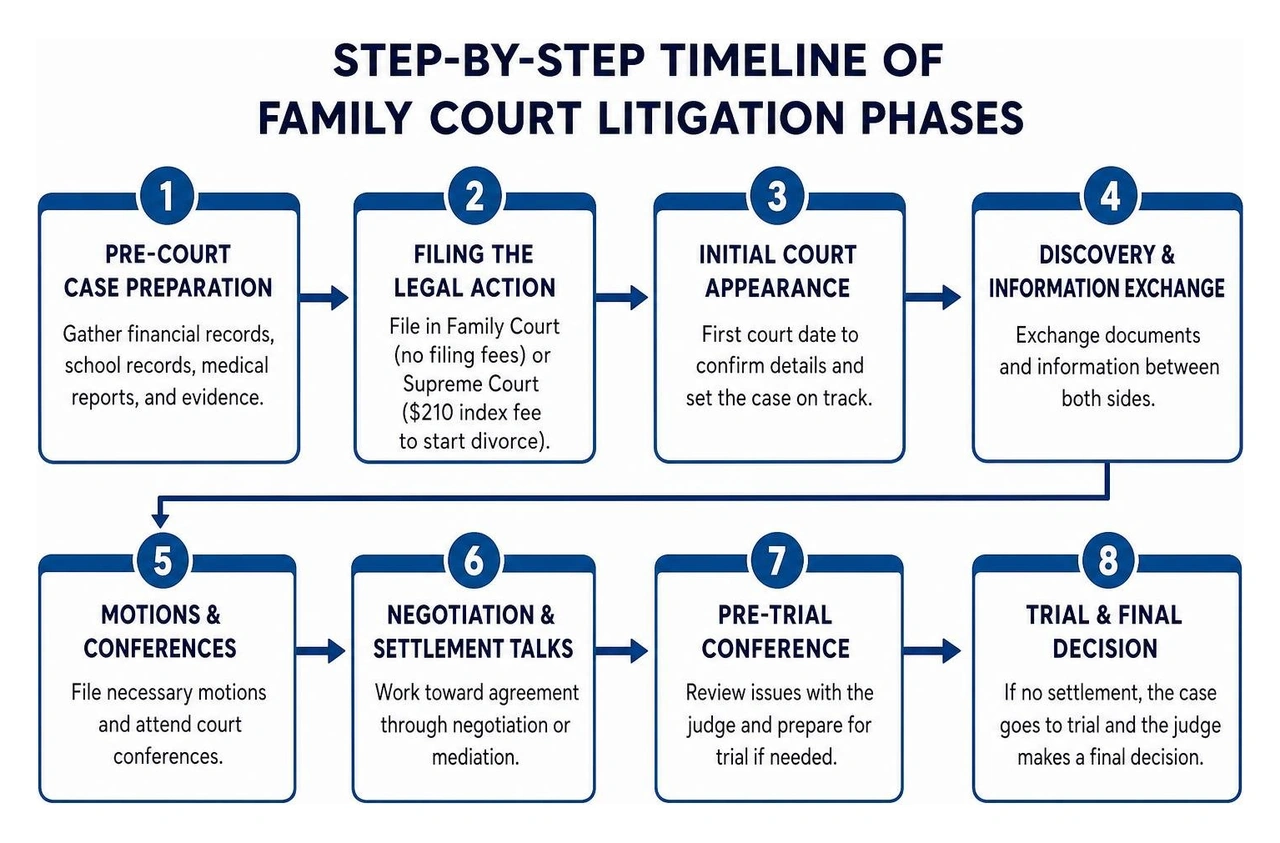
- Suffolk County Family Court: There are $0 filing fees to file for child custody, visitation, child support, paternity, or family offenses (orders of protection). The state keeps Family Court free of filing charges so parents and children can access justice quickly.
- New York State Supreme Court: If you are filing for a divorce, you must file in Supreme Court. There is a $210 index number fee to start the case, plus additional fees for filing notes of issue, motions, and the final judgment.
If you cannot afford Supreme Court divorce filing fees, you can ask the court for a fee waiver (called a Poor Person Order). The judge will review your monthly income and savings to decide if you qualify.
Typical Stage-by-Stage Expenses in Family Proceedings

A family legal case moves in steps. Each step takes time, effort, and careful planning. Knowing what happens at each stage helps you budget and avoid unexpected surprises.
Pre-Court Case Preparation
Before anyone speaks to a judge, your lawyer must build your foundation. This preparation phase involves:
- Gathering bank statements, tax returns, and pay stubs.
- Collecting school records, medical reports, and text message evidence.
- Reviewing your goals regarding custody schedules or support payments.
- Drafting initial petitions and sworn legal statements.
A quick warning about modern tools: Never use artificial intelligence programs like ChatGPT to draft your custody agreements or legal petitions. Generic, robotic AI documents often miss critical local rules and fail to protect your parental rights. A simple mistake in child custody wording can cause major changes in your child's life down the road. Only a caring human lawyer with deep knowledge of Suffolk County Family Court can protect your family properly.
Contested Hearings, Evidence Preparation, and Disbursements
If both sides cannot agree early on, your case moves into contested court appearances. In Suffolk County, you may appear for preliminary conferences, compliance conferences, and settlement discussions.
During this stage, out-of-pocket expenses (called disbursements) can arise:
- Process Server Fees: Paying a licensed professional to deliver court papers (usually $75 to $150).
- Subpoena Costs: Ordering certified school, police, or medical records.
- Expert Witness Fees: In contested custody trials, fees for forensic psychologists, appraisers, or private investigators can range from $3,000 to over $10,000.
Because these steps require extensive work, the average cost of custody litigation at traditional hourly law firms can easily climb past $15,000 to $30,000. With Steve Zalewski's transparent flat fee model, your legal defense costs stay clear and predictable from day one.
Cost Orders and Fee Contribution Rules
Many people wonder if they can make their ex-partner pay for their legal bills. The short answer is: sometimes, but it depends on the financial situation of both parties and how each side behaves during the case.
General Rules on Costs and Conduct-Based Fee Shifting
In many legal systems around the world, the starting rule is that each side pays their own legal costs. For instance, Australian law under Section 117 of the Family Law Act sets the basic rule that each party pays their own way, unless bad conduct justifies an order. Similarly, in landmark Canadian decisions like Dickson v. Dickson, the court awarded $180,000 in legal fees against a husband after he hid financial assets and showed an outrageous lack of honesty.
In New York, courts follow similar principles:
- Financial Disparity (The "Monied Spouse" Rule): In divorce actions, New York law presumes that the spouse with significantly more income and assets should contribute to the other spouse's reasonable legal fees. This ensures both sides have equal access to skilled legal representation.
- Bad-Faith Conduct: If one party hides assets, refuses to turn over required financial records, files fake claims, or drags out court dates purely to harass the other side, a Family Court or Supreme Court judge can order that party to pay a portion of the innocent side's legal fees.
Requesting Contributions to Attorney Fees
To ask the court for legal fee help, your lawyer files a formal motion for interim counsel fees. You must submit a detailed financial statement (called a Statement of Net Worth) showing:
- Your complete monthly income, expenses, and debts.
- Your total savings and assets.
- Proof of your ex-partner's higher income.
- Your lawyer's written retainer agreement and billing invoices.
The judge will look at the financial gap between both sides and decide if an award is fair.
Managing and Contesting Legal Fees
Understanding your billing rights helps you stay in control of your finances while your case is active.
How to Challenge or Reduce Family Court Solicitor Costs
If you hire an hourly lawyer, you are entitled to regular, detailed billing statements. In legal systems governed by statutes like the UK's Solicitors Act assessments in family cases, courts review legal bills line-by-line to confirm every charge is reasonable.
In New York, you have strong client rights under court rules:
- Written Retainer Agreements: Your lawyer must provide a clear written agreement explaining their rates, billing units, and expenses before starting work.
- Regular Invoices: You must receive itemized bills at least every 90 days.
- Fee Dispute Arbitration: If you believe you were overbilled, you have the right to resolve the dispute through free or low-cost client-attorney fee arbitration.
Practical Strategies for Litigants to Control Expenses
Court cases can feel overwhelming, but you can take simple steps to keep your legal expenses under control:
- Stay Organized: Keep your documents, tax returns, and communications filed neatly in folders so your lawyer spends less time sorting through paperwork.
- Group Your Questions: Instead of calling your lawyer five times a day with single questions, write them down and discuss them all in one focused meeting.
- Focus on the Big Picture: Do not spend thousands of dollars arguing over small household items. Save your energy and budget for what matters most: your children and your long-term stability.
- Beware of Going Completely Alone: In 2026 court statistics, over 51% of parents in private child proceedings attempted to handle matters without a lawyer. While self-representation saves upfront fees, navigating complex evidence rules alone can lead to unfavorable custody orders. You can explore whether handling custody matters without a full-service lawyer makes sense for your specific situation.
- Choose Upfront Flat Fees: Working with an affordable family lawyer near me who uses an honest flat-fee model eliminates the fear of runaway hourly bills.
Frequently Asked Questions About Family Court Costs
Can I ask the court to order my spouse or ex-partner to pay my legal fees?
Yes. If there is a big difference between your income and your ex-partner's income, you can ask the judge to order them to contribute to your legal fees. You can also ask for fee contributions if your ex-partner unnecessarily delays the case or refuses to disclose their financial records.
What happens if I cannot afford family court filing fees?
In New York, Suffolk County Family Court petitions (for custody, support, visitation, and protection orders) have no filing fees. If you are filing for divorce in Supreme Court, you can submit an application for a fee waiver (Poor Person relief) asking the judge to waive the filing fees based on your income.
Can a party with limited financial resources be ordered to pay the other side's costs?
Generally, courts will not order a low-income person to pay another person's attorney fees. However, courts around the world, from New York to international courts handling legal aid cost protection exceptions, maintain strict rules: if a low-income litigant commits outright fraud, lies under oath, or engages in severe misconduct, the court can still order them to pay financial penalties.
Conclusion
Legal disputes involving your children and your family are deeply personal. You need a trusted legal team that treats you like a neighbor, speaks plain English, and offers clear, upfront pricing with zero surprises.
At Zacarese & Zalewski P.C., we proudly serve families across Central Islip, Riverhead, Islandia, and all of Suffolk County. When you work with us, you get Steven Zalewski's decades of trial experience, honest flat fees that cover all appearances, and payment plans tailored to your budget. Contact a trusted family law attorney in Suffolk County, NY today to schedule your consultation and protect what matters most.
📱 Cell: (516) 660-4354 📧 Email: steve@zandzfamilylawyers.com 🏛 Address: 1601 Veterans Memorial Highway, Suite 500, Islandia, NY 11749
i guarantee you will be heard
Ready to Take the Next Step?
At Zacarese & Zalewski P.C., when something isn’t right, say something—and we’ll do something about it with you.
Our flat-fee structure is clear: one flat fee for pre-trial work, and a trial fee only if your case goes to trial or a hearing. Call now and a professional will return your call quickly; if we miss you, we'll call back the same day.