
When you speak, I guarantee you will be heard
Zacarese & Zalewski P.C.
Preparing for Your Family Court Hearing and Submitting Evidence
Call now: 516-660-4354
"He didn't just win my case. He gave me back my future, my peace of mind, and my ability to breathe again."
From the very first conversation, he changed everything. He didn't just see a case, he saw me, and treated me like family. His knowledge of the law was unmatched, but what truly set him apart was his humanity. If you are looking for a lawyer, stop searching right now.


Comprehensive Framework for Family Court Trial Preparation

To prepare for your family court trial, start now by writing down exactly what you want the judge to order, collecting proof of your income and your child's daily routine, and putting every court deadline into one calendar. Then build a trial notebook that holds your pleadings, court orders, discovery notes, and a timeline of events. Judges expect your facts to be ready from day one, and these early steps replace fear with confidence.
Think of being unprepared as driving in a heavy Long Island snowstorm without headlights. When you prepare early, you see the road ahead. In September 2026, courts move fast, and you need a clear, written goal sheet. For example, you might want primary residential custody or a specific child support amount. Writing that goal gives your case direction.
Around 100 Days Before Trial, building a dedicated trial notebook helps keep all your papers in order. This notebook holds your pleadings, court orders, calendar deadlines, and discovery notes. If you are wondering what to expect at your first family court appearance, early conferences set strict deadlines for exchanging documents. Missing these dates can hurt your case.
Depending on where your hearing is held, your case may follow a traditional formal path or an informal track. Here is how they compare:
| Feature | Traditional Family Court Trial | Informal Court Hearing |
|---|---|---|
| Rules of Evidence | Strict formal rules and objections | Relaxed rules guided by the judge |
| Questioning | Direct and cross-examination by lawyers | Judge asks questions directly to parties |
| Agreements | Standard trial track | Both sides must agree to this format |
| Document Filing | Formal exhibit lists and pre-marked binders | Basic documents submitted to the court clerk |
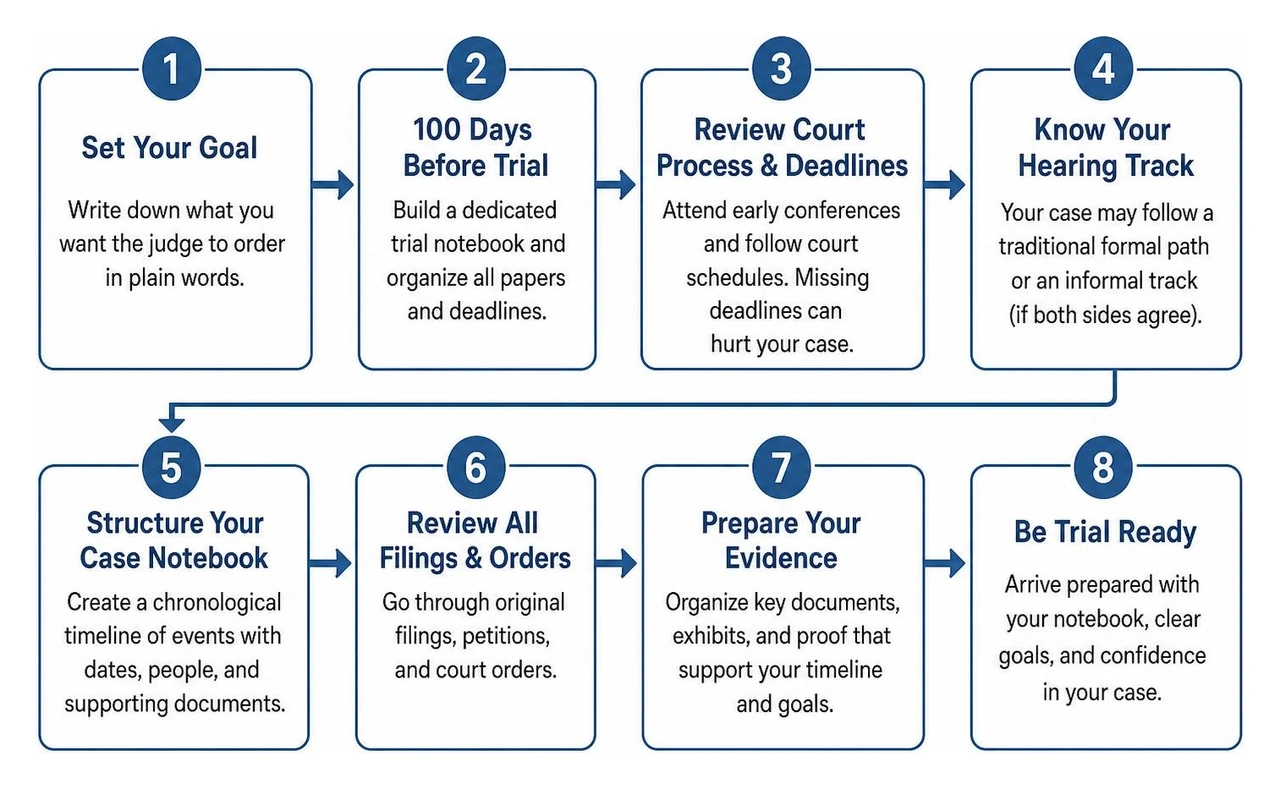
Structuring the Case Notebook and Timeline 100 Days Out
A case notebook acts as your master control center. In this binder, put every single event on a chronological timeline. List the date, the event, who was there, and the document that proves it happened.
Review all original court filings and petitions. When you understand what really happens in a family court case, you realize that judges make decisions based on patterns of behavior, not one-time arguments. Use your timeline to track:
- Court scheduling orders and pretrial conferences
- Deadlines to send questions and document requests to the other parent
- Cutoff dates to share your final witness and exhibit lists
- Dates when child evaluations or home checks must be finished
Evidence Preservation: Employment Records, Pay Stubs, and Medical Documentation
Money and work schedules play huge roles in custody and child support hearings. You must prove what you earn, what the other parent earns, and how your job schedule fits your child's daily routine.
Do not just bring a single pay stub. Collect complete records showing:
- Base salary, overtime pay, shift differentials, and bonuses
- Uniform allowances, travel stipends, and retirement account contributions
- Requests for Family and Medical Leave (FMLA), paid sick leave, or disability records
- Timesheets proving when you are physically home to care for your children
These documents show your true total income for official child support worksheets. They also show your availability to handle morning school drop-offs and bedtime routines. When preparing these financial papers, following a reliable trial readiness statement guidebook ensures you do not leave out important financial disclosures that could delay your trial.
Building an Airtight Evidentiary Record for Custody and Support

Judges focus on one main question in custody cases: what is in the best interests of the child? To show that your home is the best environment, you need clear proof of your daily parenting, your personal stability, and your honesty.
When you begin preparing for a fact-finding hearing, focus on showing that you are a dependable, rule-following parent. Always remember why honesty matters in family court. Judges quickly spot exaggerations or half-truths, and losing your credibility can ruin your entire case.
A Quick Warning About AI Tools:
It can be tempting to turn to computer programs like ChatGPT to write your custody plan or separation papers. Please do not do this. Generic, robotic computer forms do not know local court rules, and they miss critical details about your family's daily life. A simple computer mistake can permanently harm your parental rights. You need real legal advice from an experienced human attorney who understands local family court practice.
Adapting Procedural Rigor: Concise Statements and Step-by-Step Fact Presentation
When presenting facts to a judge, keep your statements short, clear, and direct. Avoid rambling stories or emotional venting. Instead, present your facts like a clear timeline:
- State the Rule or Agreement: Mention the existing custody order or parenting rule.
- State the Violation or Incident: Give the exact date, time, and action.
- Show the Proof: Provide the text message, school report, or photo.
- Explain the Impact: Explain calmly how this affected your child.
If the other side makes untrue statements about you, stay calm. Knowing how to fight back against false allegations means gathering digital proof early. Save text messages, voicemails, and emails with visible dates, times, and phone numbers. Keep original files backed up in secure cloud storage.
Demonstrating Parental Stability Through Housing and Financial Responsibility
A judge wants to see that you provide a safe, calm, and steady life for your child. In community surveys, people consistently rate safe housing, clean infrastructure, and steady budgeting as essential for a healthy community. Judges look for these exact same qualities in a parent's home.
To prove your home provides the stability your child needs, gather:
- Lease agreements, mortgage statements, and utility receipts showing uninterrupted service
- Records showing repairs, clean living spaces, and your child's dedicated bedroom
- Proof of steady family routines, including doctor visits, homework logs, and school attendance
- Records of extended family support, such as grandparents or relatives who help during work emergencies
Learning what judges actually look for in a custody case helps you highlight these simple, daily signs of parental care.
Strategic Execution in Court: Witness Management and Exhibits

Presenting your case inside the courtroom requires strict attention to detail. Every piece of paper you want the judge to read must be shared with the other party beforehand.
Review the official traditional trial preparation instructions to make sure you format your materials correctly. When you understand the family court process behind the bench, you realize that organized binders make it easy for the judge to rule in your favor.
Essential Checklists for Family Court Trial Preparation
Before walking through the courthouse doors, make sure you check off every item on this list:
- [ ] Number Your Exhibits: Mark your documents clearly. Usually, the person who filed the case uses numbers (1, 2, 3), and the responding party uses higher numbers (101, 102, 103) or letters.
- [ ] Prepare Enough Copies: Bring at least four copies of every exhibit—one for the judge, one for the court clerk, one for the other parent, and one for yourself.
- [ ] Summon Your Witnesses: Send formal witness notices well in advance and pay any required statutory appearance fees.
- [ ] Update Financial Statements: Make sure your income and expense forms reflect your current earnings within 30 days of the trial date.
- [ ] Submit Electronic Records: If your court uses an online portal, upload all PDF exhibits before the strict digital cutoff time.
Following a clear mini guide to family trials helps prevent evidence from being thrown out due to late filing. It also helps you understand what happens at a fact-finding hearing in Suffolk County Family Court.
Advanced Family Court Trial Preparation for Contested Hearings
In difficult trials, evidence rules become very strict. If a judge decides that one piece of your evidence cannot be used, do not panic. Contracts and court petitions often have built-in safety rules: if one part is removed, the rest of your case still stands strong.
Make sure your lawyer prepares detailed questions for cross-examination. Cross-examination tests whether the other parent's story holds up under pressure. Because one court date can change everything, you must follow courtroom rules carefully:
- Turn off all cell phones and smart watches before walking into the courtroom.
- Stand up whenever the judge enters or leaves the room.
- Address the judge respectfully as "Your Honor."
- Speak directly to the judge or witness, and never argue with the other parent at the table.
Why Honest Flat-Fee Representation Protects Your Family
Trial preparation takes hours of hard work. At many law firms, every email, phone call, and court delay comes with an expensive hourly bill. When cases get complicated, hourly retainers run out quickly. Some firms demand thousands of dollars more on short notice or leave clients to represent themselves right before trial.
Steven Zalewski is one of the most well-known family court trial lawyers in Suffolk County. He handles cases across Suffolk County Family Court, representing parents in Islandia, Central Islip, and Riverhead.
At Zacarese & Zalewski P.C., we do things differently with our honest flat-fee model:
- Pre-Trial Fee: A single flat fee that covers every phone call, document review, negotiation, and court appearance leading up to trial. No matter how many times the court reschedules, you never pay extra hourly charges.
- Trial Fee: A clear, set fee due 30 days before your scheduled trial date that covers all trial preparation, witness work, and courtroom advocacy.
We believe no parent should ever be abandoned mid-case because their budget ran dry. Steve never leaves a client behind because they ran out of money. We also offer straightforward payment plans to help your family manage costs without extra stress.
Frequently Asked Questions About Family Court Hearings
What documents do I need to submit before my trial date?
You must submit your completed trial record, a final list of all witnesses who will testify, your pre-marked exhibit list, and updated sworn financial declarations. You must also file formal proof showing that copies were delivered to the other side. Review our guide on preparing for your family court appearance in Suffolk County for detailed filing instructions.
How do I handle unexpected changes or excluded evidence during the hearing?
If the judge rules that a document cannot be admitted as an exhibit, your lawyer can make a formal statement on the record explaining what the evidence would have shown. Always follow your attorney's guidance on what to avoid doing during an active family court case so you do not accidentally damage your remaining claims.
What should I avoid doing in the courtroom before a family court judge?
Never interrupt the judge, the lawyers, or the other party while they are speaking. Do not roll your eyes, shake your head, or make noise during testimony. Avoid bringing food, chewing gum, or leaving electronic devices on. The biggest mistake parents make in family court is letting their temper take over, which makes a poor impression on the judge.
Conclusion
Getting ready for a family court trial takes organization, patience, and clear evidence. When you gather your employment files, organize your home records, and prepare your witness testimony ahead of time, you give your child the strongest voice in court.
You do not have to walk into the courtroom alone. At Zacarese & Zalewski P.C., we provide compassionate legal guidance, fast same-day answers, and clear flat-fee pricing for parents across Long Island. Schedule your Suffolk County family law attorney consultation today to get started.
📱 Cell: (516) 660-4354
📧 Email: steve@zandzfamilylawyers.com
🏛 Address: 1601 Veterans Memorial Highway, Suite 500, Islandia, NY 11749
i guarantee you will be heard
Ready to Take the Next Step?
At Zacarese & Zalewski P.C., when something isn’t right, say something—and we’ll do something about it with you.
Our flat-fee structure is clear: one flat fee for pre-trial work, and a trial fee only if your case goes to trial or a hearing. Call now and a professional will return your call quickly; if we miss you, we'll call back the same day.