
When you speak, I guarantee you will be heard
Zacarese & Zalewski P.C.
Navigating Suffolk Family Court from Riverhead to Central Islip
Call now: 516-660-4354
"He didn't just win my case. He gave me back my future, my peace of mind, and my ability to breathe again."
From the very first conversation, he changed everything. He didn't just see a case, he saw me, and treated me like family. His knowledge of the law was unmatched, but what truly set him apart was his humanity. If you are looking for a lawyer, stop searching right now.


A Clear Starting Point for Suffolk County New York Family Court

Suffolk County New York Family Court handles many legal issues involving children and families, including custody, visitation, child support, paternity, child abuse or neglect, family offense orders of protection, and youth cases.
| Quick answer | What to know |
|---|---|
| Main court locations | Central Islip and Riverhead |
| Common filings | Custody, visitation, support, paternity, and protection orders |
| How cases begin | A person files a petition with the court, often with help from Probation intake |
| Divorce cases | Divorce and legal separation are handled in Suffolk County Supreme Court, not Family Court |
| Need a lawyer? | In some case types, people who qualify financially can ask the court for assigned counsel |
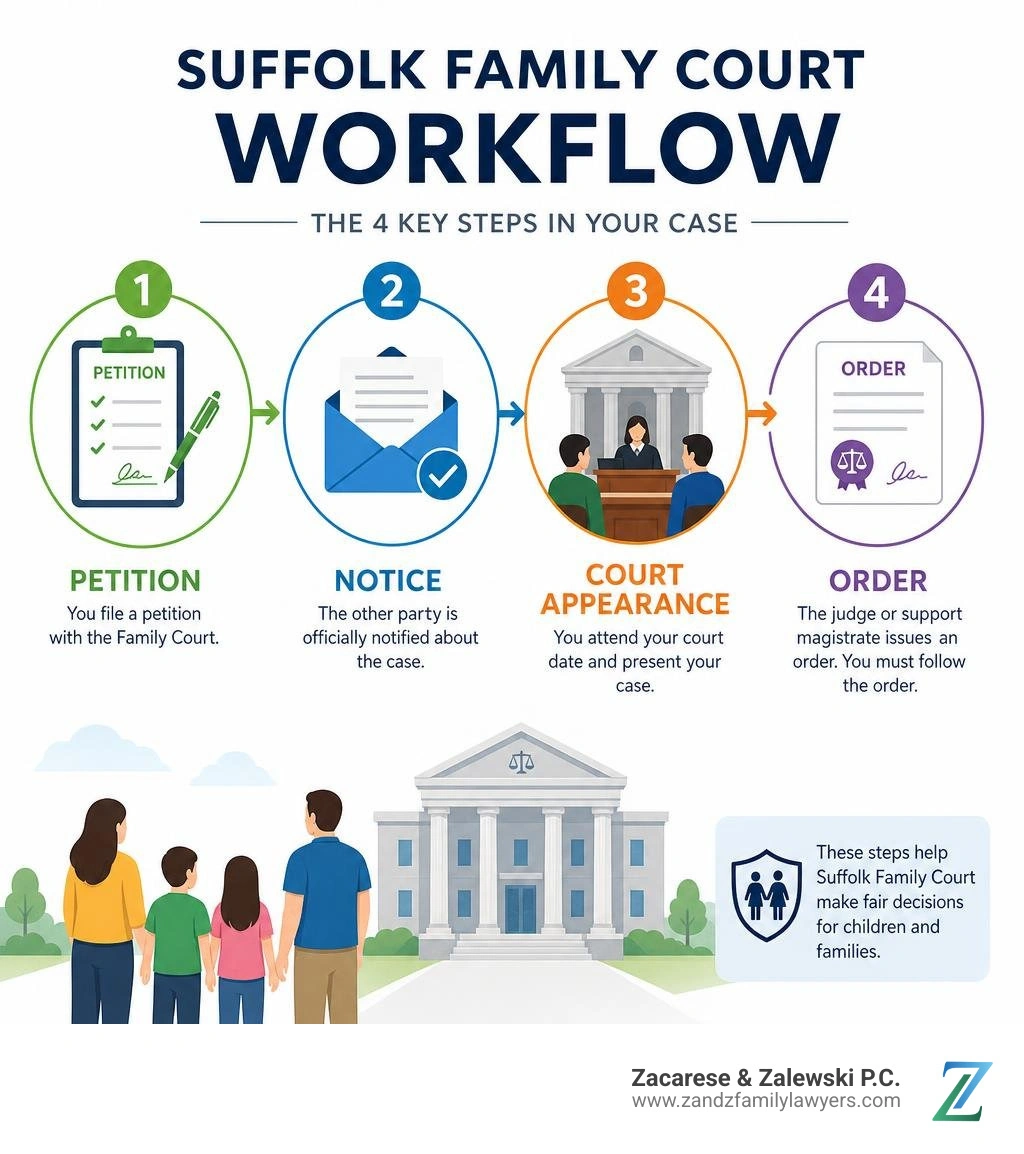
Family Court can feel confusing because the rules, forms, and court dates matter. A missed appearance or incomplete filing can affect your case. The good news is that most cases follow a clear path: file a petition, notify the other party, attend court, and follow any order the judge or support magistrate makes.
From the Cohalan Court Complex in Central Islip to the Cromarty Court Complex in Riverhead, families come to court with urgent questions about where a child will live, when a parent can visit, or how support will be paid. Steven Zalewski, one of the most well-known family court trial lawyers in Suffolk County, has helped families face these high-stakes moments with a direct approach and clear flat-fee options.
This guide explains what Suffolk Family Court does, where to go, and what to expect before your first appearance.
Understanding Case Types in the Suffolk County New York Family Court
The suffolk county new york family court handles many types of cases. Every case type has its own set of rules under the New York Family Court Act.
The court steps in when families need decisions on child safety, parenting time, or money support. Here are the main types of cases heard in Suffolk County Family Court:
- Custody and Visitation (Article 6): These cases decide where a child lives and how parents share time.
- Child and Spousal Support (Article 4): These cases set payment rules for raising children or helping a spouse.
- Paternity (Article 5): These cases legalize who the father of a child is.
- Family Offense (Article 8): These cases involve domestic abuse between family or relationship members. They can lead to temporary or final orders of protection.
- Child Abuse and Neglect (Article 10): Child Protective Services (CPS) brings these cases if they believe a child is harmed or in danger.
- Guardianship and Adoption: These cases give adults legal rights to care for a child.
- Persons In Need of Supervision (PINS) and Juvenile Delinquency: These cases involve young people who need guidance or broke laws.
The table below shows how Family Court compares to Supreme Court in Suffolk County:
| Issue | Family Court | Supreme Court |
|---|---|---|
| Granting a Divorce | No | Yes |
| Child Custody & Support | Yes | Yes (during divorce) |
| Orders of Protection | Yes | Yes |
| Adoption | Yes | Yes |
| Division of Property | No | Yes |
Custody, Visitation, and Child Support Filings
When parents split up, deciding where the child lives comes first. For a New York court to hear a new custody case, the child usually must live in New York state for at least six months.
When you start a case, you file a petition. The person who files is called the Petitioner. The other parent is the Respondent. Judges look at what is in the best interest of the child. They look at who was the main caregiver, home stability, and any history of abuse. To learn more about this process, read our detailed guide on How Custody Is Decided in Suffolk County Family Court.
Child support filings follow clear state math rules. Payments depend on parent incomes and the number of kids. But extra costs like daycare and medical bills get split too.
If violence happens at home, safety comes first. A party can file a family offense petition to get an order of protection. You can learn about legal help for these urgent cases by visiting our page on Suffolk County Orders of Protection Attorney for Family Offense Cases.
PINS, AFY, and Juvenile Delinquency Matters in Suffolk County New York Family Court
When teens struggle with bad behavior, skipping school, or running away, parents can feel lost. The court has a process called Persons In Need of Supervision (PINS).
Suffolk County tries to keep youth out of court whenever possible. Before filing a PINS case in court, families go through pre-diversion services. The county uses a special team called Alternatives for Youth (AFY).
Parents cannot walk into court to start an AFY case. They must call the Probation Department AFY unit by phone at 631-853-5281 or 631-853-7889. An AFY worker contacts the family within 72 hours. They give short-term crisis help at home to fix problems before court gets involved.
If a child runs away from home, Family Court no longer issues quick arrest warrants. Parents must contact local police right away to file an official missing persons report.
You can learn more about probation intake and youth programs by checking the official county site for Family Court Probation.
Court Locations, Filing Procedures, and Legal Representation
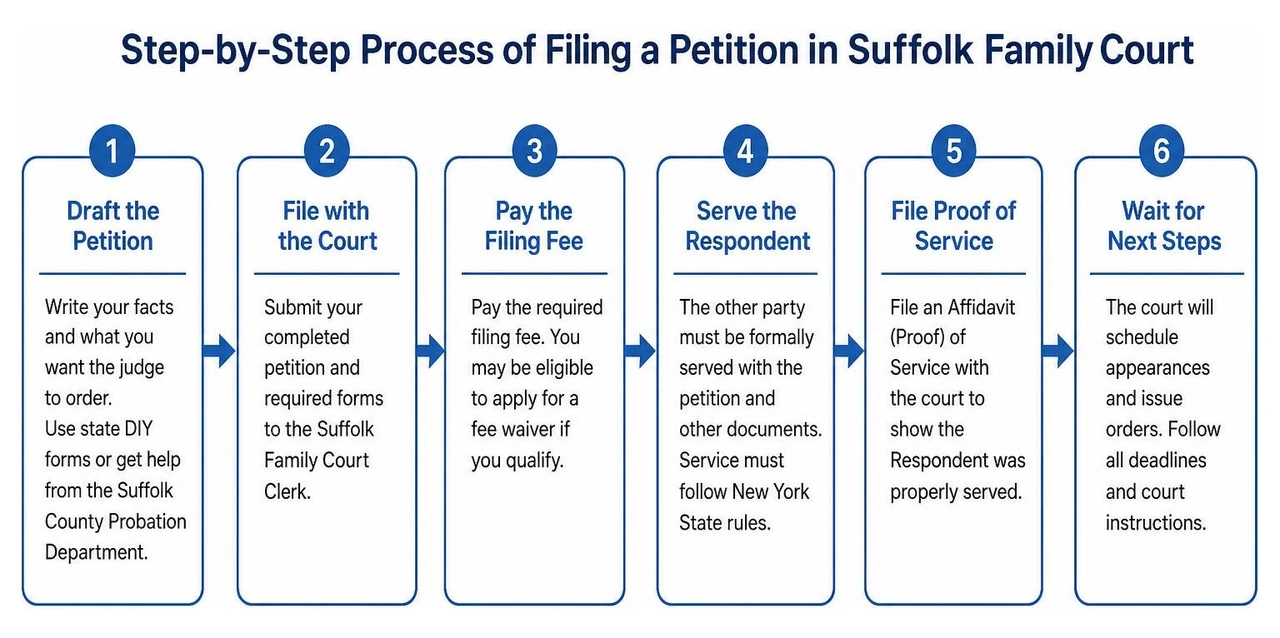
Starting a case in the suffolk county new york family court takes clear steps. You must complete the proper paperwork, file it, and make sure the other side gets served.
Here is how the basic petition process works:
- Drafting the Petition: You write down your facts and what you want the judge to order. You can use state DIY online forms or get help from the Suffolk County Probation Department.
- Filing with the Clerk: You hand in your signed papers to the court clerk. Court clerks must accept your papers. Only a judge can dismiss a case.
- Serving the Papers: You cannot give court papers to the respondent yourself. An adult over 18 who is not part of the case must hand-deliver them.
- Filing Proof of Service: The person who served the papers signs a form called an Affidavit of Service. You bring this signed, notarized paper back to court.
To get a complete overview of county rules, read our full Suffolk Family Court Guide 2026.
Navigating Central Islip and Riverhead Courthouses

Suffolk County Family Court operates in two main building locations. Where your case goes depends on where you live in the county.
The Western Suffolk location is at the Cohalan Court Complex in Central Islip:
- Address: 400 Carleton Avenue, Central Islip, NY 11722
- General Phone: 631-740-3800
- Probation Intake Phone: 631-853-4246
The Eastern Suffolk location is at the Cromarty Court Complex in Riverhead:
- Address: 210 Center Drive, 2nd Floor, Riverhead, NY 11901
- General Phone: 631-852-3905 or 631-852-3906
- Probation Intake Phone: 631-852-1939
You can check specific contact pages for Family Court - Central Islip and Family Court - Riverhead. You can also look up court staff numbers using the state's Family Court Directory.
Securing Counsel and Legal Aid in Suffolk County New York Family Court
Family Court cases move fast and carry big consequences. Under New York Family Court Act Section 262, you may have a right to a free court-appointed lawyer if you cannot afford one.
Free lawyers are given for cases like:
- Child abuse or neglect (Article 10)
- Orders of Protection and family offenses (Article 8)
- Custody and visitation disputes
- Paternity defense
- Willful support violation cases where jail is a risk
That court-appointed lawyers are not given to people who file standard child support cases.
In Suffolk County, the Legal Aid Society has staff attorneys at both court sites. Central Islip has seven staff attorneys, including Spanish-speaking staff. Riverhead has two staff attorneys. You can check if you qualify by visiting the Legal Aid window directly inside the courthouse before your first hearing. Read more about these services at the Family Court Bureau – Sclas page.
When you hire private legal representation, pricing models matter. Many law firms charge high hourly fees. As your case gets complicated, those hourly bills stack up fast. Some firms even abandon clients when money runs out mid-case.
At Zacarese & Zalewski, we do things differently. Steven Zalewski, one of the most well-known family court trial lawyers in Suffolk County, uses a clear flat-fee structure:
- Pre-Trial Flat Fee: This covers all work, motions, and court dates leading up to trial, no matter how many times you go to court in Central Islip or Riverhead.
- Trial Fee: A single set fee due 30 days before trial begins if your case does not settle.
- Payment Plans: We offer payment plans to fit family budgets.
We also warn clients against using AI computer programs to write legal papers. AI tools generate generic robotic forms that miss local Suffolk County rules and key factual details. A bad document can ruin your family's financial and personal life for years. Only a human lawyer with local Suffolk County court experience and true empathy can protect your children and your future.
Resolving Disputes: Mediation, Support Enforcement, and Appeals
Not every family court case ends in a dramatic trial. Many cases reach agreement through negotiations or court mediation. But when cases drag on, people often ask: How Long Does a Family Court Case Really Take in Suffolk County? Simple cases may finish in a few months, while tough custody disputes can take much longer.
Before going into any court hearing, make sure you are prepared. Here is a handy checklist of what to bring:
- Official government photo ID
- Copies of your filed petition and Affidavit of Service
- Current pay stubs and tax forms (for support cases)
- Proof of expenses, like child care or health bills
- Any past court orders or police reports
- A notepad and pen to write down key details
Family Court vs. Supreme Court Jurisdiction
People often mix up Family Court and Supreme Court. The biggest difference is simple: Family Court cannot grant a divorce.
If you want to dissolve a marriage or divide marital property, you must file a matrimonial action in New York State Supreme Court.
However, after a divorce is finished, Family Court can handle post-divorce petitions to change child support, custody, or visitation.
Supreme Court also offers special dispute options, like the Suffolk Matrimonial Mediation Program | New York Courts. This program lets divorcing spouses work with a mediator for free on a dual track while their court case moves forward. Cases with domestic violence or severe power imbalances are excluded from mediation for safety reasons.
To learn more about filing separation papers, visit the official county resource on Divorce and Separation.
Objections, Appeals, and Order Copies
If a Support Magistrate issues a child support order you disagree with, you do not file an immediate appeal to a higher court. You must first file a written Objection within 30 days of receiving the order (or 35 days if mailed). A Family Court Judge reviews your objection paper and makes a decision.
If a Family Court Judge issues a final order you disagree with, you can file an appeal with the Appellate Division, Second Department.
If you need copies of past court orders or official case dispositions, you must submit a written request with photo ID to the General Clerk's Office. If you mail your request, your signature must be notarized, and you must include a self-addressed stamped envelope.
For full court answers, review the official Suffolk Family Court Frequently Asked Questions | New York Courts.
Frequently Asked Questions About Suffolk Family Court
How do I confirm my scheduled court date or obtain court order copies?
To confirm your next court date, call the Family Court General Clerk's Office at 631-740-8000. Make sure you have your case docket number ready.
You can also track cases with upcoming court appearances online using the New York eCourts WebFamily system.
To get official order copies, visit the clerk's office in person with valid photo ID or send a notarized request by mail.
What happens during my first appearance in court?
Your first visit to court is usually an initial appearance or arraignment. Plan to arrive early to go through security screeners.
When you find your assigned courtroom part, check in with the court officer outside or inside the room.
During this first visit, the judge or support magistrate reads the petition, checks if you need a lawyer, and may issue temporary orders for custody, support, or protection. If you cannot reach a settlement, the judge schedules a Fact-Finding Hearing, which acts as the trial.
Read our guides on What to Expect at Your First Family Court Appearance and What Happens at a Fact-Finding Hearing in Suffolk County Family Court to prepare.
How does the Child Support Enforcement Bureau (CSEB) work in Suffolk County?
The Child Support Enforcement Bureau helps parents collect child support payments and enforce past orders. CSEB can collect money by taking funds directly from paychecks, intercepting tax refunds, or suspending driver licenses for unpaid debts.
You can reach CSEB by phone at 1-888-208-4485. You can also visit their local Suffolk County office in person:
- Address: 3455 Veterans Memorial Highway, Ronkonkoma, NY 11779
Conclusion
Navigating the suffolk county new york family court system in Central Islip or Riverhead does not have to feel overwhelming. Whether you are dealing with custody, support, or protective orders, understanding court steps helps you make smart choices for your family.
At Zacarese & Zalewski, we are committed to helping local families across Suffolk County, including Islandia, Central Islip, and Riverhead. Steven Zalewski, one of the most well-known family court trial lawyers in Suffolk County, provides straight talk, rapid same-day answers, and reliable flat-fee pricing so you never have to worry about surprise legal bills.
If you are facing a case in Family Court, reach out to an experienced Suffolk County Family Law Attorney today to protect your rights and your children's future.
📱 Cell: (516) 660-4354📧 Email: steve@zandzfamilylawyers.com🏛 Address: 1601 Veterans Memorial Highway, Suite 500, Islandia, NY 11749
i guarantee you will be heard
Ready to Take the Next Step?
At Zacarese & Zalewski P.C., when something isn’t right, say something—and we’ll do something about it with you.
Our flat-fee structure is clear: one flat fee for pre-trial work, and a trial fee only if your case goes to trial or a hearing. Call now and a professional will return your call quickly; if we miss you, we'll call back the same day.