
When you speak, I guarantee you will be heard
Zacarese & Zalewski P.C.
Navigating Your First Child Custody Court Hearing Step by Step
Call now: 516-660-4354
"He didn't just win my case. He gave me back my future, my peace of mind, and my ability to breathe again."
From the very first conversation, he changed everything. He didn't just see a case, he saw me, and treated me like family. His knowledge of the law was unmatched, but what truly set him apart was his humanity. If you are looking for a lawyer, stop searching right now.


What Happens at First Custody Hearing: Purpose and Temporary Orders

The Core Purpose: Setting Stability Over Finality
When you walk into family court for the very first time, you might feel like your whole life is on the line. It is completely normal to feel nervous. However, knowing what to expect at your first family court appearance can help calm your fears.
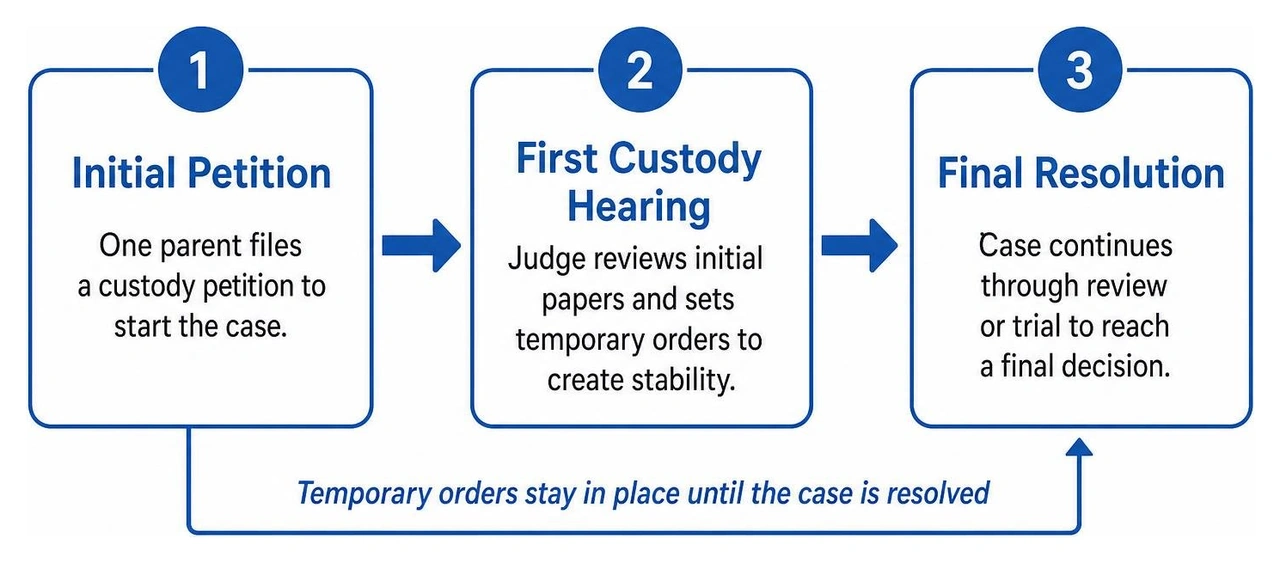
The main goal of this first visit is not to make a permanent choice. Instead, the judge wants to create a safe, steady routine for your child while your case is open. In the legal world, this is called setting temporary or interim relief.
Think of this hearing as hitting the pause button on arguments so your child's daily life stays normal. The judge looks at the initial papers filed by both sides, checks the court schedule, and makes sure everyone has basic ground rules to follow. This first hearing usually moves quickly—often lasting between 15 minutes and an hour. The judge will not decide who gets final custody today. Their only job right now is to keep things stable and safe for your little ones until a full review or trial can happen.
Types of Temporary Orders Issued by the Judge
To keep the peace at home, the judge will issue short-term rules called temporary orders. These orders stay in place until your case ends or until the judge changes them. Even though they are called "temporary," temporary custody orders and baseline routines matter a lot. They set the tone for how parenting time will work for months to come.
Here are the common temporary orders a judge might set during your first visit:
- Temporary Legal Custody: Decides who makes big choices about your child’s school, doctors, and religious upbringing.
- Physical Placement and Parenting Time: Sets the exact weekly schedule for where your child sleeps and when each parent spends time with them.
- Temporary Child Support: Calculates a basic financial support amount using state formulas so the child's daily living costs are covered.
- Non-Disparagement Rules: Orders both parents not to say bad things about each other in front of the child or on social media.
- Geographic Restrictions: Prevents either parent from moving the child out of the county or state without written permission from the court.
Inside the Courtroom: Key People and Procedural Flow
Who Will Be in the Courtroom?
Walking into a courtroom can feel intimidating if you do not know who everyone is. Luckily, each person in the room has a specific, helpful job:
- The Family Court Judge: The person who listens to the facts, manages the hearing, and makes the legal rulings.
- The Court Attorney: A lawyer who works directly for the judge. They often meet with both parents' lawyers before the hearing to see if everyone can agree on basic issues.
- The Court Clerk: The person who handles all the legal files, marks evidence, and calls out your case name.
- The Court Reporter: The person who types down every single word spoken on the record.
- The Court Officer or Bailiff: Uniformed officers who keep everyone safe and help people find where to sit.
- The Attorney for the Child (AFC): In many custody cases, the court appoints a neutral lawyer whose only job is to speak up for your child's legal rights and wishes.
- A Guardian ad Litem (GAL): In some complex cases, a guardian helps figure out what is truly best for the child, especially if the child is very young.
Step-by-Step Breakdown: What Happens at First Custody Hearing
Understanding the basic courtroom procedures in family court hearings makes the whole morning much less scary. A survey of court helpers shows that parents who arrive at least 30 minutes early feel far less stressed and forget fewer papers.
Here is what happens step by step:
- Calendar Call: The court officer calls your case name. You and your attorney step past the gate and stand before the judge's bench.
- Entering Appearances: The lawyers state their names and tell the judge which parent they represent.
- Reviewing the Child's Current Routine: The judge asks where the child is currently living, where they go to school, and how visits have been handled lately.
- Listening to Short Arguments: Each attorney gives a brief summary of what their client wants for the short-term schedule.
- Entering the Temporary Order: The judge decides on a temporary schedule and reads it out loud for the court record.
- Setting the Next Court Date: The judge gives you a future date to return, which could be for mediation, a conference, or a trial.
| Feature | First Custody Hearing (Temporary) | Final Custody Trial |
|---|---|---|
| Main Goal | Set short-term rules and stability | Make permanent custody decisions |
| Typical Length | 15 to 60 minutes | Several hours to multiple days |
| Witness Testimony | Rare; mostly lawyer statements | Common; full cross-examinations |
| Evidence Used | Basic papers and declarations | Detailed records, expert reports, and exhibits |
| Order Status | Interim rules (can be adjusted) | Final binding court judgment |
How Judges Evaluate the Best Interest of the Child
Key Legal Factors and Caregiving History
In every custody case across the country, the judge’s top rule is always the "best interest of the child." For example, Texas Family Code § 153.002 says, "The best interest of the child shall always be the primary consideration of the court in determining the issues of conservatorship and possession of and access to the child." Courts in every state follow this same core idea.
When looking at how judges evaluate child custody decisions, the judge looks at real-life facts rather than hurt feelings between adults. They want to know:
- Who gets the child ready for school and makes their meals?
- Who takes the child to doctor visits and helps with homework?
- Which parent provides a calm, safe, and steady home?
- Can both parents support the child's bond with the other parent?
- Are there any safety issues, drug problems, or domestic violence concerns?
Judges like keeping things as close to the child’s normal routine as possible. If you have been the one driving them to school and packing their lunch every day, be ready to show that clearly.
Addressing Child Testimony and Confidential Interviews
Many parents wonder if their child has to take the witness stand. The answer is almost always no, especially at a first hearing. Family judges work hard to shield children from adult arguments.
In New York, if a judge needs to know an older child’s thoughts, they hold a private meeting in their office called a Lincoln hearing. The parents are not allowed in the room. Only the judge, the child, the child’s lawyer, and the court reporter are present. This allows the child to speak freely without feeling pressured by mom or dad. At your first appearance, you should never bring your child to court unless the judge specifically ordered you to do so.
Preparing Evidence and Answering Judge Questions
Essential Documents and Evidence to Bring
Being organized is one of the best ways to show the judge that you are a dependable, caring parent. Walk into court with your papers neatly organized in a folder or binder. It is smart to bring three copies of everything: one for the judge, one for the other parent's lawyer, and one for yourself.
Here is a helpful checklist of what to bring:
- Your Photo ID and Court Notice: Required to pass through building security and check in.
- Child's School and Daycare Records: Attendance sheets, report cards, and pickup authorization forms.
- Medical and Doctor Records: Proof of routine checkups, immunization sheets, and health insurance cards.
- A Simple Proposed Parenting Plan: A clear, realistic calendar showing exact days and drop-off times you want.
- Written Communication Logs: Polite text messages or emails from co-parenting apps showing your efforts to plan visits.
- Financial Proof: Your two most recent paystubs or tax forms if child support will be discussed.
- Proof of Address: A lease or utility bill showing your home is safe and ready for your child.
Responding to the Bench: Questioning and Courtroom Conduct
If the judge asks you a question directly, take a deep breath before speaking. How you act in the courtroom tells the judge a lot about your parenting. Following these guidelines on first custody hearing protocols will keep your case on solid ground:
- Address the Judge Respectfully: Always say "Your Honor" and stand up when you speak.
- Keep Your Answers Short and Factual: Answer only what was asked. If the judge asks what time your child wakes up for school, say "7:00 AM," not a long story about how the other parent never buys cereal.
- Focus on Your Child, Not Your Ex: Talk about your child’s bedtime, soccer practice, and homework needs. Avoid name-calling or complaining about past relationship drama.
- Stay Calm and Silent When Others Speak: Never shake your head, roll your eyes, or interrupt the other parent. The judge notices body language.
Post-Hearing Realities: Next Steps and Common Mistakes to Avoid
What to Do If You Disagree with Temporary Orders

It is possible that you will not love everything in the temporary order. You might feel you did not get enough time or that the schedule is unfair. However, you must follow the court order to the letter.
If you ignore the order, you can be held in contempt of court. This can lead to heavy fines or even losing time with your child later on. If a schedule is truly not working because of major changes in your child's life, your lawyer can file a formal motion asking the judge to adjust it. Never take matters into your own hands.
Next Steps: Discovery, Mediation, and Future Court Dates
Once your temporary orders are set, your case moves into the main legal phase. Understanding how family court cases work from start to finish helps you plan for the months ahead.
Here is what often happens next:
- Court-Ordered Mediation: In many areas, parents meet with a trained mediator to try working out a peaceful agreement without a trial. For example, in North Carolina, contested custody cases are set for mediation under G.S. 50-13.1(b) unless excused for safety issues.
- Exchanging Information (Discovery): Both sides share work schedules, living arrangements, and financial records.
- Custody Evaluations: In complicated cases, the judge might appoint a forensic mental health professional or social worker. Custody evaluations are expensive, often starting around $5,000 and climbing past $15,000, with the cost usually split between the parents.
- Building Your Track Record: Use the months under your temporary order to prove you are reliable. Show up on time for every single visit and keep a quiet, written record of all exchanges.
Critical Mistakes Parents Must Avoid
To protect your rights and keep your case strong, steer clear of these common pitfalls:
- Losing Your Temper: Emotional outbursts in the hallway or courtroom make judges wonder if you can stay calm around your kids.
- Trash-Talking the Other Parent: Speaking poorly about your co-parent makes you look unwilling to support your child's relationship with their family.
- Posting on Social Media: Never vent about your case, your ex, or your court dates on Facebook, Instagram, or TikTok. Judges read these posts, and deleting them later can be seen as destroying evidence.
- Showing Up Late or Skipping Court: Missing your hearing can result in the judge signing an order giving the other parent everything they asked for.
- Relying on Artificial Intelligence: A major mistake parents make today is turning to AI tools like ChatGPT to draft custody schedules or separation agreements. Generic, robotic AI forms miss critical local rules and human details that can ruin your family’s future. Only a real attorney with genuine empathy and local court experience can truly protect your parental rights.
Why Honest Flat-Fee Legal Guidance Matters
Custody battles are emotional enough without the fear of running out of money halfway through your case. In Suffolk County, New York, Steven Zalewski is widely known as one of the most trusted family court trial lawyers. Whether your case is heard at the Suffolk County Family Court in Central Islip or Riverhead, having experienced representation makes all the difference.
Unlike traditional law firms that bill by the hour or quit when a case gets difficult, our office uses a clear, honest flat-fee model:
- Pre-Trial Fee: One set flat fee that covers all prep work, legal filings, client calls, and every single court appearance leading up to trial—no matter how many times we have to appear before the judge.
- Trial Fee: A single, clear fee due 30 days before your scheduled trial date if your case cannot be settled outside of court.
We believe no parent should ever be abandoned mid-case simply because their savings ran dry. Steve never leaves a client behind. We also offer straightforward payment plans to help families through tough times.
Frequently Asked Questions About Initial Custody Hearings
How long do temporary custody orders last?
Temporary custody orders last until the judge changes them or until a final custody agreement or trial judgment is signed. This can take anywhere from a few months to over a year, depending on how busy the court docket is.
What happens if one parent fails to appear at the first hearing?
If the other parent was properly served with court papers and still does not show up, the judge can move forward without them. The court may issue a default order giving you the temporary custody and parenting time you requested.
Will the court order a custody evaluation at this first appearance?
If both parents strongly disagree on basic facts or if there are serious safety claims, the judge may order a custody evaluation during the first appearance. The judge will name an independent expert and explain how parents must split the cost.
Conclusion
Your first custody hearing is not about winning or losing an argument. It is simply about putting clear rules in place so your child feels safe, loved, and supported. When you arrive early, bring organized records, and keep your focus on your child's daily needs, you set a positive tone for your entire case.
If you are facing an upcoming court date in Central Islip, Riverhead, or anywhere across Long Island, do not walk into the courtroom alone. Turn to dedicated Suffolk County custody lawyers who offer honest flat fees and rapid, same-day support.
📱 Cell: (516) 660-4354
📧 Email: steve@zandzfamilylawyers.com
🏛 Address: 1601 Veterans Memorial Highway, Suite 500, Islandia, NY 11749
i guarantee you will be heard
Ready to Take the Next Step?
At Zacarese & Zalewski P.C., when something isn’t right, say something—and we’ll do something about it with you.
Our flat-fee structure is clear: one flat fee for pre-trial work, and a trial fee only if your case goes to trial or a hearing. Call now and a professional will return your call quickly; if we miss you, we'll call back the same day.