
When you speak, I guarantee you will be heard
Zacarese & Zalewski P.C.
Family Court Default Hearing Guide: Winning Custody by Default
Call now: 516-660-4354
"He didn't just win my case. He gave me back my future, my peace of mind, and my ability to breathe again."
From the very first conversation, he changed everything. He didn't just see a case, he saw me, and treated me like family. His knowledge of the law was unmatched, but what truly set him apart was his humanity. If you are looking for a lawyer, stop searching right now.


What Is a Default Hearing and When Does It Apply?

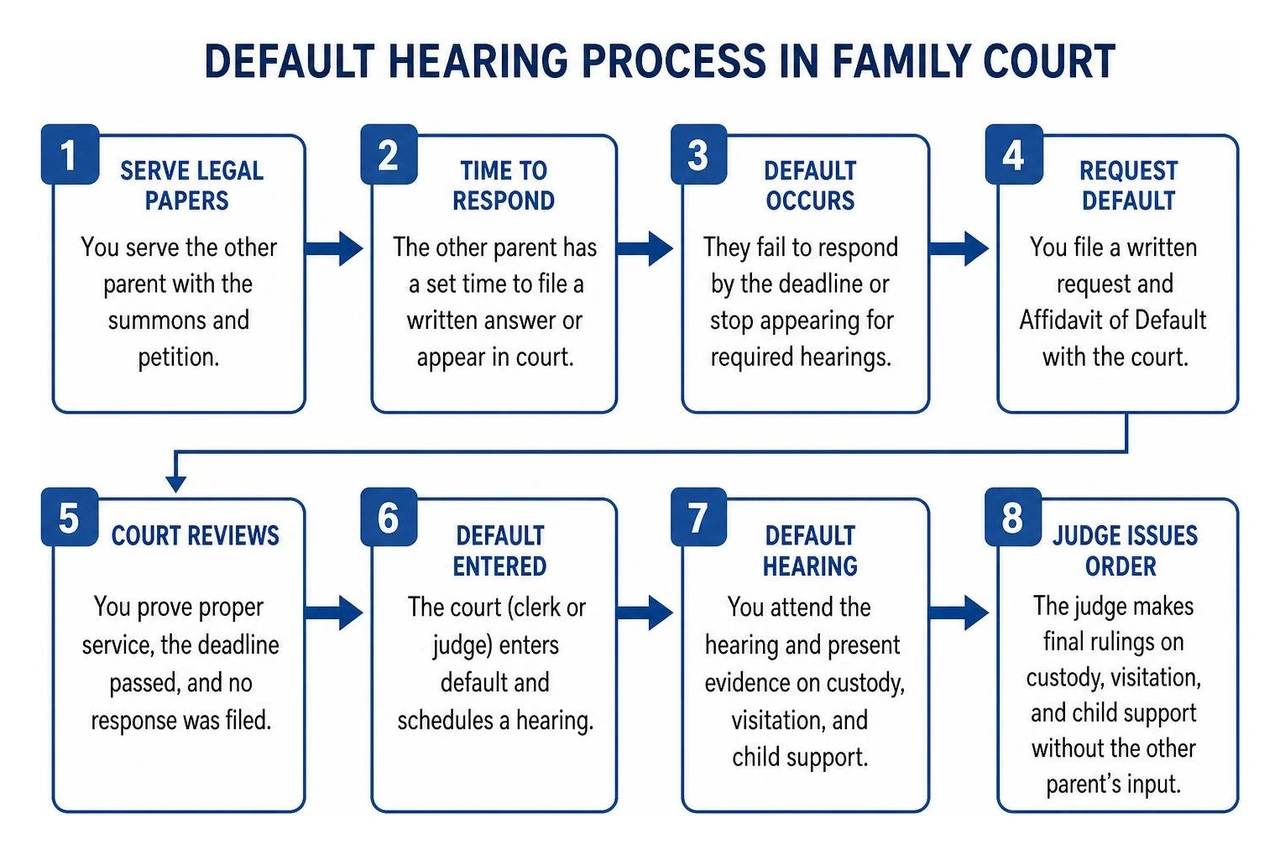
When you start a family case, you hand official legal papers to the other party. In custody, child support, or divorce matters, the law gives that person a set time to answer. When they fail to reply or skip court entirely, the case cannot just sit in limbo forever. The legal system uses a special process so you can finish your case. Understanding from start to finish what really happens in a family court case helps you see why the court must step in when one side simply walks away.
A default hearing family court proceeding is a formal court date where the judge moves forward without the other parent. It keeps the court running smoothly and ensures your children get the legal protection, custody schedule, and financial support they need without endless delays.
Grounds for Entering a Default in Custody and Support Cases
A judge will not schedule a default hearing just because someone is five minutes late. Specific legal conditions must be met first:
- Total Failure to Respond: The other party received the summons and petition but never filed a written answer within the deadline.
- Failure to Appear: The other side filed an initial paper but then completely stopped showing up for mandatory conferences or calendar calls.
- Clear Proof of Notice: You must show the court solid proof that the other parent was properly handed the legal papers in person, by certified mail, or through court-approved publication.
When these conditions exist, the court finds the other parent in procedural default. This gives the judge the legal power to make final rulings on custody, visitation, and child support without that parent's input.
Initiating the Default Hearing Family Court Process
To start the process, you must formally ask the court to enter a default. You usually file a written request along with a sworn statement called an Affidavit of Default. In this paper, you swear under oath that:
- The other parent was legally served with the summons and petition.
- The legal deadline to answer has completely passed.
- The other parent has not filed any responsive pleading or asked for an extension.
In many places, established statutory guidelines on default judgments outline whether the court clerk or the judge signs off on the default entry. Once the paperwork is verified, the court sets a date for your default hearing family court session and notifies you when to come present your facts.
Statutory Notice Requirements and Pre-Hearing Timelines
Courts take constitutional fairness very seriously. Before a judge cuts off someone's chance to speak on custody, strict waiting periods must pass. These timelines depend heavily on how and where the other parent was served.
| Service Method | Typical Waiting Period to Respond | When Default Can Be Requested |
|---|---|---|
| In-State Personal Delivery | 20 to 30 days | Immediately after the deadline passes |
| Out-of-State Personal Delivery | 30 to 60 days | After the extended window closes |
| Service by Publication (Newspaper) | 60 days | After the final notice runs plus 10–20 days |
| Service by Certified Mail | Up to 90 days | After postal proof of delivery is logged |
Protecting Due Process and Military Service Verification
Federal law provides strong safeguards for people serving in the military. Under the Servicemembers Civil Relief Act (SCRA), you cannot take a default judgment against active-duty military members who might be deployed or stationed far away and unable to defend themselves in court.
Before any family judge grants a default, you must file a Military Status Affidavit. You can check their active status online through the official Defense Manpower Data Center (DMDC) database. If the other parent is on active duty, the court will pause the case or appoint a special attorney to look out for their interests.
Notice Rules and County-Specific Scheduling Procedures
Every courthouse handles its calendar a bit differently. Knowing what to expect at your first family court hearing in Suffolk County makes a huge difference in avoiding procedural delays. In some courts, default requests are placed on daily morning calendars, while other jurisdictions schedule special afternoon sessions specifically for default inquests.
In places like North Carolina, local rules require strict pre-trial memorandums, while in Texas, courts may dismiss a case if notice rules are not followed to the letter. Missing a simple local rule can cause the judge to cancel your hearing and force you to start the notice process all over again.
Required Documentation and Evidence Preparation

Many parents think that if the other side does not show up, the judge simply stamps "Approved" on whatever they asked for. That is a dangerous myth. When children are involved, judges have an independent duty to protect their best interests. You still carry the burden of proof to show that your proposed parenting schedule is safe, practical, and healthy for your kids.
Essential Custody Filings: Parenting Plans and Support Worksheets
Before walking into the courtroom, you must prepare and submit complete paperwork packets. Do not try to use artificial intelligence like ChatGPT to draft your custody agreements or parenting plans. Generic, robotic AI forms routinely miss critical local court rules, leave out vital enforcement clauses, and fail to account for the unique safety needs of your children. A computer program does not understand the local judges in Central Islip or Riverhead. Only an experienced human attorney with real empathy and deep local court knowledge can safeguard your family's future.
Your default packet should include:
- Proposed Parenting Plan: A clear schedule detailing weekday routines, weekend visits, holidays, and school vacation plans.
- Sworn Financial Statement: A full breakdown of your income, child care costs, health insurance premiums, and living expenses.
- Child Support Worksheet: Accurate state-mandated child support calculations.
- Parent Education Certificate: Proof that you completed any court-ordered parenting classes.
- Jurisdiction Affidavits: Sworn statements showing where the child has lived for the past five years to prove the court has legal authority over the case.
Preparing Evidence for Your Default Hearing Family Court Date
You need solid proof to back up every request. Proper family court trial preparation is essential even when the other chair sits empty. If you want sole decision-making authority, you must show the judge why that serves your child best.
Bring organized evidence that follows official courtroom presentation standards:
- Certified school report cards and attendance records.
- Pediatrician records and medical histories.
- Daycare bills, tutoring invoices, and activity receipts.
- Printed text messages or emails showing you handle all parenting duties alone.
- Three clean copies of every exhibit: one for the judge, one for the court clerk, and one for your own reference.
What Happens During a Default Hearing vs. Contested Trial
A default hearing is much faster and less adversarial than a full trial, but it is still a formal court proceeding under oath.
| Feature | Default Hearing (Inquest) | Contested Custody Trial |
|---|---|---|
| Hearing Duration | 15 to 45 minutes | Several days or weeks |
| Parties Present | Moving parent and their attorney | Both parents, both attorneys, and child's lawyer |
| Cross-Examination | None (judge asks questions directly) | Intense questioning by opposing counsel |
| Evidence Presentation | Direct testimony and sworn offers of proof | Complex witness testimony and disputed exhibits |
| Cost and Stress | Lower legal costs, highly streamlined | High stress, significant time commitment |
Judicial Inquest and Offers of Proof
During your default hearing, the judge will conduct what is known as an inquest. Your attorney will call you to the witness stand, where you swear to tell the truth. You will answer direct questions establishing:
- How and when the other party was served with the summons.
- That the child has lived in the county continuously.
- Your daily routine with the child, including feeding, school drop-offs, and doctor visits.
- Why your proposed custody and visitation schedule provides the child with stability.
In some courtrooms, the judge may accept an "offer of proof." This means your lawyer summarizes what your evidence shows, and you affirm under oath that the statements are true. The judge will review your documents, ask you a few direct questions from the bench, and ensure the requested child support numbers match state formulas.
Issuing the Default Judgment and Serving Final Orders
Once the judge is satisfied with your testimony and proof, they will make formal findings on the record. Knowing how one court date can change everything in family court highlights why this final step matters so much.
The judge signs a written order or directs your attorney to submit a formal judgment for signature. Once signed, that document must be entered into official court records. You must then serve a copy of the signed order with a formal "Notice of Entry" on the defaulting parent. This starts the legal clock for any appeals and makes the custody orders fully enforceable by law enforcement and school officials.
Can a Default Custody Judgment Be Set Aside or Vacated?
Yes. While a default judgment is a binding legal order, the law allows a defaulting parent to ask the court to reopen the case under specific, limited circumstances.
Legal Grounds for Vacating: Excusable Neglect vs. Improper Service
A judge will not overturn a default order simply because the other parent is unhappy with the result. They must file a formal Motion to Vacate Default and prove two distinct things:
- A Reasonable Excuse: They must show a legitimate reason for missing court, such as a severe medical emergency, documented hospitalization, or proof that they were never legally served with the papers (lack of personal jurisdiction).
- A Meritorious Defense: They must convince the judge that if the case is reopened, they have real evidence that could lead to a different custody outcome for the child.
Simple forgetfulness, being busy with work, or deliberately ignoring court mail does not count as a valid excuse.
Procedural Steps for Filing a Motion for Relief from Default
If the other parent wants to challenge the order, they must file an Order to Show Cause promptly—usually within one year of the judgment date (or sooner under local court rules). The judge will hold a hearing to decide if their excuse is real. If the judge vacates the default, the case goes back onto the active calendar for standard litigation. If the motion is denied, your default custody decree remains completely in effect.
Why Choose Zacarese & Zalewski for Your Family Court Case
When your child's future is on the line, you need legal help that is steady, reliable, and completely transparent. Steven Zalewski is widely recognized as one of the most well-known family court trial lawyers in Suffolk County. Whether your case is heard at the Suffolk County Family Court in Central Islip, the courthouse in Riverhead, or managed from our offices in Islandia, Steve brings decades of real courtroom experience directly to your side.
Honest Flat-Fee Representation With Zero Surprises
Most law firms charge high hourly rates that make it impossible to know what your case will cost. Worse yet, when a case drags on or gets complicated, many hourly firms demand more retainer money or abandon clients mid-case when funds run dry.
At Zacarese & Zalewski P.C., we do things differently. We use an honest, two-part flat-fee model:
- Pre-Trial Flat Fee: Covers every single step leading up to trial—including drafting petitions, managing service, filing default applications, attending conferences, and handling every pre-trial appearance no matter how many court dates it takes.
- Trial Flat Fee: A single, set fee due 30 days before your scheduled trial date if a contested trial becomes necessary.
Steve never walks away or leaves a client behind because they ran out of money. We believe every parent deserves top-tier legal defense, which is why we also offer flexible payment plans to fit your family budget.
Frequently Asked Questions About Family Court Defaults
How long does a default custody hearing usually take?
A typical default hearing or inquest moves quickly. Most take between 15 and 30 minutes. Because the other parent is not present to argue, cross-examine witnesses, or introduce opposing evidence, the judge focuses entirely on reviewing your documents, hearing your sworn testimony, and verifying child support calculations.
Can the respondent appear at the default hearing without an answer?
If the other parent suddenly shows up on the morning of the default hearing, the judge will not automatically grant your default. Judges prefer resolving custody cases on the merits rather than technicalities. The judge will usually ask the other parent why they failed to respond, may accept a late appearance, and will likely adjourn the hearing to give them a short deadline to file a formal written answer.
What happens if the other parent files a late response before the hearing date?
If the other parent files an answer with the court clerk before your default hearing date arrives, the default is "cured." The court will cancel the uncontested inquest and convert the case back into a standard contested proceeding. The clerk will then schedule an initial case conference for both sides to appear.
Conclusion
A default hearing provides a clear, lawful path to secure custody and child support when the other parent refuses to participate. But winning by default requires careful attention to service rules, strict deadlines, and organized evidence.
Do not leave your family's stability to chance. If you need dedicated child custody representation in Suffolk County, reach out to our team today for clear guidance and dependable flat-fee advocacy.
📱 Cell: (516) 660-4354
📧 Email: steve@zandzfamilylawyers.com
🏛 Address: 1601 Veterans Memorial Highway, Suite 500, Islandia, NY 11749
i guarantee you will be heard
Ready to Take the Next Step?
At Zacarese & Zalewski P.C., when something isn’t right, say something—and we’ll do something about it with you.
Our flat-fee structure is clear: one flat fee for pre-trial work, and a trial fee only if your case goes to trial or a hearing. Call now and a professional will return your call quickly; if we miss you, we'll call back the same day.