
When you speak, I guarantee you will be heard
Zacarese & Zalewski P.C.
Understanding Family Law Appeals and What It Takes to Win
Call now: 516-660-4354
"He didn't just win my case. He gave me back my future, my peace of mind, and my ability to breathe again."
From the very first conversation, he changed everything. He didn't just see a case, he saw me, and treated me like family. His knowledge of the law was unmatched, but what truly set him apart was his humanity. If you are looking for a lawyer, stop searching right now.


Family Law Appeals: What to Know Before You File

Family law appeals ask a higher court to review a lower court's decision for a serious mistake. They are not a new trial. The court usually reviews the existing record, rather than hearing new witnesses or evidence. Custody and support orders may be appealed, but whether an order qualifies and how long you have to file depend on the court and the type of order.
If you think a ruling was wrong, act quickly. Get a copy of the order, note when it was issued, and ask a lawyer to review the record and filing deadline. Disagreeing with the outcome alone is not enough; an appeal needs a legal reason.

Family law appeals further reading:
Fundamentals of the Appellate Process in Domestic Relations
When a family court judge issues a ruling that feels unfair, many people think they can just show up in a higher court and tell their story again. But the appellate court works very differently from your local trial court.
The appellate court is a higher court that checks the lower court's work. Instead of one judge sitting at the bench listening to parents testify, a panel of three judges reviews the written record. They check whether the trial judge followed the law and acted within their legal powers.
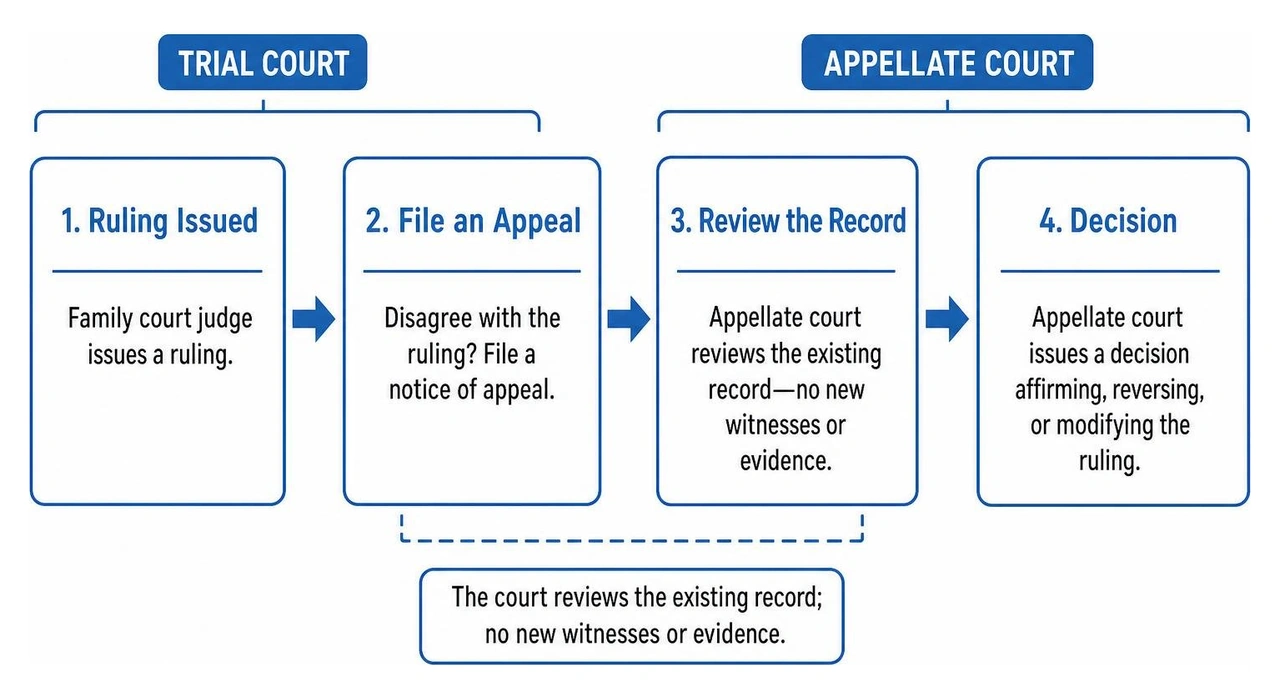
What Are Family Law Appeals and How Do They Differ from Retrials?
An appeal is not a second chance to present your case. You do not get to bring new witnesses, show fresh text messages, or ask the judge for a do-over. The person who files the appeal is called the appellant, and the person responding is called the respondent.
The judges only look at the exact words, papers, and evidence already presented in the trial record. To see how this fits into the bigger picture of your case, read about understanding what really happens in a family court case.
| Feature | Trial Court Proceeding | Appellate Court Review |
|---|---|---|
| Who Decides | Single trial judge | Panel of three judges |
| Witness Testimony | Live witnesses testify and are cross-examined | No witnesses are ever called |
| New Evidence | New documents and photos can be introduced | Strictly no new evidence allowed |
| Focus | Finding facts and deciding what happened | Checking for serious legal and procedural errors |
| Oral Arguments | Lawyers make opening and closing statements | Lawyers answer questions from the judges |
Appealable Orders: Custody, Support, and Property Division
You cannot appeal every single word a judge says during a hearing. In general, you can only appeal a final judgment or order that completely finishes a specific issue. Common appealable orders include:
- Child Custody and Visitation: Final parenting plans and decision-making orders.
- Child Support and Spousal Support: Final support calculations, awards, and denials.
- Property Division: The final division of marital assets, houses, and debts.
- Attorney's Fees: Final orders requiring one party to pay the other's legal costs.
Temporary decisions made while a case is ongoing (called interlocutory orders) usually cannot be appealed right away. However, some states, like Illinois, allow immediate review for certain custody matters. In other places, such as Australia, parties may need special permission from the court.
Emergency Writs vs. Traditional Appeals
A standard appeal can take over a year to finish. If a trial judge makes a huge mistake that will immediately hurt a child or cause extreme financial ruin, waiting months is not an option.
In those rare emergencies, a party can file a petition for a writ (such as a writ of mandate or writ of prohibition). A writ asks the higher court for immediate, extraordinary relief. While an appeal waits for the entire case to end, a writ asks the higher court to step in right now to stop irreparable harm before it is too late.
Legal Grounds and Standards of Review in Family Law Appeals

You cannot win an appeal just because you dislike the judge's ruling. You must prove that the trial judge made a clear legal mistake that changed the outcome of your case.
Valid Grounds for Challenging a Trial Court Judgment
To succeed on appeal, you must show clear legal errors on the record, such as:
- Abuse of Discretion: The judge made an arbitrary, unreasonable decision that makes no sense based on the facts.
- Misapplication of the Law: The judge applied the wrong legal rule, statute, or formula.
- Insufficient Evidence: The judge made findings that were completely unsupported by the trial record.
- Procedural Errors: The court violated key court rules, such as refusing to let a parent present their case. Understanding what should happen early on starts with knowing the expectations at a fact-finding hearing.
- Constitutional Violations: The court infringed on fundamental parental rights without due process.
Standards of Review and the No New Evidence Rule
The higher court looks at different issues through different lenses, known as "standards of review":
- De Novo: Used for pure questions of law. The appellate judges look at the legal statute from scratch, giving zero deference to the trial judge.
- Abuse of Discretion: Used for everyday family law calls like custody and support. The appellate court gives high respect to the trial judge and only overturns decisions that are plainly unreasonable.
- Substantial Evidence: Used for factual findings. If there is reasonable evidence supporting the judge's view, the ruling stands.
Because the appellate record is closed, winning requires thorough family court trial preparation in the lower court to ensure all objections and evidence are properly preserved.
Step-by-Step Timeline and Procedural Requirements
Appeals require strict adherence to written court rules. Missing a single filing deadline by even one day can cause your entire appeal to be dismissed immediately.
Key Jurisdictional Deadlines for Family Law Appeals
Every state sets strict deadlines for filing your initial Notice of Appeal:
- California: Generally, 60 days after service of the Notice of Entry of Judgment, or 180 days after entry of the order.
- Texas: A Notice of Appeal must be filed within 30 days after the final decree is signed. For parental termination cases, accelerated rules apply.
- Washington: The notice of appeal must be filed within 30 days of the decision.
- Australia: Rules require filing within 28 days and serving within 14 days.
Navigating the Appellate Process from Notice to Oral Argument

Once you file your Notice of Appeal, the formal process unfolds over several stages:
- Designation of the Record: You request and pay for the clerk's transcript (all written court filings) and the reporter's transcript (the word-for-word spoken trial record).
- Appellant's Opening Brief: Your attorney writes a comprehensive legal book citing statutes, trial transcripts, and past court decisions to show where the judge erred.
- Respondent's Brief: The other side files a written argument defending the trial judge's decision.
- Reply Brief: The appellant gets one final written response addressing the other side's points.
- Oral Argument: The lawyers appear before the three-judge panel to answer sharp questions about the law and evidence.
- The Decision: The court issues a written opinion that either affirms (keeps), reverses (overturns), or remands (sends back for a new hearing) the decision.
What Happens to Court Orders Pending Appeal and How Stays Work
Filing an appeal does not pause or freeze the trial judge's order. If the court ordered you to pay $1,500 a month in child support or turn over custody on weekends, you must obey that order. If you stop paying or refuse visitation, you can be held in contempt of court, face fines, or even go to jail.
To stop an order during an appeal, you must file a motion for a stay. In financial matters, courts often require you to post a cash bond (called a supersedeas bond). In child custody cases, stays are rarely granted unless you prove the child is in immediate physical or emotional danger.
Strategic Considerations, Costs, and Alternatives
Before jumping into an appeal, it is critical to weigh the high costs against the likelihood of success.
Success Rates, Financial Risks, and Choosing Counsel
Appeals are an uphill battle. In civil and family cases, fewer than 20% of appeals actually succeed in overturning the original decision. The appellate court assumes the trial judge got it right unless you can prove a major mistake.
Furthermore, hourly legal fees for appeals can reach tens of thousands of dollars. That is why choosing the right representation matters. At Zacarese & Zalewski P.C., Steven Zalewski is known throughout Suffolk County Family Court—including the courthouses in Central Islip, Riverhead, and our primary office in Islandia—as a dedicated trial lawyer who protects families with total financial transparency.
We offer transparent flat fee representation structures that keep you in control:
- Pre-Trial Fee: A single flat fee covering everything leading up to trial, including all court appearances, filings, and negotiations, no matter how many dates it takes.
- Trial Fee: A clear, set fee due 30 days before your scheduled trial date if your case goes the distance.
Unlike other firms that revert to expensive hourly rates or drop clients mid-case when things get complicated, Steve never abandons a client because money ran short. We also offer practical payment plans to make quality legal help accessible.
A Warning About AI and Family Court: Please do not use artificial intelligence tools like ChatGPT to write legal briefs, draft custody agreements, or prepare court petitions. Generic AI software produces robotic documents that miss local court rules, make up fake cases, and leave out critical details that can permanently hurt your family's future. Only an experienced human lawyer with genuine empathy and local Suffolk County court knowledge can properly safeguard your parental rights.
Post-Judgment Alternatives: Modifications vs. Appeals
An appeal is not always your best move. Depending on what happened, you may have simpler, faster options:
- Motion for a New Trial: Asking the trial judge to correct an obvious mistake right after the decision.
- Motion to Vacate Default: Asking the court to set aside an order entered because you missed a court date due to a legitimate emergency.
- Judgment Nunc Pro Tunc: A simple motion to fix minor clerical and math typos in the written decree.
- Post-Judgment Modification: If major changes have happened in your child's life since the trial (like a job loss or a parent moving away), filing for a modification with a dedicated family court lawyer is often much faster and cheaper than an appeal.
Frequently Asked Questions About Family Law Appeals
Can I introduce new evidence or call new witnesses on appeal?
No. The appellate court operates under a strict "closed record" rule. The judges will only review the evidence, exhibits, and transcripts that were presented to the trial judge. If you forgot to introduce a piece of evidence during the trial, you cannot show it to the appellate court.
Do I still have to follow custody and support orders during an appeal?
Yes. An appeal does not automatically pause lower court orders. You must follow all custody, visitation, and support terms unless the court grants a formal motion for a stay. Disobeying active orders can lead to severe contempt penalties.
How long does the family court appeal process usually take?
The entire appellate process typically takes between 12 and 18 months from the date you file your initial Notice of Appeal to the day the judges issue their final written opinion.
Conclusion
Challenging a family court order is a serious decision that requires swift action, strict attention to deadlines, and an honest assessment of your legal grounds. If you believe your trial judge made a critical legal error, do not wait. Talk to an experienced Suffolk County family law attorney to evaluate your options and protect your rights.
📱 Cell: (516) 660-4354 📧 Email: steve@zandzfamilylawyers.com 🏛 Address: 1601 Veterans Memorial Highway, Suite 500, Islandia, NY 11749
i guarantee you will be heard
Ready to Take the Next Step?
At Zacarese & Zalewski P.C., when something isn’t right, say something—and we’ll do something about it with you.
Our flat-fee structure is clear: one flat fee for pre-trial work, and a trial fee only if your case goes to trial or a hearing. Call now and a professional will return your call quickly; if we miss you, we'll call back the same day.