
When you speak, I guarantee you will be heard
Zacarese & Zalewski P.C.
Certified Specialists: Elevating Your Legal Strategy in Family Court
Call now: 516-660-4354
"He didn't just win my case. He gave me back my future, my peace of mind, and my ability to breathe again."
From the very first conversation, he changed everything. He didn't just see a case, he saw me, and treated me like family. His knowledge of the law was unmatched, but what truly set him apart was his humanity. If you are looking for a lawyer, stop searching right now.


What Defines a Certified Family Law Specialist?

A family law specialist is an attorney who focuses their legal practice primarily or exclusively on domestic relations law. In states with formal legal specialization programs, the term "Certified Family Law Specialist" has a specific legal definition. It refers to an attorney who has met rigorous state bar standards beyond basic bar admission.
State bar boards of legal specialization establish these programs to protect consumers and raise legal competence. Certified attorneys must demonstrate continuous practice devotion, complete extra training, and pass detailed examinations.
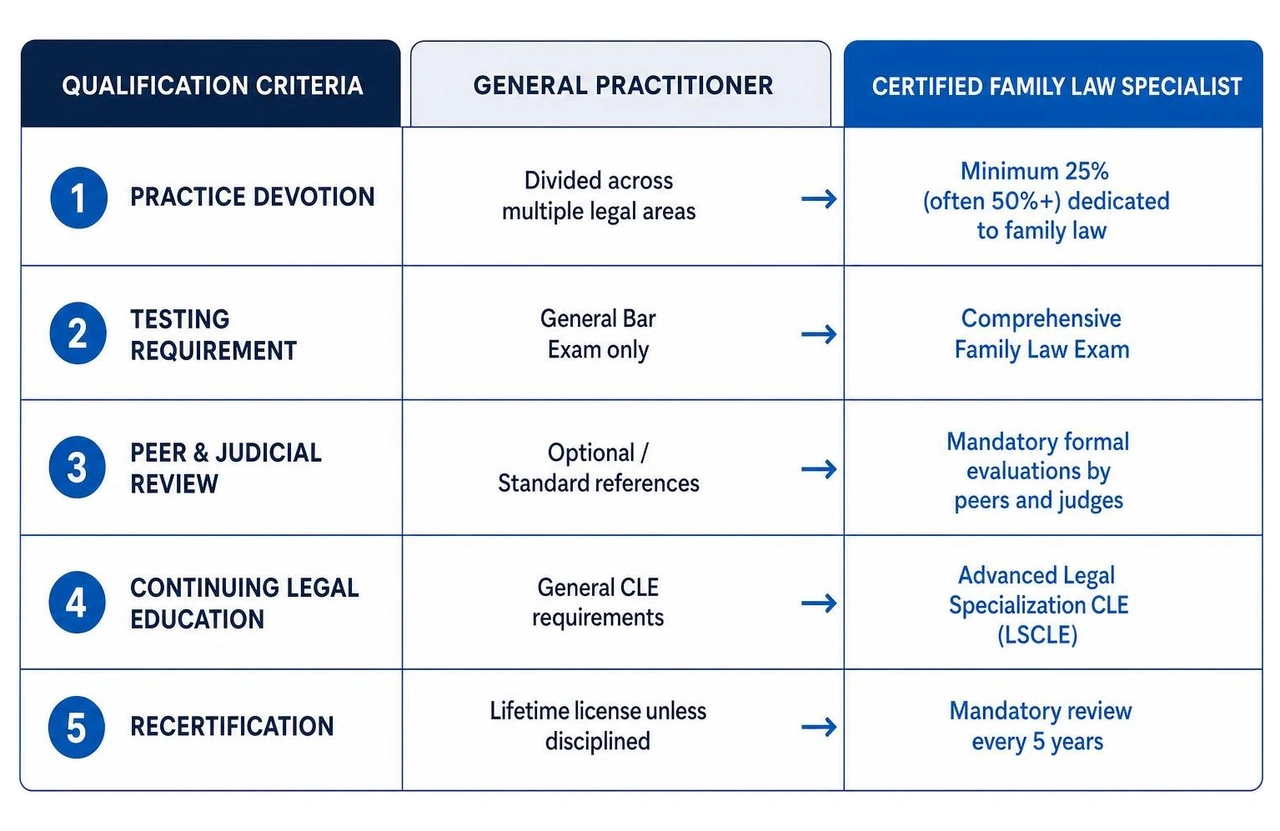
| Qualification Criteria | General Practitioner | Certified Family Law Specialist |
|---|---|---|
| Practice Devotion | Divided across multiple legal areas | Minimum 25% (often 50%+) dedicated to family law |
| Testing Requirement | General Bar Exam only | Comprehensive Family Law Exam |
| Peer & Judicial Review | Optional / Standard references | Mandatory formal evaluations by peers and judges |
| Continuing Legal Education | General CLE requirements | Advanced Legal Specialization CLE (LSCLE) |
| Recertification | Lifetime license unless disciplined | Mandatory review every 5 years |
Core Qualifications and Scope of Practice
To earn certification, a lawyer must demonstrate substantive legal knowledge and trial advocacy skills. A family law specialist manages complex matters including:
- Contested child custody and visitation disputes
- Complex asset division, business valuations, and debt distribution
- Child support, spousal maintenance, and post-judgment modifications
- Child Protective Services (CPS) defense, neglect, and abuse allegations
Key Differences: General Practitioner vs. Family Law Specialist
General practice attorneys handle diverse cases, such as real estate closings, simple wills, and personal injury claims. While capable in basic matters, general practitioners may lack deep familiarity with rapidly changing family court precedents.
In contrast, a dedicated practitioner focuses entirely on family court procedures. Top practitioners often belong to selective national organizations, such as the American Academy of Matrimonial Lawyers (AAML). If you need help with child custody or support in Islandia, Central Islip, or Riverhead, working with an experienced Family Law Attorney Suffolk County NY ensures your strategy aligns with local court standards.
The Path to Certification: Requirements and Rigorous Standards

Achieving specialist certification requires significant effort. State bars create strict roadmaps to ensure that only tested, highly experienced attorneys earn the credential.
Substantial Practice Experience and Case Hours
Most state certification programs require an attorney to practice law continuously for at least five years. In California, lawyers must devote at least 25 percent of their continuous practice to family law. In North Carolina, applicants must average at least 600 hours per year in family law over five years, with at least 400 hours in any single year.
Applicants must also show hands-on trial experience, including:
- Contested trials and evidentiary hearings
- Negotiated property settlements
- Deposition transcripts and oral arguments
- Alternative dispute resolution, such as mediation or collaborative law
Comprehensive Written Examination and Legal Education
Candidates must pass a comprehensive written examination covering state and federal family law statutes, evidentiary rules, tax implications, and financial asset distribution.
Specialists must also fulfill ongoing education standards. In California, for example, specialists must complete 36 hours of Legal Specialization Continuing Legal Education (LSCLE) every three years. Specialized training programs in high-net-worth divorce, complex financial remedies, or modern international custody rules help keep practitioners updated.
Judicial and Peer Review Evaluations
Testing and hours are not the only requirements. State legal specialization boards conduct thorough peer and judicial reviews.
Applicants submit names of judges and fellow lawyers who have observed them in court. These references provide confidential assessments of the applicant's legal skill, ethics, courtroom demeanor, and legal strategy.
State-by-State Certification Landscape and Program Differences

Legal specialization frameworks vary across the United States. State bar associations manage their own rosters and regulatory frameworks.
State Bar Specialization Programs Across the US
States with established certification programs set clear guidelines:
- California: The California Board of Legal Specialization operates a widely recognized certification program. Only certified lawyers may market themselves as State Bar Certified Family Law Specialists.
- Nevada: The State Bar of Nevada lists board-certified specialists in fields like Family Law and Family Trial Law Advocacy.
- North Carolina: The North Carolina State Bar enforces strict practice hour baselines, triennial educational reporting, and a 6-hour written examination.
- Texas: The Texas Board of Legal Specialization requires extensive trial experience, written testing, and annual peer reviews.
Jurisdictions Without Formal Board Certification
Many states, including New York, do not offer formal state bar board certification in family law. In these states, state bar rules restrict lawyers from claiming to be "certified specialists" unless accredited by an approved organization.
In jurisdictions without state-administered certification, clients should look for practical trial experience, community reputation, and specialized practice focus. Finding the Best Family Lawyer in Suffolk County means selecting a trial attorney who knows local court procedures in Central Islip and Riverhead.
Strategic Benefits and Potential Limitations for Clients
Retaining an attorney who focuses on domestic relations offers strategic advantages during emotionally challenging disputes.
Advantages of High-Level Specialization in Complex Cases
Focused legal representation helps resolve complex financial and personal matters, such as:
- High-Net-Worth Asset Tracing: Uncovering hidden accounts, evaluating business valuations, dividing deferred compensation, and managing complex tax liabilities.
- Complex Custody & Parental Rights: Navigating relocation applications, interstate custody rules, and high-conflict custody disputes.
- Forensic Integration: Working effectively with forensic accountants, mental health professionals, and property appraisers to build clear court evidence.
Focused legal representation helps address intricate cross-border jurisdictional disputes, high-asset splits, gray divorce, and complex financial matters. Working with financial settlement specialists, forensic accountants, mental health professionals, and property appraisers helps build clear court evidence and protect marital estates.
Evaluating Limitations and Criticisms of Certification Programs
Formal certification is valuable, but consumers should understand its limitations:
- Administrative Requirements: High application fees and lengthy administrative processes mean some skilled trial lawyers choose not to apply for formal credentials.
- Focus on Litigation over Mediation: Some certification standards emphasize courtroom trial hours rather than out-of-court settlement skills.
- Credentials vs. Real-World Compatibility: A certification badge shows technical knowledge, but it cannot guarantee personal responsiveness, clear communication, or local court experience.
At Zacarese & Zalewski P.C., Our Approach combines aggressive courtroom trial readiness with accessible, transparent client communication.
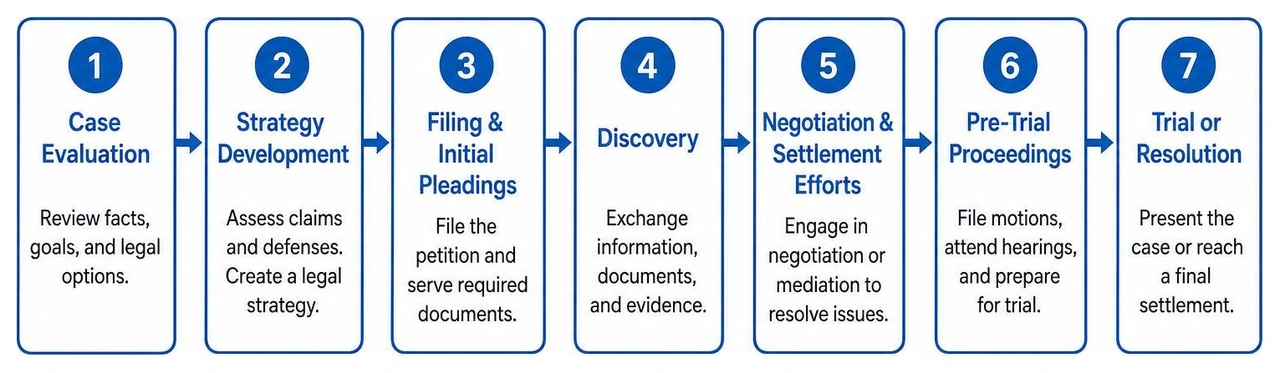
How to Verify Credentials and Choose the Right Legal Counsel
Verifying an attorney's credentials ensures your chosen counsel possesses verified trial experience.
Step-by-Step Credential Verification Process
- Search State Bar Directories: Check your state bar's official website to confirm active standing and review specialization rosters.
- Review Disciplinary History: Ensure the attorney has a clean ethical record with no public administrative sanctions.
- Confirm Local Court Experience: Ask how often the attorney appears in your specific court, such as the Suffolk County Family Court in Central Islip.
- Evaluate Fee Structures: Request written details regarding legal fees, trial costs, and billing schedules.
When You Should Retain a Family Law Specialist
Consider retaining a dedicated trial lawyer when facing:
- Contested child custody or emergency CPS safety plan petitions
- Disputed claims regarding business ownership or separate property tracing
- Relocation applications or international parenting disputes
- Complex enforcement or post-judgment modification hearings
Protecting Your Family: Human Insight vs. AI Assistance
In recent years, some people have considered using artificial intelligence (AI) programs to draft parenting plans, custody agreements, or divorce papers. We strongly warn readers against using AI to draft family law agreements.
Generic robotic programs cannot understand the subtle emotional dynamics of your household or local legal precedents. AI software often misses critical state-specific statutory language, resulting in unenforceable agreements that can ruin a family's life for years.
Only a human attorney with local Suffolk County legal insight, deep courtroom experience, and genuine empathy can protect your family's future. Family court decisions carry lifelong consequences for your children and assets. Entrusting these crucial matters to automated software poses significant risks.
Understanding Legal Fees: Flat-Fee Structure vs. Hourly Billing
Legal fees in family court can create uncertainty. Traditional law firms often charge high hourly rates. Under hourly billing, as your case grows more complex, legal fees rise—and some firms abandon clients who run out of money mid-case.
We believe legal fees should be clear and predictable. Steven Zalewski uses an upfront flat-fee model for family court representation:
- All Court Appearances Included: The flat fee covers all pre-trial court appearances in Suffolk County Family Court, regardless of how many times your case is called.
- Pre-Trial Fee: A single Pre-Trial Fee covers all legal work, document drafting, motions, and court appearances leading up to trial.
- Set Trial Fee: If your case goes to trial, a clear, set Trial Fee is due 30 days before the trial begins.
- Flexible Payment Plans: We offer flexible payment plans so quality trial representation remains accessible.
Explicitly contrasting Steven Zalewski's transparent flat fee with traditional hourly firms highlights the value of fee clarity. You will never receive surprising bills for short phone calls, emails, or extra court appearances.
Frequently Asked Questions About Legal Specialization
How many years of experience does a certified specialist need?
In states with formal certification, attorneys generally need at least five continuous years of active legal practice. They must also show that 25 to 50 percent of their daily legal work is devoted exclusively to family law.
Does every state offer family law board certification?
No. States like California, Nevada, North Carolina, and Texas offer formal state bar board certification. Other states, including New York, do not have a state-administered certification board, relying instead on legal practice experience and specialized bar association memberships.
Is hiring a certified specialist more expensive than a general lawyer?
Specialized lawyers may charge higher hourly rates due to their focused experience. However, retaining an experienced trial lawyer who uses a Flat Fee Family Court Lawyer in Suffolk County NY structure often reduces overall litigation costs by avoiding inefficient billing practices.
Conclusion
Choosing the right representation in family court can significantly impact your future and your children's well-being. Whether an attorney holds a formal board certification badge or brings decades of dedicated courtroom experience, you need a lawyer who communicates clearly, acts quickly, and understands local court rules.
At Zacarese & Zalewski P.C., Steven Zalewski is recognized as one of the most well-known family court trial lawyers in Suffolk County. We represent parents and spouses across Islandia, Central Islip, Riverhead, and all of Suffolk County. We provide straight talk, rapid same-day responses, and transparent flat-fee pricing so you always know what to expect.
To discuss your case with an experienced trial attorney, learn more about our Flat Fee Family Court Lawyer in Suffolk County NY services today.
📱 Cell: (516) 660-4354📧 Email: steve@zandzfamilylawyers.com🏛 Address: 1601 Veterans Memorial Highway, Suite 500, Islandia, NY 11749
i guarantee you will be heard
Ready to Take the Next Step?
At Zacarese & Zalewski P.C., when something isn’t right, say something—and we’ll do something about it with you.
Our flat-fee structure is clear: one flat fee for pre-trial work, and a trial fee only if your case goes to trial or a hearing. Call now and a professional will return your call quickly; if we miss you, we'll call back the same day.