
When you speak, I guarantee you will be heard
Zacarese & Zalewski P.C.
A Quick Start Guide to Grandparents' Legal Rights
Call now: 516-660-4354
"He didn't just win my case. He gave me back my future, my peace of mind, and my ability to breathe again."
From the very first conversation, he changed everything. He didn't just see a case, he saw me, and treated me like family. His knowledge of the law was unmatched, but what truly set him apart was his humanity. If you are looking for a lawyer, stop searching right now.


What Grandparents Rights Really Mean

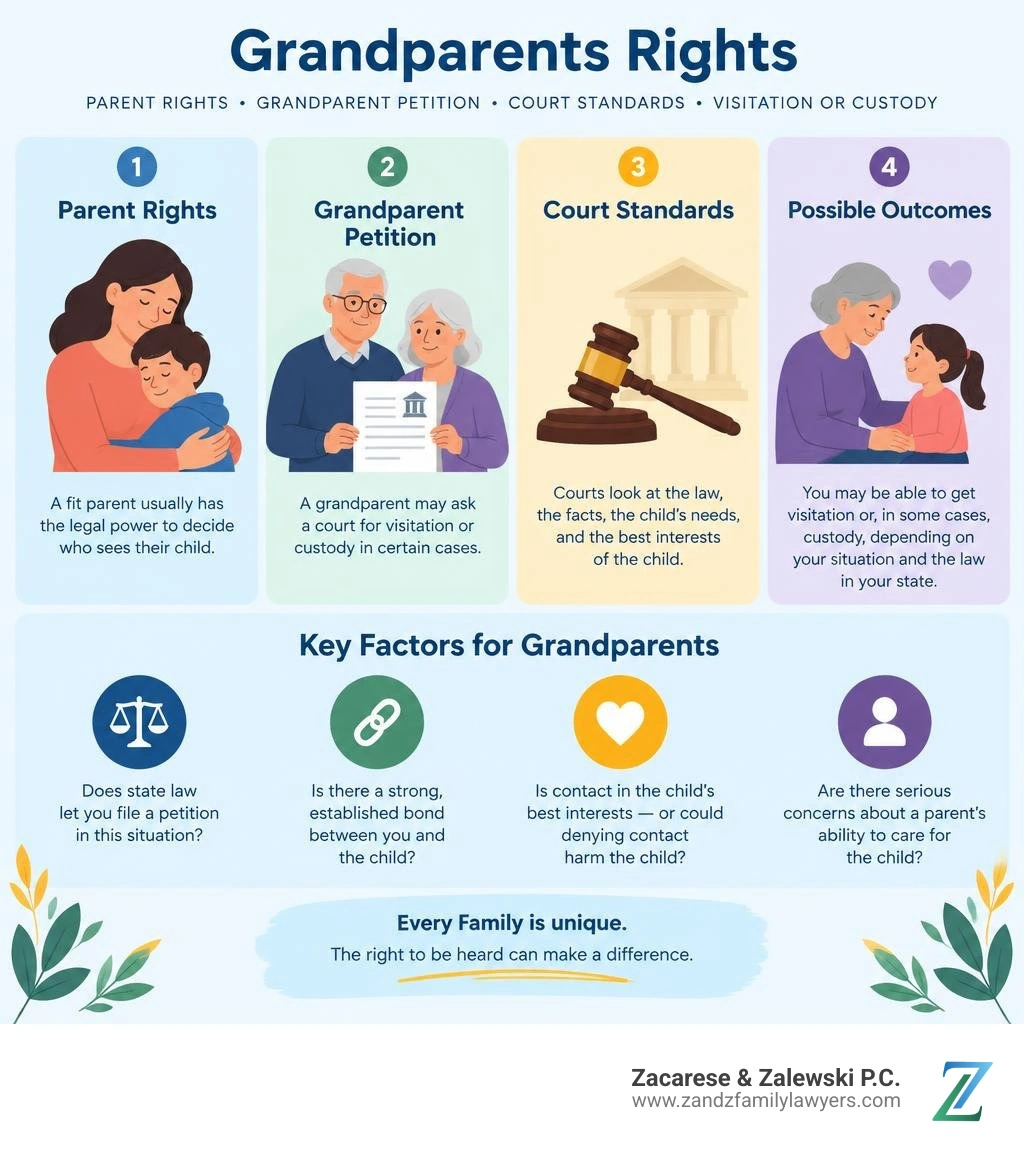
Grandparents do not have an automatic legal right to visit or raise a grandchild. A fit parent usually has the legal power to decide who sees their child. But a grandparent may ask a court for visitation or custody in certain cases, such as a parent's death, divorce, abandonment, unfitness, or when the grandparent has been a major caregiver.
For grandparents rights cases, the key questions are:
- Does state law let you file a petition in this situation?
- Is there a strong, established bond between you and the child?
- Can you show that contact is in the child's best interests - or, in some states, that denying contact could harm the child?
- Are there serious concerns about a parent's ability to care for the child?
The U.S. Supreme Court has made clear that courts must give special weight to the decisions of fit parents. That does not mean grandparents have no options. It means the facts, the child's needs, and the law in the state where the child lives matter a great deal.
This guide explains the difference between visitation and custody, when a grandparent may have legal standing, and practical steps to consider before starting a family court case.
Understanding Grandparents Rights: Standing, Custody, and the Law

When family relationships break down, grandparents often find themselves locked out of their grandchildren's lives. It hurts deeply, but before a judge will even listen to your story, you must have what the law calls "standing." Standing simply means you have the legal right under state law to open a court case.
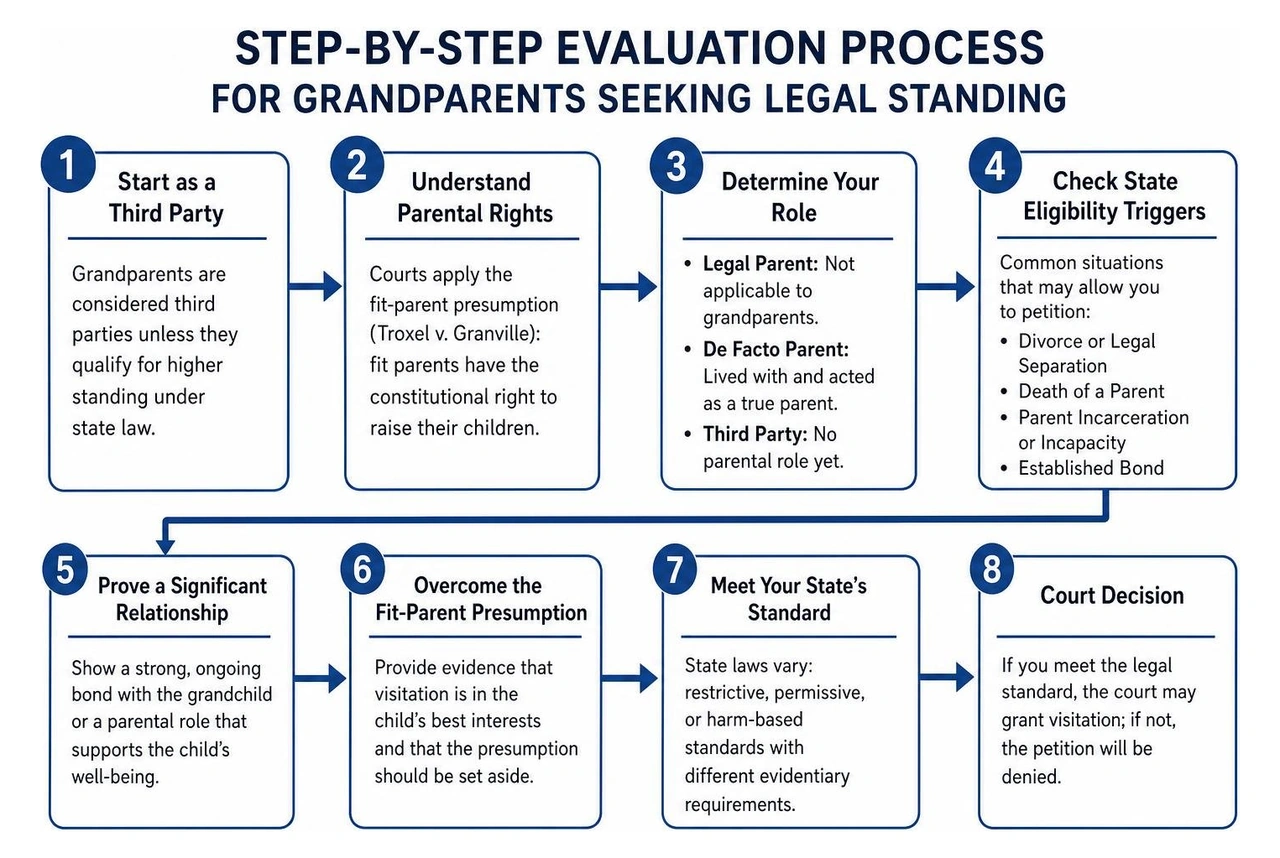
The biggest rule in this area of law comes from a famous 2000 U.S. Supreme Court case called Troxel v. Granville. In that case, the highest court ruled that the Fourteenth Amendment protects a parent's basic right to raise their children as they see fit. Under the law, judges must follow the "fit-parent presumption." This means the court starts by assuming that a good, capable parent makes choices that are best for their child.
Understanding parents' constitutional rights over grandparents is essential before starting any legal fight. Grandparents cannot simply walk into court and ask for time with a grandchild just because they love them. You must prove why the court should step in and override what the parent wants.
Legal Parent vs. De Facto Parent vs. Third Party
To understand your legal standing, you need to know how the court views your role:
- Legal Parent: The biological or adoptive mother or father recognized by law. They hold primary constitutional authority over the child.
- De Facto Parent (or Psychological Parent): A non-parent who has lived with the child and acted as a true parent for a long time, with the consent of the legal parent. Courts look at whether you provided daily care, formed a deep parent-child bond, and supported the child without expecting money in return.
- Third Party: Anyone who is not a legal parent. Under basic law, grandparents start as third parties unless they prove they stepped into a parental role.
Knowing what rights grandparents have when caring for a child helps you see if your past caregiving elevates your standing beyond an ordinary third-party relative.
When Can Grandparents Rights Be Exercised for Visitation?
Every state sets specific rules for when a grandparent can ask for visitation. A question many families ask is whether grandparent visitation is an automatic right. It is not automatic anywhere in the United States.
Common situations that allow grandparents to petition include:
- Divorce or Legal Separation: When the parents split up, judges may consider whether continuing regular visits helps keep the child's life steady.
- Death of a Parent: If your son or daughter passes away, many state laws let you step in so the child keeps a bond with your side of the family.
- Parent Incarceration or Incapacity: When a parent is in jail, missing, or medically unable to care for the child.
- Established Bond: Situations where the grandchild lived with you for an extended time.
You can learn more about state frameworks by reviewing grandparent visitation laws and standards across states.
State Visitation Standards: Restrictive, Permissive, and Harm-Based Laws
State laws across the country fall into distinct categories. Reviewing state-by-state grandparents rights comparisons shows three main legal standards:
| State Law Category | What It Means | Typical Evidentiary Standard |
|---|---|---|
| Permissive States | Any person may ask for visitation at any time if it serves the child's best interests. | Preponderance of the evidence |
| Restrictive States (Approx. 20 states) | Only grandparents can petition, and only during specific events like divorce, death, or parental separation. | Preponderance of the evidence |
| Harm-Standard States (Approx. 13 states) | Grandparents must prove that cutting off contact will cause real emotional or physical harm to the child. | Clear and convincing evidence |
In harm-standard states like Florida, Georgia, and North Dakota, winning a case is much tougher. For example, North Dakota data shows that 7 in 100 kids (nearly 12,304 children) live in homes headed by relatives, with 7,443 living with grandparents. Even so, courts require clear, concrete proof of harm before telling a fit parent what to do.
How Courts Evaluate the Best Interests of the Child
If you meet your state's threshold, the judge examines the "best interests of the child." Courts balance several factors:
- The strength and length of your relationship with the grandchild.
- Your moral fitness, physical health, and emotional stability.
- The child's own wishes, if the child is old and mature enough.
- Your willingness to encourage a loving bond between the child and their parents.
- Whether you can provide guidance, love, and a safe space during visits, including requesting holiday visitation schedules.
The Legal Impact of Adoption and Extended Family Status
Adoption changes everything. If a stranger adopts the child, all prior grandparent visitation rights end. However, if a stepparent or another close relative adopts the child, many states allow grandparents to keep their court-ordered visits.
Specific statutes, such as Florida statutory rules on grandparent visitation, protect grandparents and great-grandparents in special cases, like when a parent is criminally liable for the other parent's death.
Seeking Custody vs. Visitation: Standards of Proof and Extraordinary Circumstances

Visitation means spending scheduled time with your grandchild. Legal and physical custody means you make major life decisions—such as schooling, healthcare, and religious upbringing—and provide the child's primary home.
To win custody over a biological parent's objection, you must meet the extraordinary circumstances standard for grandparent custody. Courts require proof of:
- Complete abandonment by the parents.
- Severe, unaddressed parental substance abuse or mental illness.
- A history of abuse, neglect, or domestic violence in the home.
- Prolonged separation where the parent surrendered daily care to the grandparent.
Asserting Grandparents Rights When Parents Are Unfit
When a parent's actions place a child in danger, you may need to act right away by stepping in for emergency child custody. If a child is neglected, judges will look at whether you have been grandparents serving as the sole stable caregivers.
Important Warning on Legal Planning: Do not use artificial intelligence tools like ChatGPT to draft custody petitions or separation agreements. Generic computer forms miss critical local court rules and evidentiary details. A robotic document can harm your case and risk your grandchild's safety. Protecting your family requires a skilled human attorney with genuine empathy and deep knowledge of local courts.
Kinship Care, Medical Consent, and School Enrollment Without Custody
Many grandparents care for grandchildren informally without filing a lawsuit. If you need to make everyday decisions without full custody:
- Caregiver Educational & Medical Affidavits: Many states let you sign an affidavit to enroll a child in school and approve medical visits if the parents are unavailable.
- Power of Attorney: A parent can sign a temporary power of attorney giving you legal decision-making powers.
- Financial and Public Support: Grandparents raising grandchildren may qualify for SNAP, Medicaid, CHIP, and TANF "child-only" grants, which do not look at the grandparent's personal income.
The Step-by-Step Legal Process: Petitions, Mediation, and Enforcement
Filing a court case involves a clear sequence:
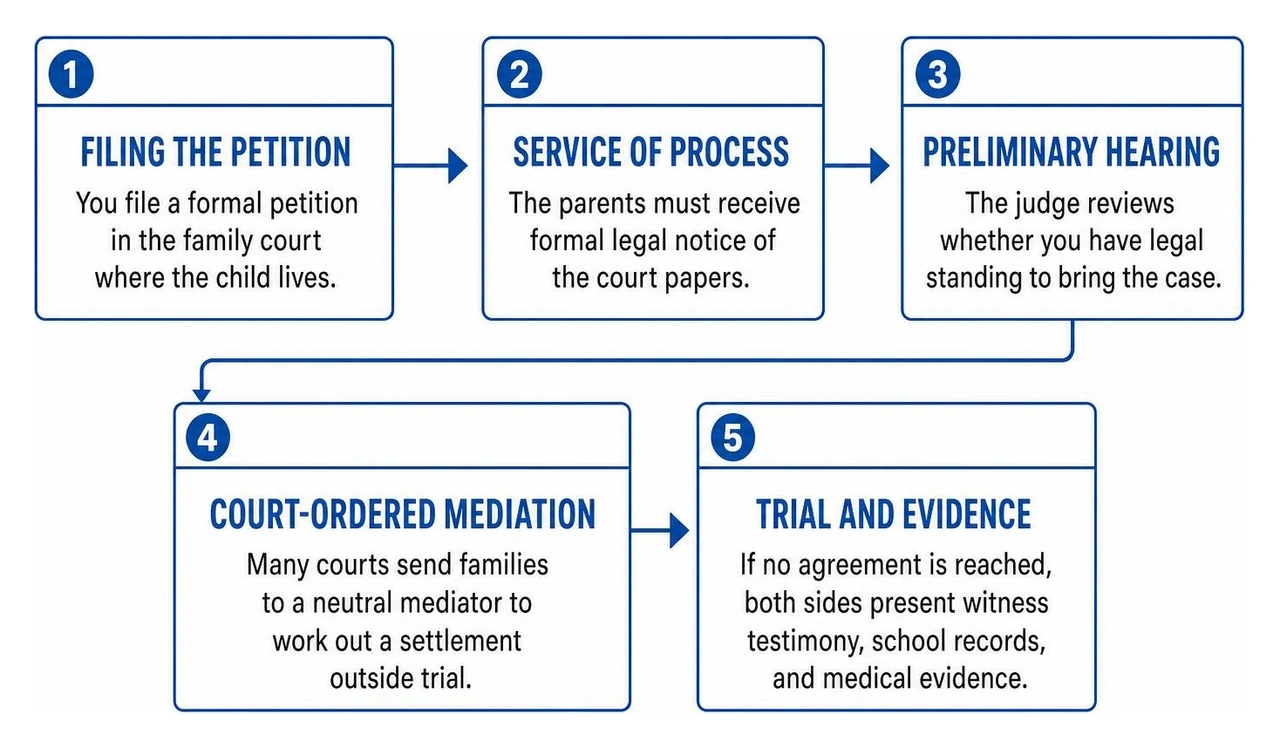
- Filing the Petition: You file a formal petition in the family court where the child lives.
- Service of Process: The parents must receive formal legal notice of the court papers.
- Preliminary Hearing: The judge reviews whether you have legal standing to bring the case.
- Court-Ordered Mediation: Many courts send families to a neutral mediator to work out a settlement outside trial.
- Trial and Evidence: If no agreement is reached, both sides present witness testimony, school records, and medical evidence.
Resolving Disputes Outside Court: Mediation and Family Agreements
Courtroom battles are expensive, slow, and often destroy family bonds forever. A news feature on a contested family court case revealed parents spending between $140,000 and $300,000 in legal fees. Mediation gives you a private setting to work out a regular schedule without emotional and financial devastation.
Frequently Asked Questions About Grandparents Rights
Can a parent legally deny grandparent visitation?
Yes. Fit parents have the legal authority to choose who spends time with their children. A grandparent must file a petition and prove special legal grounds to override that decision.
What happens if a parent ignores a court-ordered visitation schedule?
If a parent refuses to follow a signed court order, you can file a motion for contempt. Judges can order make-up visitation time, fine the parent, or make them pay your attorney fees.
How much does it cost to sue for grandparents' rights?
Traditional law firms charge high hourly rates with large upfront retainers that quickly run out. Contested trials can cost tens of thousands of dollars. At Zacarese & Zalewski P.C., we do things differently.
Led by Steven Zalewski—one of the most well-known family court trial lawyers in Suffolk County—we use an honest, upfront flat-fee model. Our flat fee covers all court appearances, no matter how many times we appear in Suffolk County Family Court in Islandia, Central Islip, or Riverhead.
Our pricing is split into two clear parts:
- Pre-Trial Fee: Covers all preparation, motions, conferences, and appearances leading up to trial.
- Trial Fee: A single, transparent set fee due 30 days before the scheduled trial date if the case cannot settle.
Other firms switch back to hourly rates or abandon their clients mid-case when money gets tight. Steve never leaves a client behind because they ran out of money, and manageable payment plans are always available.
Conclusion
Protecting your relationship with your grandchild starts with honest advice and clear legal standing. Before entering a courtroom, understand your rights, evaluate your options, and choose an advocate who will stand beside you through every step. For dedicated guidance, consider consulting a grandparent custody attorney to protect your family's future.
📱 Cell: (516) 660-4354 📧 Email: steve@zandzfamilylawyers.com 🏛 Address: 1601 Veterans Memorial Highway, Suite 500, Islandia, NY 11749
i guarantee you will be heard
Ready to Take the Next Step?
At Zacarese & Zalewski P.C., when something isn’t right, say something—and we’ll do something about it with you.
Our flat-fee structure is clear: one flat fee for pre-trial work, and a trial fee only if your case goes to trial or a hearing. Call now and a professional will return your call quickly; if we miss you, we'll call back the same day.