
When you speak, I guarantee you will be heard
Zacarese & Zalewski P.C.
Understanding Parents Rights Against Grandparents Visitation Claims
Call now: 516-660-4354
"He didn't just win my case. He gave me back my future, my peace of mind, and my ability to breathe again."
From the very first conversation, he changed everything. He didn't just see a case, he saw me, and treated me like family. His knowledge of the law was unmatched, but what truly set him apart was his humanity. If you are looking for a lawyer, stop searching right now.


Constitutional Precedents: Legal Protections of Parents Rights Over Grandparents

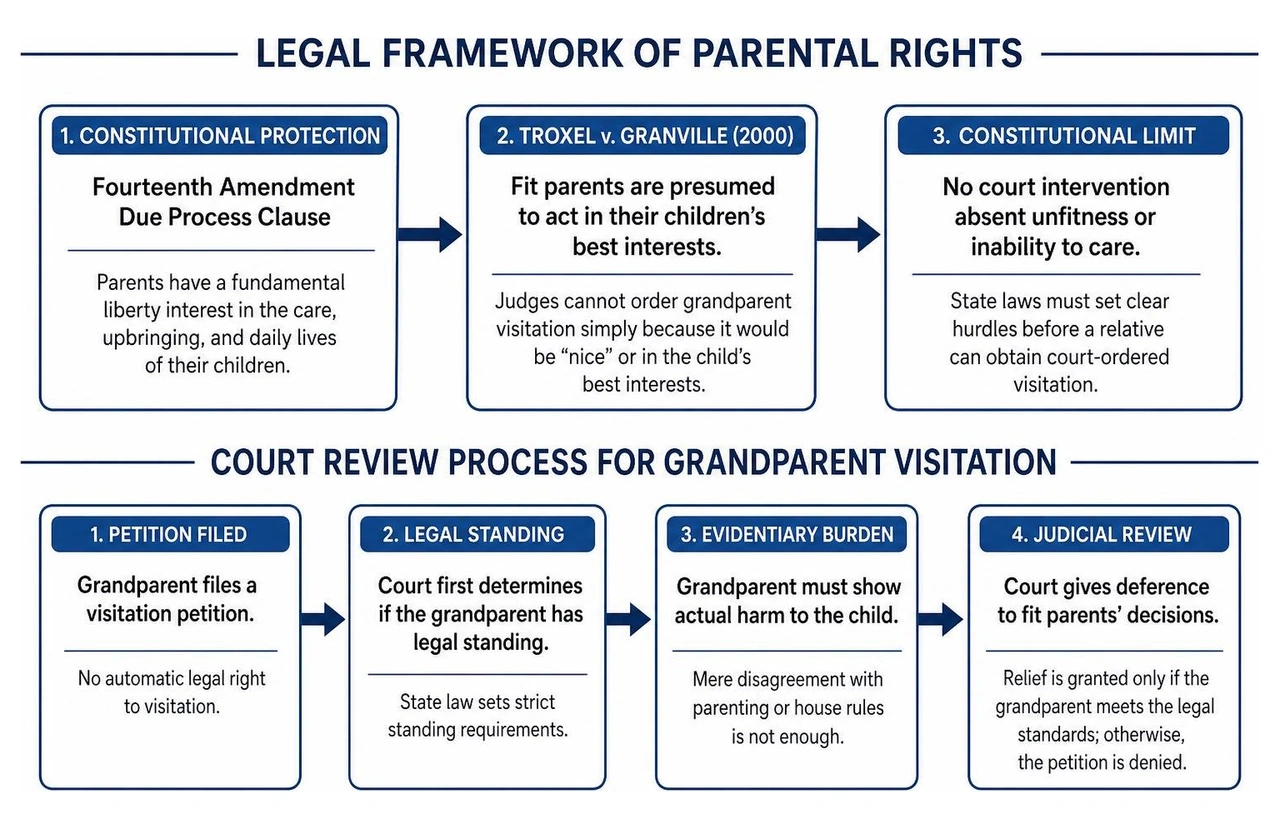
When family disagreements turn into legal battles, the United States Constitution stands firmly in your corner. As a mom or dad, your authority to raise your children is not just a personal belief—it is a protected constitutional right. Under the Fourteenth Amendment’s Due Process Clause, parents hold a fundamental liberty interest in directing the care, upbringing, and daily lives of their children.
The law understands that parents, not state judges or extended relatives, know what is best for their children. Unless you are shown to be unfit or unable to care for your child safely, judges cannot simply step in and replace your judgment with their own.
The Significance of Troxel v. Granville and Due Process
The landmark case protecting your family is the United States Supreme Court decision in Troxel v. Granville (2000). In that case, the Supreme Court struck down a state law that allowed any person to ask for visitation at any time as long as a judge thought it served the child's best interests.
The Supreme Court ruled that this approach was far too broad. The justices made it clear that fit parents are presumed to act in their children's best interests. A judge cannot give grandparents court-ordered visits simply because the judge thinks it would be nice. When asking whether grandparent visitation is an automatic legal right, the answer under federal constitutional law is clear: it is not. A parent’s voice carries the primary weight in court.
Constitutional Limits on Parents Rights Over Grandparents
Because of this constitutional protection, state laws must set clear legal hurdles before a relative can take a parent to court. A grandparent cannot simply walk into court and demand a schedule just because they disagree with your house rules.
Across the country, courts and legislatures continue to debate these boundaries. In high-profile cases highlighted in recent news reports on grandparent visitation conflicts, parents have spent significant time and resources protecting their right to make decisions for their families. Without strict legal limits, any family disagreement could end up in a courtroom. To protect parents, the law requires grandparents to meet specific legal standing rules and show actual harm to the child before a court will even consider intervening.
State Standards and Evidentiary Burdens for Nonparental Visitation
While the Constitution protects your basic rights, each state writes its own family court statutes. Understanding the specific legal tests used in state courts helps you protect your family when a petition is filed.
| Legal Standard | How the Court Applies It | Evidentiary Burden | Impact on Parents |
|---|---|---|---|
| Presumption of Parental Fitness | Assumes fit parents make safe, healthy choices for their children. | High burden on the non-parent to disprove. | Protects parental autonomy and family privacy. |
| Harm Threshold Standard | Requires proof that cutting off visits directly harms the child. | Clear and convincing evidence required from petitioner. | Prevents relatives from suing over simple family disagreements. |
| Best Interests Standard | Evaluates emotional ties, child health, and stability. | Considered only after passing legal standing thresholds. | Ensures the child's daily routine is not disrupted. |
The Presumption of Parental Fitness and Harm Thresholds
Under the law, a "fit parent" is someone who adequately cares for their child’s physical, emotional, and mental needs. When you make a parenting decision—such as saying no to overnight visits or stepping back from family conflict—the court must give special weight to your choice.
Grandparents who file for court-ordered time must usually overcome this presumption. In states like Florida, under statutes governing nonparental visitation, the law sets strict rules. Petitions are only allowed in very narrow situations, such as when parents are missing, deceased, or pose a direct threat of harm. When reviewing grandparent visitation and third-party rights, judges look for clear evidence of harm before they will question a fit parent's decisions.
When Do Courts Override Parents Rights Over Grandparents?
There are limited situations where courts may look deeper into a family dispute. A judge will only consider overriding parents rights over grandparents if there is strong proof that the parents are unfit, have abandoned their duties, or have created a serious risk of harm to the child.
In New York, for example, a court may only step in if a non-parent proves extraordinary circumstances in custody and visitation cases. These situations include prolonged separation where a grandparent acted as the primary daily caregiver for an extended period, child neglect, or severe disruptions. Outside of these rare and serious facts, the court must respect the choices of fit parents.
Balancing Extended Family in School and Community Settings
School and community activities often become battlegrounds during family estrangements. It is important to know that legal authority over school records, emergency contacts, and campus pickup lists belongs entirely to the parents.
- School Records: Under federal privacy laws, educational institutions can only release academic and medical records to legal parents or court-appointed guardians.
- Authorized Pickups: Schools and sports leagues must follow the parent's written instructions regarding who is allowed to pick up a child.
- Community Events: While schools may host Grandparents Day or open expos, these events do not grant legal visitation rights or override parental rules.
Setting clear, calm boundaries with school staff ensures your children stay protected without bringing personal family conflict into their daily classrooms.
Navigating Family Court Petitions and Parental Defense Strategies

Facing a family court petition can feel overwhelming. Having a clear legal strategy helps keep your family grounded and protected throughout the process.
Why You Should Never Use AI for Family Law Matters
When a legal petition arrives in the mail, it can be tempting to search online tools or use generative AI programs like ChatGPT to draft your answers, custody agreements, or separation papers. Doing so can seriously harm your case.
Generic AI chatbots do not understand local court rules, cannot evaluate evidence, and often miss critical statutory details. An automated computer program cannot stand beside you in a courtroom, show empathy for your family, or present the local nuances that a judge looks for. Protecting your children requires a real attorney who understands local family court rules and knows how to safeguard your rights.
Challenging Standing and Lack of Substantial Harm
If a non-parent files a court petition for visits, the first defense is often challenging their legal right to sue in the first place. You can ask the court to dismiss the case right away if the petition fails to show parental unfitness or actual harm to the child.
Working with a local Long Island grandparent custody attorney allows you to present a clear defense early. You can gather text messages, school logs, and personal records showing that you provide a stable, loving home, proving that the lawsuit lacks legal grounds.
Mediation and Protecting Parental Authority
Not every family dispute needs to end in a courtroom trial. Many parents find success using private dispute resolution to set healthy boundaries. Working through custody modification and mediation options allows parents to stay in full control of their schedules, holiday plans, and communication rules without handing their authority over to a judge.
Transparent Flat-Fee Legal Defense in Suffolk County
When facing a family court battle, unexpected legal bills can add unnecessary stress. At Zacarese & Zalewski P.C., we believe you deserve honest, clear support. Steven Zalewski is one of the most well-known family court trial lawyers in Suffolk County, regularly representing families at Suffolk County Family Court and across Islandia, Central Islip, and Riverhead.
We use a simple, transparent flat-fee model designed to protect your peace of mind:
- Pre-Trial Flat Fee: A single set fee that covers all case preparation, document filing, negotiations, and every court appearance leading up to trial—no matter how many court dates are required.
- Trial Flat Fee: A single set fee due 30 days before your scheduled trial date if your case proceeds to a hearing.
Unlike other law firms that bill by the hour, charge surprise fees for short phone calls, or revert to hourly rates when a case gets tough, Steve never leaves a client behind because they ran out of money. We also offer flexible payment plans to keep quality legal representation accessible. Having a dedicated Suffolk County custody lawyer focused on children's best interests ensures your parental rights are fully protected from day one.
Frequently Asked Questions About Parents Rights and Visitation
Can grandparents force visitation if both fit parents object?
No. When both parents are fit and united in their decision to deny or limit visits, courts will almost always dismiss the petition. Under constitutional law, judges must respect the shared decision of fit parents unless there is clear proof of unfitness or direct harm to the child.
What constitutes extraordinary circumstances in nonparental custody petitions?
Extraordinary circumstances require much more than a simple disagreement over family visits. In New York, this standard requires proof of serious issues, such as child abandonment, severe neglect, extended disruption of custody where a non-parent raised the child as their own for a prolonged period, or clear parental unfitness.
How do state laws vary regarding third-party visitation?
State laws vary significantly across the country. Some states have restrictive laws that only permit petitions when a parent has died or the home is disrupted. Other states require clear and convincing proof of direct psychological or physical harm to the child before granting a hearing.
Conclusion
Your right to raise, protect, and make decisions for your children is one of the highest liberties recognized by law. While family relationships are valuable, they never replace your authority as a parent. When facing nonparental visitation claims, understanding your rights and having the right legal support makes all the difference.
For dedicated legal support and trusted guidance on New York grandparent custody and parental defense, reach out to our team today:
📱 Cell: (516) 660-4354
📧 Email: steve@zandzfamilylawyers.com
🏛 Address: 1601 Veterans Memorial Highway, Suite 500, Islandia, NY 11749
i guarantee you will be heard
Ready to Take the Next Step?
At Zacarese & Zalewski P.C., when something isn’t right, say something—and we’ll do something about it with you.
Our flat-fee structure is clear: one flat fee for pre-trial work, and a trial fee only if your case goes to trial or a hearing. Call now and a professional will return your call quickly; if we miss you, we'll call back the same day.