
When you speak, I guarantee you will be heard
Zacarese & Zalewski P.C.
Finding Your Judge in the Suffolk County Court System
Call now: 516-660-4354
"He didn't just win my case. He gave me back my future, my peace of mind, and my ability to breathe again."
From the very first conversation, he changed everything. He didn't just see a case, he saw me, and treated me like family. His knowledge of the law was unmatched, but what truly set him apart was his humanity. If you are looking for a lawyer, stop searching right now.


How to Find Your Suffolk County Judge
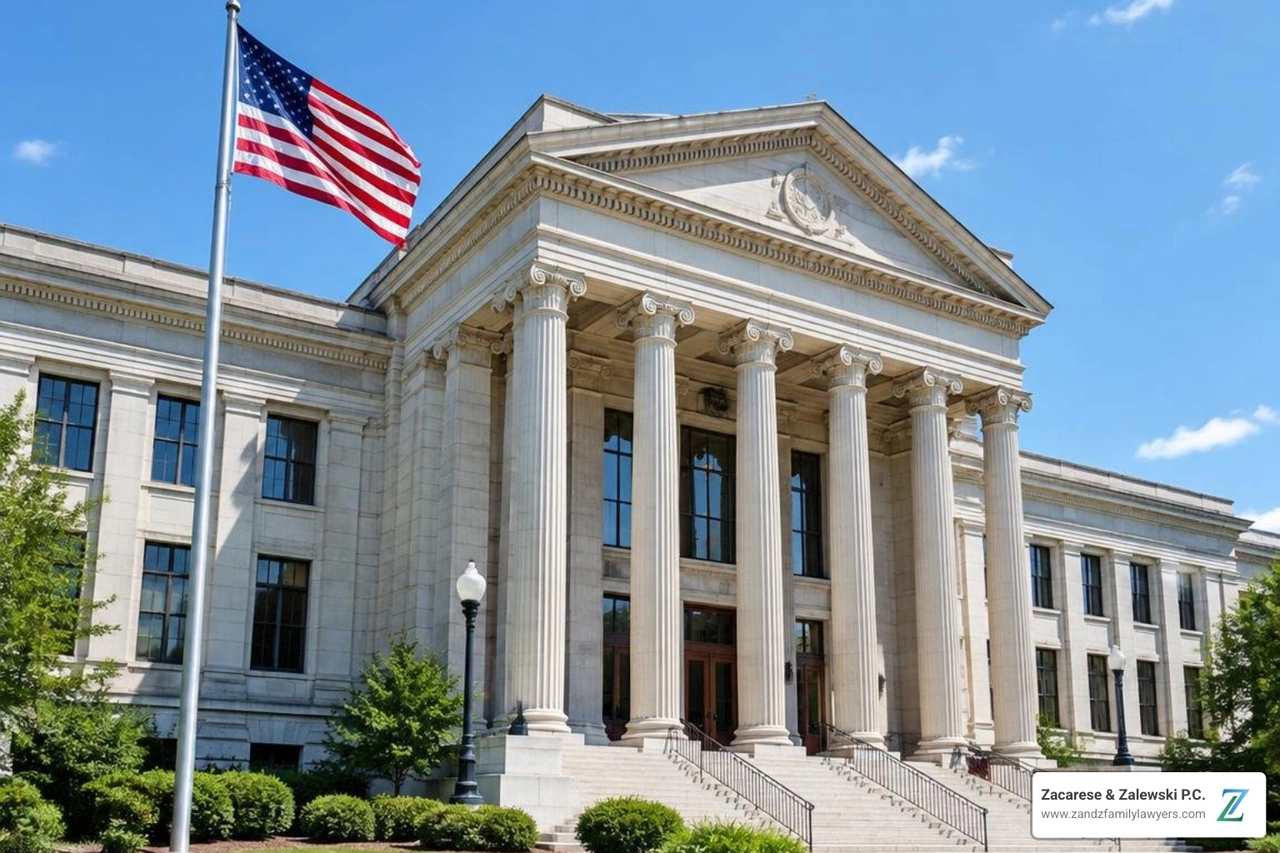
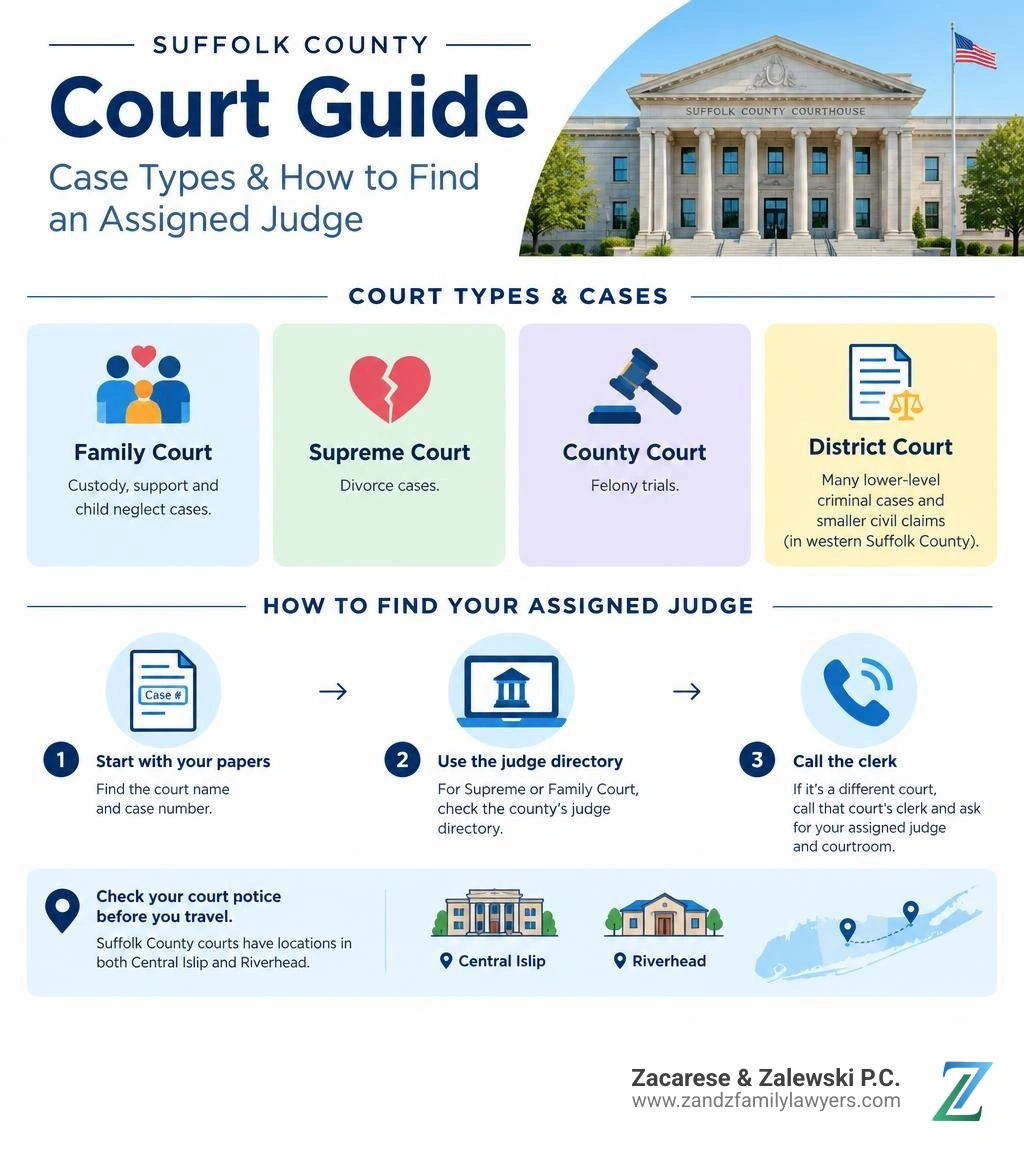
To find the Suffolk County judge assigned to your case, start with the court name and case number on your papers. For Supreme Court or Family Court, use the county’s judge directory. If your papers name a different court, call that court’s clerk and ask for your assigned judge and courtroom.
The type of case helps you know where to look. Family Court handles custody, support, and child neglect cases. Supreme Court handles divorce. County Court handles felony trials, while District Court handles many lower-level criminal cases and smaller civil claims in western Suffolk County. Check your court notice before you travel: Suffolk County courts have locations in both Central Islip and Riverhead.
Suffolk county judges vocab to learn:
- family court in Suffolk County
- is family court open in suffolk county
- child support lawyer in Suffolk County
Overview of the Suffolk County Court Structure and Jurisdictions
Going to court can feel overwhelming. Suffolk County has about 1.5 million residents, and our local courts handle thousands of cases every week. Understanding how the court system works makes the process much less stressful.
Suffolk County makes up the 10th Judicial District in New York. Each court level handles specific kinds of legal disputes. Below is a quick look at how the different courts divide their work:
| Court Level | Main Case Types Handled | Money Limits | Typical Locations |
|---|---|---|---|
| Supreme Court | Divorces, major civil lawsuits, guardianships | Over $25,000 | Riverhead & Central Islip |
| County Court | Felony criminal trials, major indictments | Up to $25,000 (civil) | Riverhead |
| District Court | Misdemeanors, felony arraignments, evictions | Up to $15,000 ($5,000 small claims) | Central Islip & western towns |
| Family Court | Child custody, child support, visitation, CPS neglect | No dollar limit on support | Central Islip & Riverhead |
Supreme Court vs. County Court Authority
People often mix up the Supreme Court and the County Court.
The Suffolk County Supreme Court is the main trial court for major civil lawsuits involving large dollar amounts. It is also the only court that can grant a legal divorce, divide marital property, and decide complex post-divorce matters.
In contrast, the Suffolk County Court focuses mainly on serious criminal matters. While it shares some misdemeanor duties with local town courts, it holds the sole power to conduct trials for felony charges. It also has limited civil authority for claims up to $25,000. Decisions from both of these courts are reviewed on appeal by the Appellate Division, Second Department.
District Court and Local Justice Courts
If you have a smaller civil dispute or a misdemeanor charge in western Suffolk County, your case goes to District Court. The District Court covers the five western towns: Babylon, Brookhaven, Huntington, Islip, and Smithtown.
District Court handles:
- Civil lawsuits claiming up to $15,000
- Small claims cases up to $5,000
- Landlord-tenant eviction disputes
- Misdemeanor crimes and initial felony arraignments
In the eastern towns of Riverhead, Southold, East Hampton, Southampton, and Shelter Island, local Town and Village Justice Courts handle small claims and local traffic or criminal violations.
Key Courts and Presiding Suffolk County Judges
Suffolk County judges manage heavy caseloads. Administrative and supervising judges ensure cases move smoothly and fairly through the system.
Supreme and Matrimonial Parts for Suffolk County Judges
Contested divorces and marital property divisions are heard in the Supreme Court’s Matrimonial Parts. In Suffolk County, these proceedings are centralized at the John P. Cohalan Jr. Court Complex in Central Islip.
Hon. Cheryl A. Joseph serves as the Supervising Judge for the Matrimonial Parts. You can view her career and background in the Hon. Cheryl A. Joseph Judicial Directory. She works alongside Supervising Judge Hon. Thomas F. Whelan to oversee civil courtroom parts. These judges help families resolve tough disputes over equitable distribution, spousal maintenance, and legal separation.
How Suffolk County Judges Manage Family Court Proceedings
When parents are not married, or when child welfare is involved, cases go to Family Court. Our Suffolk County Family Court guide provides detailed information on how these parts operate.
In Family Court, judges and support magistrates hear matters involving:
- Child custody and parenting schedules
- Child support establishment and modifications
- Paternity petitions
- Child Protective Services (CPS) abuse and neglect cases
- Family offenses and orders of protection
Judges look closely at the child's daily routine, home life, and schooling when making decisions. You can read more about how custody is decided in Suffolk County Family Court to see what factors judges evaluate most. For general procedural help, consult our guide to the Suffolk County New York Family Court.
Specialized Parts: Veterans Court, Diversion, and Youth Parts
Suffolk County has pioneered specialized problem-solving courts. These parts help address root causes like trauma, mental health challenges, or substance abuse.
Former District Administrative Judge Hon. C. Randall Hinrichs helped expand many of these programs over his decades on the bench, including the East End Veterans Court. Other specialized programs include:
- Veterans Court: Connects military veterans charged with non-violent offenses to treatment and counseling.
- Judicial Diversion Program: Provides structured substance use rehabilitation instead of jail time for eligible non-violent offenses.
- Felony Youth Part: Addresses criminal matters involving adolescent offenders under specific youth-justice laws.
- Sex Offense Court: Coordinates specialized judicial oversight and victim services for specific offense categories.
Courthouse Locations, Operating Hours, and Case Lookup
Court facilities are open Monday through Friday from 9:00 AM to 5:00 PM, excluding official state holidays.
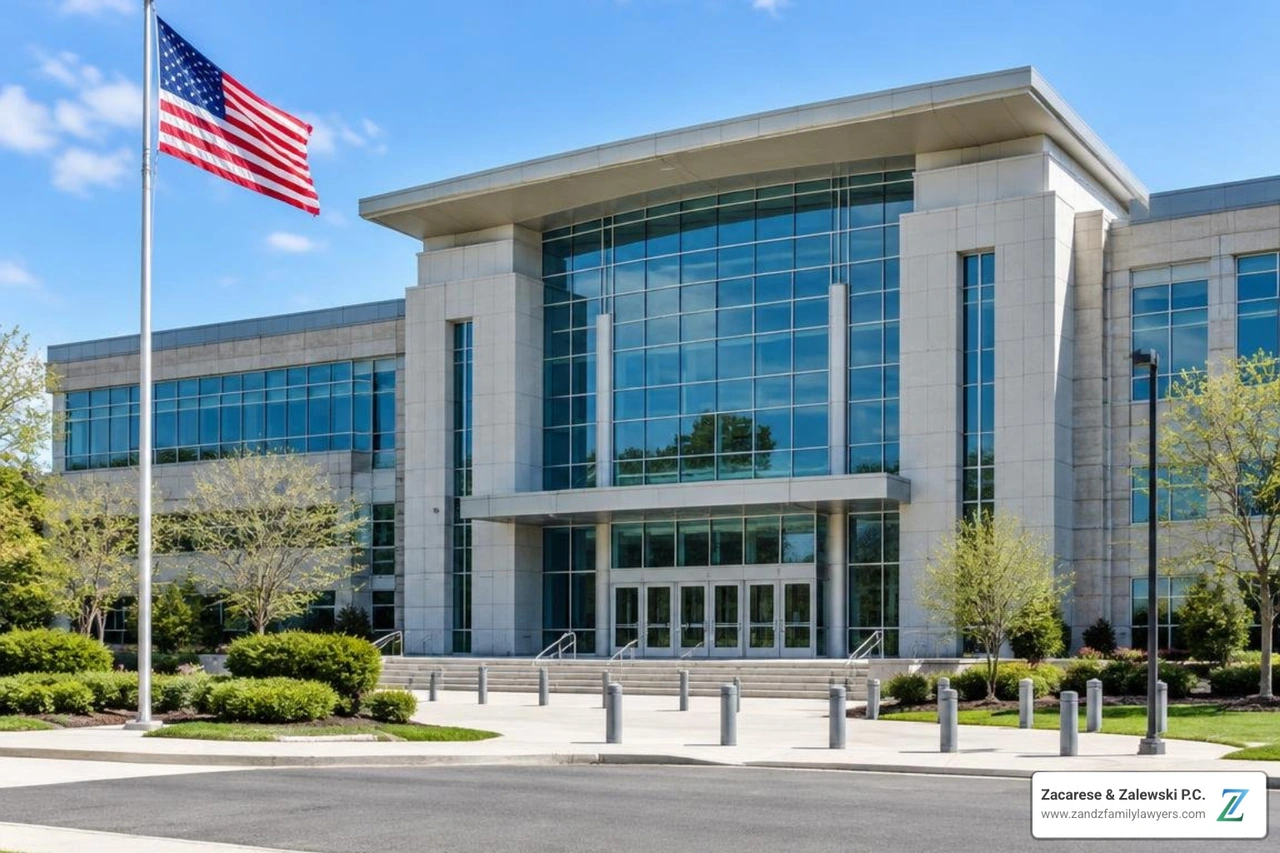
The primary court locations in Suffolk County are:
- Central Islip (John P. Cohalan Jr. Court Complex / Hon. Marquette L. Floyd Supreme Court Building): 400 Carleton Avenue, Central Islip, NY 11722. (Houses Family Court, District Court, and Supreme Court Matrimonial Parts).
- Riverhead (Arthur M. Cromarty Criminal Court Complex): 210 Center Drive, Riverhead, NY 11901. (Houses County Court and Criminal Supreme Parts).
- Riverhead (Hon. Alan D. Oshrin Supreme Court Building): 1 Court Street, Riverhead, NY 11901. (Houses Civil Supreme Court Parts).
Finding Your Assigned Judge and Checking Case Status
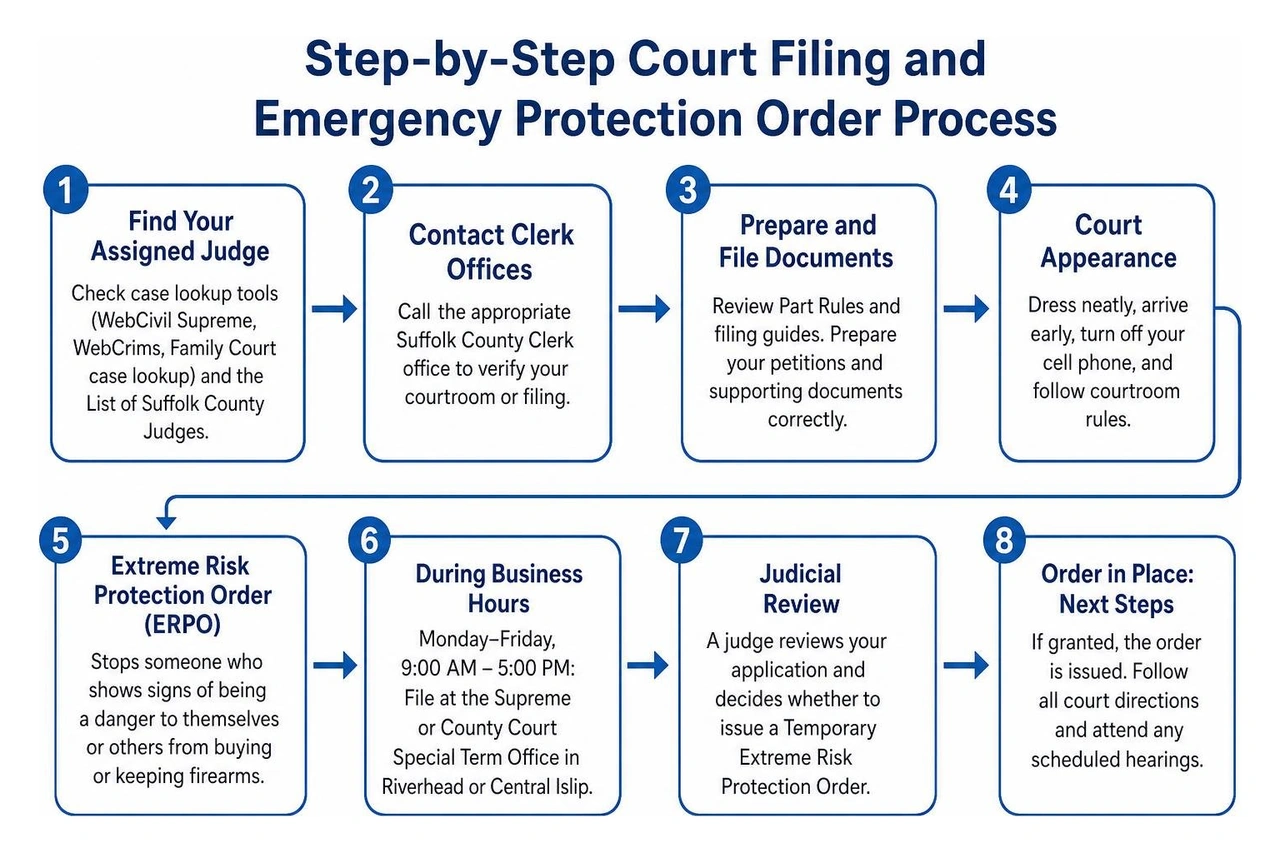
You can check which judge is handling your case using public online tools:
- Look up active Supreme Court civil cases on the state's WebCivil Supreme system.
- Check active criminal cases through WebCrims.
- For custody or support disputes, use the Suffolk County Family Court case lookup to check your calendar date and part assignment.
- View published parts and contact lines on the official List of Suffolk County Judges.
Contact Information for Main Suffolk County Clerk Offices
If you have questions about your courtroom or need to verify a filing, you can call the clerk offices directly:
- County Court Chief Clerk’s Office: 631-852-2120
- County Court Criminal Office: 631-852-1462
- Special Term Office (Motions and Appeals): 631-852-2130
- Supreme Court Chief Clerk’s Office: 631-852-2334
- Suffolk County Clerk’s Office for Records: 631-852-2000
- District Court General Information: 631-208-5775
Navigating Court Appearances, Filing Rules, and Protection Orders
Knowing what to expect before you walk through the courthouse metal detectors will help you stay calm. Dress neatly, arrive early, and turn off your cell phone before entering the courtroom.
If you are heading to court for the first time, take a moment to review what to expect at your first Family Court hearing in Suffolk County. Each judge has specific courtroom rules (called Part Rules) regarding how evidence is marked, how motions are filed, and when attorneys must check in. You can also review our Suffolk County Family Court filing guide to ensure your initial petitions are prepared correctly.
Extreme Risk Protection Orders and Emergency Filings
An Extreme Risk Protection Order (ERPO) stops someone who shows signs of being a danger to themselves or others from buying or keeping firearms.
- During Business Hours (Monday–Friday, 9:00 AM – 5:00 PM): Applications for a Temporary Extreme Risk Protection Order should be filed at the Supreme or County Court Special Term Office in Riverhead or Central Islip.
- Off-Hours and Emergencies: If you need an emergency order at night, over the weekend, or on a holiday, call 911 or contact the Office of Court Administration emergency line at 1-800-430-8457.
Risks of Using AI for Family Court Filings
With the rise of artificial intelligence tools like ChatGPT, some parents try using AI to draft custody petitions or separation agreements. This is risky.
AI programs generate robotic, one-size-fits-all text. They do not know local New York statutes, and they cannot understand the specific rules used by Suffolk County judges. A generic AI agreement often misses critical terms about holiday schedules, medical decision-making, or school choices. Once a flawed document is signed or filed, fixing it can take months or years. Only an experienced human attorney with real local courtroom knowledge can properly protect your rights and your children's future.
Experienced Trial Advocacy in Suffolk County Courts
When your family's future is on the line, having a strong advocate by your side makes all the difference. Steven Zalewski is one of the most well-known family court trial lawyers in Suffolk County, regularly representing parents and spouses in Central Islip, Riverhead, and our home office location in Islandia.
At Zacarese & Zalewski P.C., we do things differently than traditional law firms:
- Transparent Flat-Fee Model: You get a clear, upfront quote. Your flat fee covers all your court appearances, no matter how many times your case is adjourned or called back before the judge.
- Two-Part Fee Structure: We charge an initial Pre-Trial Fee that covers all legal work and court dates leading up to trial. If your case cannot settle and must go to a full hearing, we set a single Trial Fee, which is due 30 days before your trial date.
- No Abandonment: Many law firms bill by the hour, blow through retainers, and withdraw when a client runs out of money. Steve never leaves a client behind mid-case because funds get tight.
- Payment Plans Available: We offer flexible payment plans to keep quality legal defense affordable for working parents.
Frequently Asked Questions About Suffolk County Judges
How do I find out which judge is assigned to my Suffolk County case?
Check the top right corner of your court summons, petition, or notice of appearance for a Part Number or Judge name. You can also search your index or docket number on WebCivil Supreme or WebCrims, or call the relevant court clerk's office with your name and filing date.
How are judges selected and what are their term lengths in Suffolk County?
In New York, judges are chosen through partisan elections:
- Supreme Court Justices: Elected to 14-year terms after nomination at judicial district conventions.
- County Court and Family Court Judges: Elected county-wide to 10-year terms.
- District Court Judges: Elected by voters in the five western towns to 6-year terms.
- Mandatory Retirement: New York judges face a mandatory retirement age of 70 (though Supreme Court justices may apply for two-year extensions up to age 76).
Where are matrimonial and divorce cases heard in Suffolk County?
All contested and uncontested Supreme Court matrimonial matters are heard at the John P. Cohalan Jr. Court Complex / Hon. Marquette L. Floyd Supreme Court Building at 400 Carleton Avenue in Central Islip.
Conclusion
Understanding how Suffolk County courts work gives you the confidence to handle your legal matter. Whether your case is in Central Islip or Riverhead, knowing which court has jurisdiction and what your judge expects helps you prepare effectively. For more details on court rules and timelines, read our Suffolk Family Court guide for 2026. If you need reliable representation for a custody, support, or divorce matter, reach out to our team today.
📱 Cell: (516) 660-4354 📧 Email: steve@zandzfamilylawyers.com 🏛 Address: 1601 Veterans Memorial Highway, Suite 500, Islandia, NY 11749
i guarantee you will be heard
Ready to Take the Next Step?
At Zacarese & Zalewski P.C., when something isn’t right, say something—and we’ll do something about it with you.
Our flat-fee structure is clear: one flat fee for pre-trial work, and a trial fee only if your case goes to trial or a hearing. Call now and a professional will return your call quickly; if we miss you, we'll call back the same day.