
When you speak, I guarantee you will be heard
Zacarese & Zalewski P.C.
Cracking the Code on NY Child Support Calculations and Worksheets
Call now: 516-660-4354
"He didn't just win my case. He gave me back my future, my peace of mind, and my ability to breathe again."
From the very first conversation, he changed everything. He didn't just see a case, he saw me, and treated me like family. His knowledge of the law was unmatched, but what truly set him apart was his humanity. If you are looking for a lawyer, stop searching right now.


How to Estimate Child Support in New York

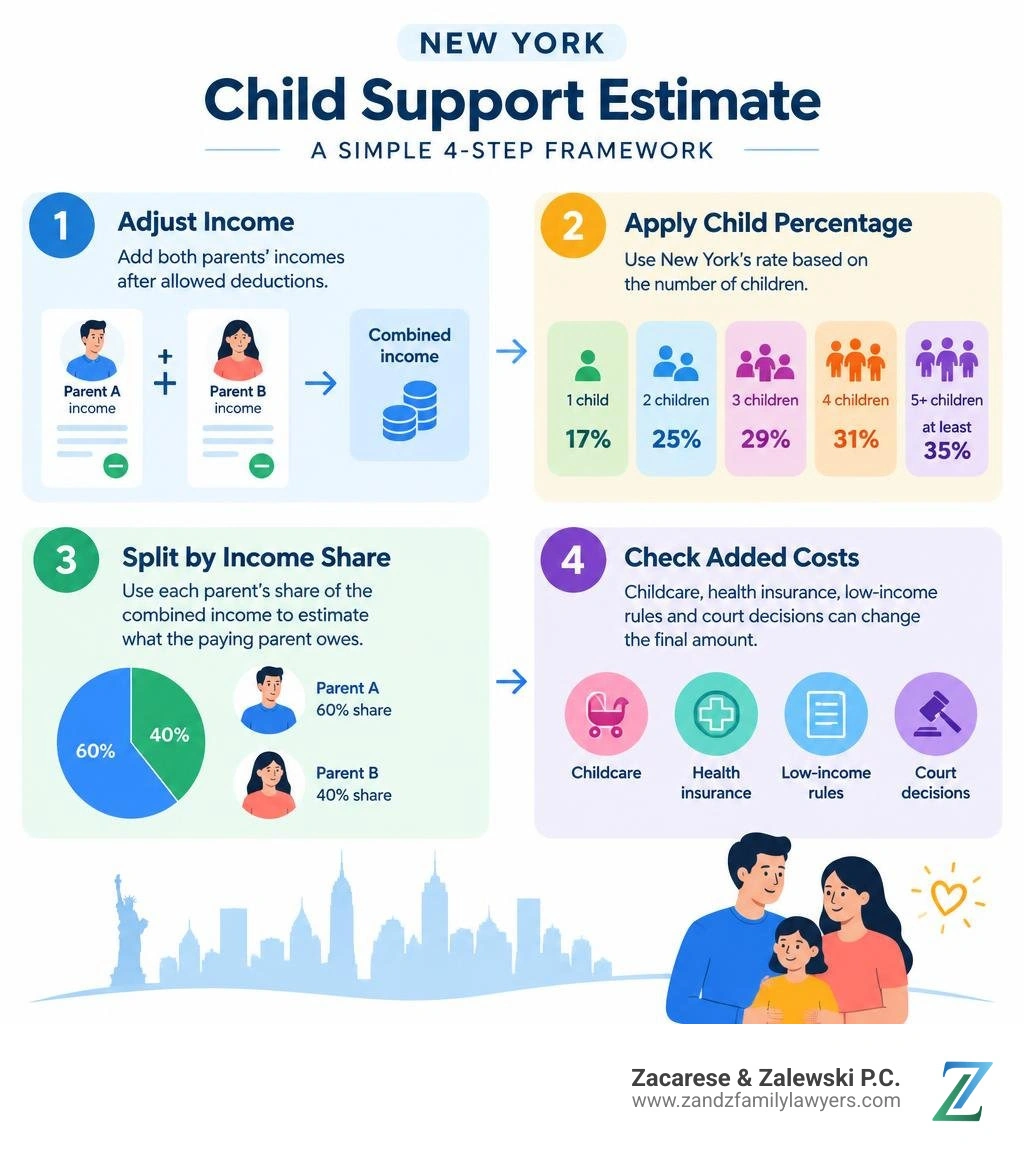
To estimate child support in New York, add both parents' incomes after allowed deductions. Apply the state's rate: 17% for one child, 25% for two, 29% for three, 31% for four, or at least 35% for five or more. Then use each parent's share of the combined income to estimate what the parent paying support owes.
That gives you a starting amount, not a final payment. Childcare, health insurance, low-income rules, and court decisions can change it. In 2026, the standard percentages apply to combined income up to $193,000; a court decides how to handle income above that amount. Use New York's Child Support Standards Chart to check your estimate. This is the basic framework for any child support calculation NY parents need to understand.
Step-by-Step Child Support Calculation NY Framework
Figuring out child support can feel overwhelming, but New York uses a clear formula. The state follows the Child Support Standards Act (CSSA). This law makes sure children get the same financial help they would have received if their parents stayed together.
To run a proper child support calculation NY, you follow a four-step process:
- Find gross income: Add up all income earned by both parents from jobs, bonuses, investments, or businesses.
- Subtract allowable taxes and costs: Take out specific mandatory deductions, such as FICA taxes, to reach each parent's adjusted gross income.
- Combine incomes and apply the percentage: Add both adjusted incomes together and apply the state percentage based on how many children you have.
- Split the cost proportionally: Divide that total dollar amount between both parents based on who earns what share of the combined income. The parent who does not have primary custody pays their share to the custodial parent.
Parents who need help calculating child support in East Northport often start by looking at how the state divides these percentages.
Statutory Percentages Across Family Sizes
The CSSA sets fixed percentages based on how many children need support:
| Number of Children | NY Statutory Percentage |
|---|---|
| 1 Child | 17% |
| 2 Children | 25% |
| 3 Children | 29% |
| 4 Children | 31% |
| 5 or More Children | At least 35% |
For example, imagine two parents have two children together. Parent A earns $60,000 after deductions, and Parent B earns $40,000 after deductions. Their combined income is $100,000.
Under the 25% rule for two children, their basic yearly child support need is $25,000. Because Parent A earns 60% of the combined money, Parent A is responsible for 60% of that $25,000, which equals $15,000 per year. If Parent B has primary physical custody, Parent A pays Parent B $15,000 per year.
Mandatory Deductions and Adjusted Gross Income
You do not calculate child support using your raw paycheck before taxes. The state allows specific items to be subtracted first. These include:
- FICA taxes (Social Security and Medicare withheld from wages)
- Local income taxes paid to New York City or Yonkers
- Court-ordered child support already paid for children from another relationship
- Court-ordered spousal maintenance (alimony) paid to an ex-spouse
Taking these deductions gives you your adjusted gross income. If you live on Long Island and are calculating child support payments in Smithtown, making sure every legal deduction is properly counted prevents you from overpaying or underreceiving.
The 2026 Income Benchmarks: Caps, Poverty Guidelines, and Reserves
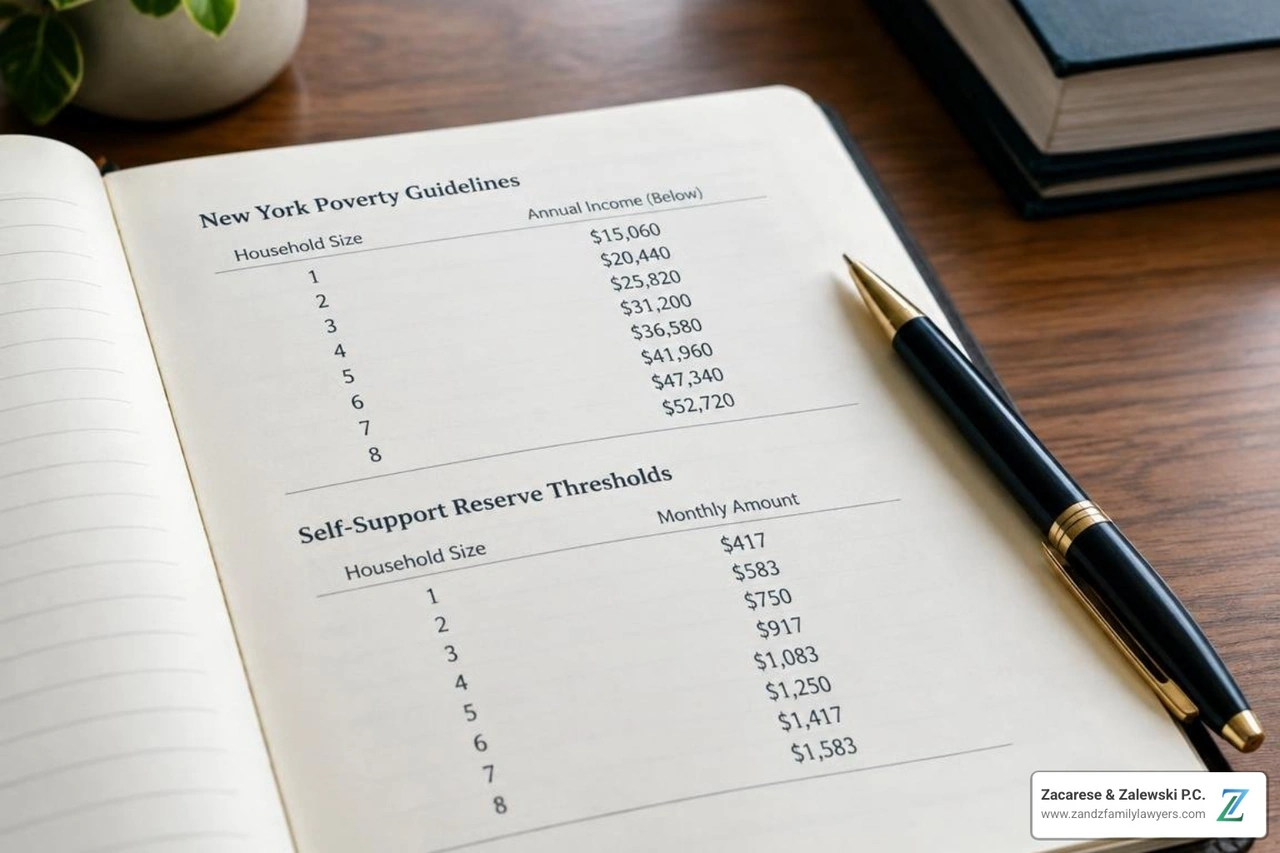
New York updates its official child support benchmarks to match changes in the cost of living. In 2026, specific statutory thresholds protect low-income parents while giving judges guidance on high earners.
Low-Income Thresholds and Self-Support Reserves
The state makes sure parents who pay support still have enough money left over to buy food and pay rent. Two key safety net numbers apply in 2026:
- 2026 Federal Poverty Level for a single person: $15,960
- 2026 New York Self-Support Reserve: $21,546
If paying the standard child support amount would pull a paying parent's income below the self-support reserve ($21,546), the court sets the basic payment at $50 per month. If paying support would push them below the poverty level ($15,960), the court sets the payment at $25 per month. These safeguards keep people from falling into total poverty while still providing some support for their children.
Navigating High Earners and the $193,000 Cap in Child Support Calculation NY
In 2026, the standard statutory income cap is $193,000 in combined parental income.
Up to $193,000, judges almost always apply the standard percentages (17%, 25%, 29%, 31%, or 35%+). But when parents make more than $193,000 together, the law gives the judge a choice. The judge can apply the percentage to the entire income, cap the calculation at $193,000, or pick a middle amount based on the children's actual lifestyle and needs.
When handling complex child support cases, this discretionary cap makes a massive difference. A family making $350,000 per year will not automatically pay support on all $350,000. The court will look at factors like the child's extracurriculars, private school tuition, and standard of living before deciding.

Beyond Basic Support: Mandatory Add-Ons and Section 413 Factors
The basic percentage is only the starting point. New York law requires parents to share additional out-of-pocket costs on top of the base child support payment.
Prorating Childcare, Health Insurance, and Medical Costs
These extra costs are called "add-ons." They get split between both parents based on their share of income:
- Work-related childcare: Daycare, babysitters, or after-school programs needed so a parent can work or attend job training.
- Health insurance: The extra cost to keep the child on a parent's health plan.
- Unreimbursed medical expenses: Copays, dental work, braces, glasses, and prescription costs (usually anything over $250 per year).
Parents can use tools like the NYS DCSE Income Withholding Calculator to see how payments and insurance withholdings work out on regular paychecks.
Judicial Discretion and Deviation Factors
Under Family Court Act Section 413, a judge can change the child support amount if following the formula strictly would be unfair. The court looks at:
- The financial resources of both parents and the child
- The child's physical and emotional health, or special needs
- The standard of living the child would have enjoyed if the family stayed together
- Tax consequences for each parent
- Non-monetary contributions each parent makes to the child's care
- Extraordinary travel costs for visitation
When you are working with a child support lawyer in Suffolk County, showing clear proof of these factors can help the judge adjust the order fairly.
Official Worksheets, Chart Interval Calculations, and Modifications
The New York State Office of Temporary and Disability Assistance publishes the official LDSS-4515 Child Support Standards Chart. This document provides exact dollar ranges to help parents and courts look up basic obligations without doing manual math.
Using the State Standards Chart for Child Support Calculation NY
The state chart groups income into narrow brackets and calculates support using the lower dollar amount of each range:
- For combined income between $25,600 and $25,699, the baseline annual obligation for one child is $4,054.
- For combined income between $50,000 and $50,099, the baseline annual obligation for two children is $12,500.
Checking these brackets gives parents reliable reference points. For a broader look at local rules, check our 2026 child support legal guidance.
Filing for Modifications When Circumstances Change
Child support orders are not locked in stone forever. You can ask the court to adjust an order if you meet any of these rules:
- A major change in your life: Such as a job loss, an involuntary pay cut, or a major change in your child's medical needs.
- Three years have passed: Either parent can ask for a review once three years pass since the order was entered or changed.
- A 15% change in income: If either parent's income goes up or down by 15% or more since the last order.
Read our guide on the rules for modifying child support in New York or consider petitioning with a child support modification attorney to make sure your paperwork is filed correctly.
Understanding Legal Representation and Local Family Court Realities
Navigating child support proceedings requires real courtroom experience. Steven Zalewski is widely known as one of the top family court trial lawyers in Suffolk County. He handles cases daily in Suffolk County Family Court, representing parents in Islandia, Central Islip, and Riverhead.
When choosing a lawyer, billing surprises are the last thing a stressed parent needs. At Zacarese & Zalewski P.C., we use an honest flat-fee structure:
- Pre-Trial Fee: Covers everything leading up to your trial—paperwork, negotiations, and all court appearances, no matter how many dates it takes.
- Trial Fee: A single set fee due 30 days before your scheduled trial date if your case cannot settle out of court.
Unlike traditional law firms that bill by the hour or quit mid-case when your retainer runs dry, Steve never leaves a client behind because they ran out of money. We also offer payment plans so every family can get quality legal help.
A Warning About AI Tools: Do not rely on AI chatbots like ChatGPT to draft your child support agreements, parenting plans, or separation forms. Generic AI tools miss critical New York statutes, ignore local Suffolk County court rules, and create errors that can cost you thousands of dollars down the road. Only an experienced human lawyer who knows the local judges and court clerks can protect your rights and your children's future.
Frequently Asked Questions About NY Child Support
How long does the legal obligation to pay child support last in New York?
In New York, child support continues until the child turns 21 years old. This is longer than most states, which stop support at 18. Support can end earlier only if the child becomes legally emancipated through full-time military service, marriage, or becoming completely self-supporting. Parents can also agree in writing to share college costs past age 21.
What enforcement actions happen if child support is not paid in New York?
New York enforces support orders strictly. If a parent falls behind on payments, the state can garnish wages, take state and federal tax refunds, freeze bank accounts, and suspend driver's or professional licenses.
For willful non-payment, the court can find a parent in contempt, which carries possible jail time. Learn more about the consequences of unpaid child support in NY or speak with a child support enforcement lawyer if you need help collecting back support.
How is child support calculated in 50/50 shared physical custody arrangements?
Even when parents share exact 50/50 physical custody, child support is still paid. Under New York's landmark case Bast v. Rossoff, the parent who earns more money is considered the "non-custodial" parent for child support purposes.
The court calculates the support obligation using standard CSSA percentages, and the higher-earning parent pays their share to the lower-earning parent. If you share equal custody, consulting a child support attorney in East Northport will help you understand what your actual payment will look like.
Conclusion
Getting child support right protects your financial stability and provides your children with the care they deserve. Whether you are establishing a new order, modifying an existing one, or dealing with enforcement, having the right legal team makes all the difference.
At Zacarese & Zalewski P.C., we offer clear flat-fee pricing, rapid same-day answers, and dedicated representation. To learn more about local court processes, explore our Suffolk County Family Court legal guide.
📱 Cell: (516) 660-4354 📧 Email: steve@zandzfamilylawyers.com 🏛 Address: 1601 Veterans Memorial Highway, Suite 500, Islandia, NY 11749
i guarantee you will be heard
Ready to Take the Next Step?
At Zacarese & Zalewski P.C., when something isn’t right, say something—and we’ll do something about it with you.
Our flat-fee structure is clear: one flat fee for pre-trial work, and a trial fee only if your case goes to trial or a hearing. Call now and a professional will return your call quickly; if we miss you, we'll call back the same day.