
When you speak, I guarantee you will be heard
Zacarese & Zalewski P.C.
Custodial Parent or Legal Guardian and Which Status Applies to You
Call now: 516-660-4354
"He didn't just win my case. He gave me back my future, my peace of mind, and my ability to breathe again."
From the very first conversation, he changed everything. He didn't just see a case, he saw me, and treated me like family. His knowledge of the law was unmatched, but what truly set him apart was his humanity. If you are looking for a lawyer, stop searching right now.


Custodial Parent vs Legal Guardian: Which Applies to You?

A custodial parent is a parent with a legal right to care for a child, make decisions, or both. A legal guardian is usually someone else whom a court gives authority to care for the child. That is the key difference in custodial parent vs legal guardian.
Custody often comes up when parents separate. Guardianship may be needed when a parent cannot care for a child and a relative or another adult must step in. Both can cover daily care and major decisions, but the court order sets each person's authority. In New York, the right path depends on who can care for the child now and what help the child needs.
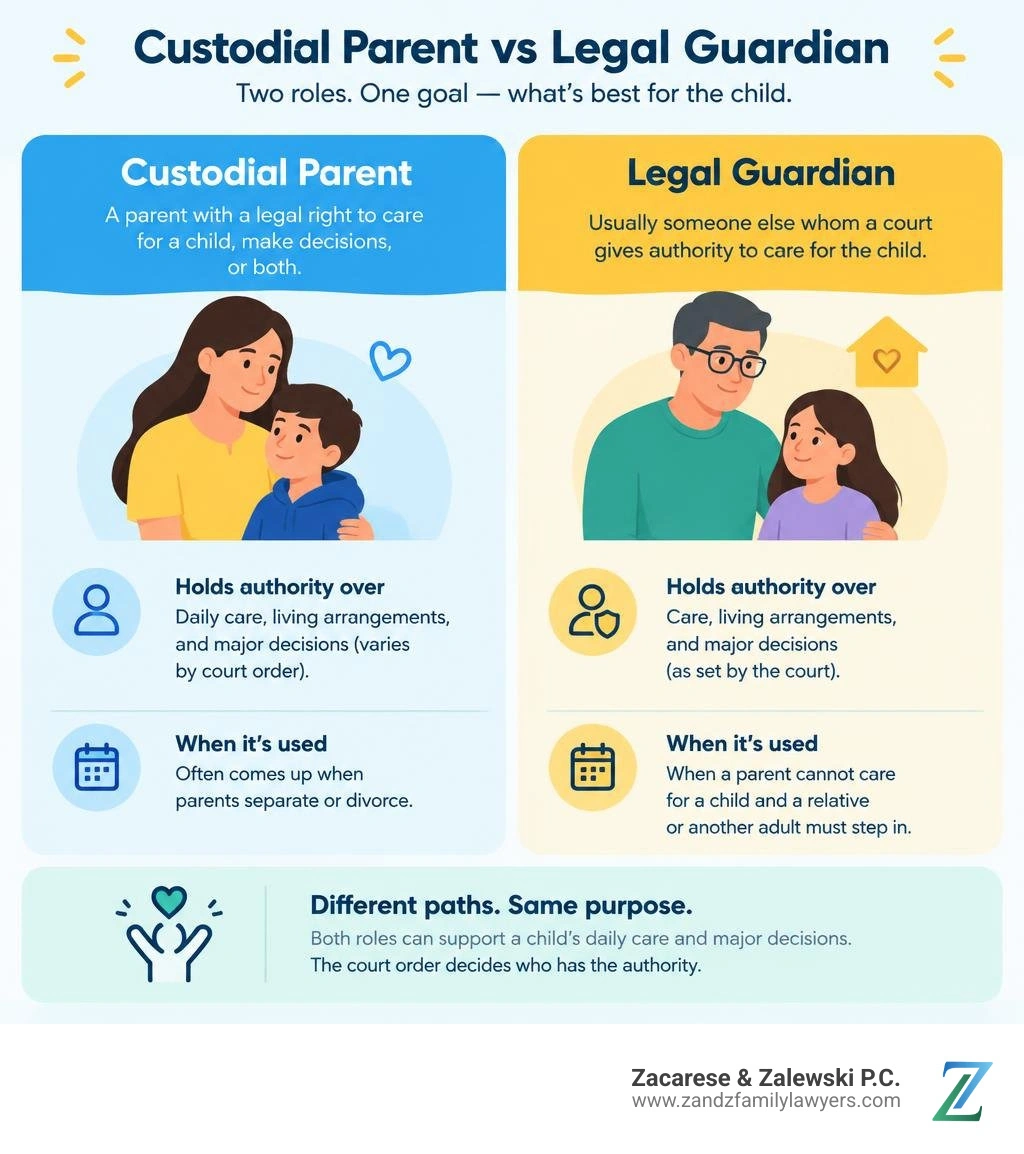
Custodial parent vs legal guardian terminology:
Custodial Parent vs Legal Guardian: Key Legal Differences
When you are caring for a child, knowing your exact legal status is very important. While both roles involve loving and protecting a child, the law treats a custodial parent and a legal guardian differently.
A custodial parent is almost always the child's biological or adoptive parent. When parents divorce or live apart, family court establishes which parent has physical and legal custody. On the other hand, according to the legal definition of a guardian, a guardian is an adult appointed by a judge to take over care when the parents cannot do the job.
Here is a quick look at how the two roles compare:
| Feature | Custodial Parent | Legal Guardian |
|---|---|---|
| Who Holds the Role? | Biological or legally adoptive parent. | A relative (like a grandparent) or another trusted adult. |
| Parental Rights | Active and fully intact. | Paused or suspended for the biological parents. |
| Court Oversight | Low after the final custody order is signed. | Ongoing; often requires annual accounting or reports to the court. |
| Duration | Permanent until the child turns 18 or orders change. | Lasts until age 18, or ends earlier if parents regain fitness or the court dismisses it. |
| Legal Duty | Standard parental rights and care duties. | Strict fiduciary duty to act only in the child's best interests. |
In New York, families often start by understanding joint vs sole custody in New York. Custody defines the everyday balance between two parents. Guardianship steps in when a third party must take the wheel because neither parent is available.
Scope of Decision-Making Authority and Parental Rights
Decision-making power is split into two main buckets: physical care and legal choices.
Physical custody means where the child sleeps, eats, and lives every day. Legal custody gives the adult the right to make big life choices. These choices cover things like where the child goes to school, what religion they practice, and what medical care they receive.
When parents share custody, finding out who makes school, medical, and other major decisions when parents share custody in New York depends on whether the judge granted joint or sole legal custody.
In a guardianship, the biological parents have their rights paused, not terminated. Think of it like a pause button on a remote control. The parents are still the legal parents on the birth certificate, but their power to make day-to-day choices is put on hold. The guardian handles all major decisions and may also manage money left to the child, which is called the ward's estate.
Decision-Making Powers: Custodial Parent vs Legal Guardian

Both custodial parents and legal guardians have the power to sign everyday paperwork. They can enroll the child in school, take them to the dentist, and sign field trip slips.
However, schools and doctors have strict rules about who gets the final say. Under state and district guidelines, such as standard school resolution policies for parental conflicts, schools look at court orders to resolve disagreements. If joint custodial parents cannot agree on a school activity, the school usually follows the choice of the parent with primary physical custody.
If a guardian is in place, the school looks straight to the guardian. But guardians carry a special fiduciary duty. This means the law holds them to a very high standard. If a guardian manages money or property for the child, they must often turn in yearly records showing every penny spent.
When Is Legal Guardianship Established Instead of Custody?
Guardianship is usually created when a child faces an emergency or a major life disruption. It is not meant for standard breakups between two capable parents. Instead, it is used when a parent cannot safely look after their child due to:
- A severe illness or physical disability
- Sudden military deployment overseas
- Incarceration or legal trouble
- Substance abuse or mental health struggles
- Abandonment or sudden death
In these tough moments, a family member can ask the court for emergency help. Sometimes, people wonder can a temporary custody order become permanent in New York. While temporary custody between parents can become permanent after a full trial, temporary guardianship usually lasts only as long as the emergency—often up to six months in many states—before a judge decides on a long-term plan.
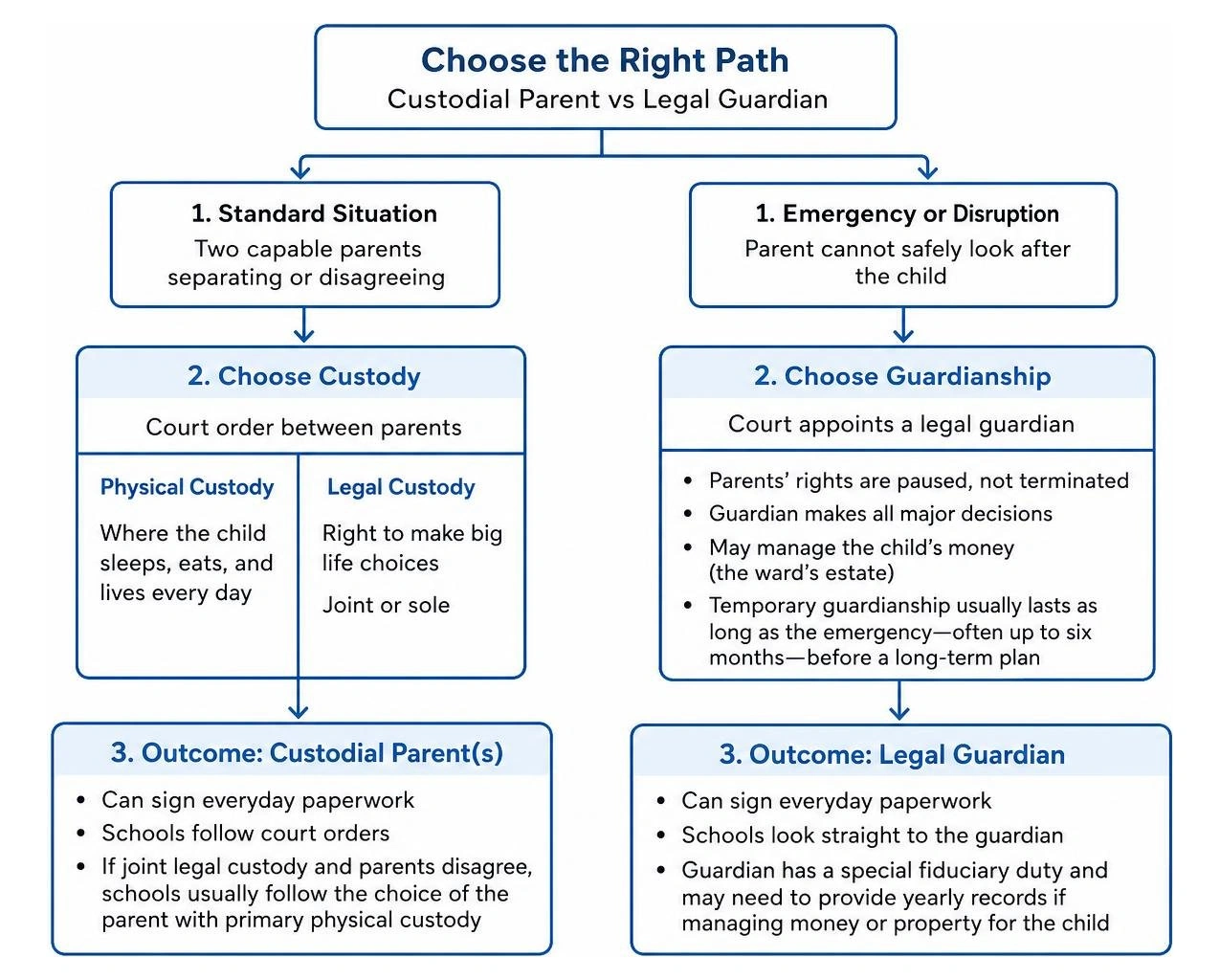
Determining the Right Path: Custodial Parent vs Legal Guardian for Relatives
Grandparents and aunts and uncles often step in to save the day when parents struggle. This is called kinship care. It keeps children out of the traditional foster care system and places them with family who already love them.
If you are a grandparent stepping up on Long Island, you should look into exercising grandparents rights in New York. Depending on the situation, a relative might file for legal custody or ask to become a legal guardian.
Families can also use tools like caregiver nomination and family preparedness planning. These tools let parents name a trusted relative in advance so everyone knows who takes over if an emergency strikes.
Alternatives to Formal Legal Guardianship
Going to court is not always the only way to help a child. In fact, courts prefer using the least restrictive option whenever possible. Some helpful alternatives include:
- Power of Attorney: A parent signs a legal paper giving another adult temporary power to make school or medical choices.
- Caregiver Authorization Affidavit: A simple sworn form that lets an informal caregiver enroll a child in local school and get basic medical checkups.
- Private Voluntary Agreements: A written family plan between parents and relatives for short-term stays.
These alternatives are great for short periods, like when a parent is in the hospital for a few weeks. But if the problem lasts many months, a formal court order is needed to keep the child safe.
How Courts Evaluate and Oversee Custody and Guardianship Cases
When cases go to court, the judge has one main goal: protecting the best interests of the child.
In New York, custody battles between parents are handled in Family Court or Supreme Court. When deciding who gets the children, you can learn how a judge decides who gets custody in Suffolk County Family Court. The judge looks at each parent's home, their ability to provide food and clothes, their emotional bond with the child, and their willingness to encourage a relationship with the other parent.
Guardianship cases for minors can be heard in Family Court or Surrogate's Court (Probate Court). Because a guardian is often not the biological parent, the court keeps a closer eye on them. The judge may order:
- A home visit by a court investigator
- Background checks on all adults in the home
- A surety bond (a type of insurance policy protecting the child's money)
- Yearly written reports on the child's health, schooling, and finances
A Warning About AI and Online Forms
When dealing with something as important as your children, please do not use AI tools like ChatGPT to draft custody agreements or guardianship paperwork. Generic computer programs do not know local New York laws. They miss small, critical details about parenting schedules, school boundaries, and medical rights. A single mistake on a robotic form can cause years of painful legal battles. You need an experienced human attorney who understands local court rules and truly cares about your family.
Experienced Representation in Suffolk County
When family issues end up in court, you need a steady hand on your side. Steven Zalewski is widely known as one of the most experienced family court trial lawyers in Suffolk County. Whether your case is heard in Islandia, Central Islip, or Riverhead, our team knows the local courtrooms and judges inside and out.
We believe that getting top-tier legal help should not come with financial surprises. That is why we use an honest, clear flat-fee model:
- Pre-Trial Fee: A single flat fee that covers all work and every single court appearance leading up to trial, no matter how many court dates it takes.
- Trial Fee: If your case cannot be settled and must go to a full trial, a single set trial fee is due 30 days before the scheduled trial date.
Many other firms bill by the hour and demand more money every time a case gets complicated, sometimes leaving clients stranded right before a hearing. Steve never leaves a client behind because they ran out of money. We also offer flexible payment plans to help you protect your family without breaking the bank.
Frequently Asked Questions About Custodial Parents and Legal Guardians
Does a legal guardian completely terminate biological parental rights?
No. Guardianship only pauses parental rights. The parents still have a legal relationship with the child and can often visit them. Adoption is the only process that permanently wipes out biological parental rights.
Can a temporary guardianship be converted into legal custody?
Yes. If a child has lived with a guardian for a long time and the biological parents still cannot provide a safe home, the guardian can ask the family court for legal custody. The court will hold a hearing to decide what living arrangement is best for the child.
Who pays child support when a legal guardian is appointed?
The biological parents are still legally required to financially support their child. Even when a legal guardian has physical care, a court can order one or both parents to pay child support to the guardian. Guardians can also apply for state caregiver benefits to help pay for food, clothing, and health insurance.
Conclusion: Navigating Custody and Guardianship for Your Family
Deciding between seeking custody or establishing a legal guardianship can feel overwhelming, but you do not have to figure it out alone. Every family situation is unique, and having clear guidance ensures your child's future is safe and secure.
At Zacarese & Zalewski P.C., we provide compassionate, straightforward legal help for parents and relatives throughout Long Island. Explore our dedicated legal representation for custody cases to see how we can help you find peace of mind.
Contact us today to speak with our team:
📱 Cell: (516) 660-4354
📧 Email: steve@zandzfamilylawyers.com
🏛 Address: 1601 Veterans Memorial Highway, Suite 500, Islandia, NY 11749
i guarantee you will be heard
Ready to Take the Next Step?
At Zacarese & Zalewski P.C., when something isn’t right, say something—and we’ll do something about it with you.
Our flat-fee structure is clear: one flat fee for pre-trial work, and a trial fee only if your case goes to trial or a hearing. Call now and a professional will return your call quickly; if we miss you, we'll call back the same day.