
When you speak, I guarantee you will be heard
Zacarese & Zalewski P.C.
Step-by-Step Guide to Understanding Custody Cases
Call now: 516-660-4354
"He didn't just win my case. He gave me back my future, my peace of mind, and my ability to breathe again."
From the very first conversation, he changed everything. He didn't just see a case, he saw me, and treated me like family. His knowledge of the law was unmatched, but what truly set him apart was his humanity. If you are looking for a lawyer, stop searching right now.


Understanding Custody Cases in Suffolk County

Custody cases decide who will make major choices for a child, where the child will live, and how each parent will spend time with them. In New York, the court's main goal is the child's best interests, with safety, stability, caregiving, and each parent's ability to meet the child's needs at the center.
| Key issue | Quick answer |
|---|---|
| Legal custody | Who makes major decisions about school, health care, and religion |
| Physical custody | Where the child lives and how daily care is shared |
| Parenting time | The schedule for visits, holidays, overnights, and contact |
| Court's focus | What arrangement best supports the child's safety and well-being |
| If parents disagree | They may use mediation, negotiate through lawyers, or ask a judge to decide |
A custody dispute can feel personal, urgent, and hard to understand. It may involve a divorce, unmarried parents, a request to change an old order, missed visits, CPS concerns, or safety issues such as domestic violence. A court order can cover far more than a weekly schedule. It can set rules for school decisions, medical care, exchanges, travel, communication, and video calls.
For Suffolk County parents, clear guidance matters from the start. Steven Zalewski is one of the most well-known family court trial lawyers in Suffolk County. Zacarese & Zalewski P.C. helps parents understand what is at stake, prepare for Family Court, and work toward a plan that protects both their parental role and their child's future.
Fundamental Types of Child Custody: Legal vs. Physical Rights
When parents split up, they must sort out two very different kinds of rights. In family law, custody is split into legal custody and physical custody. You can share both, share one, or have one parent handle both.
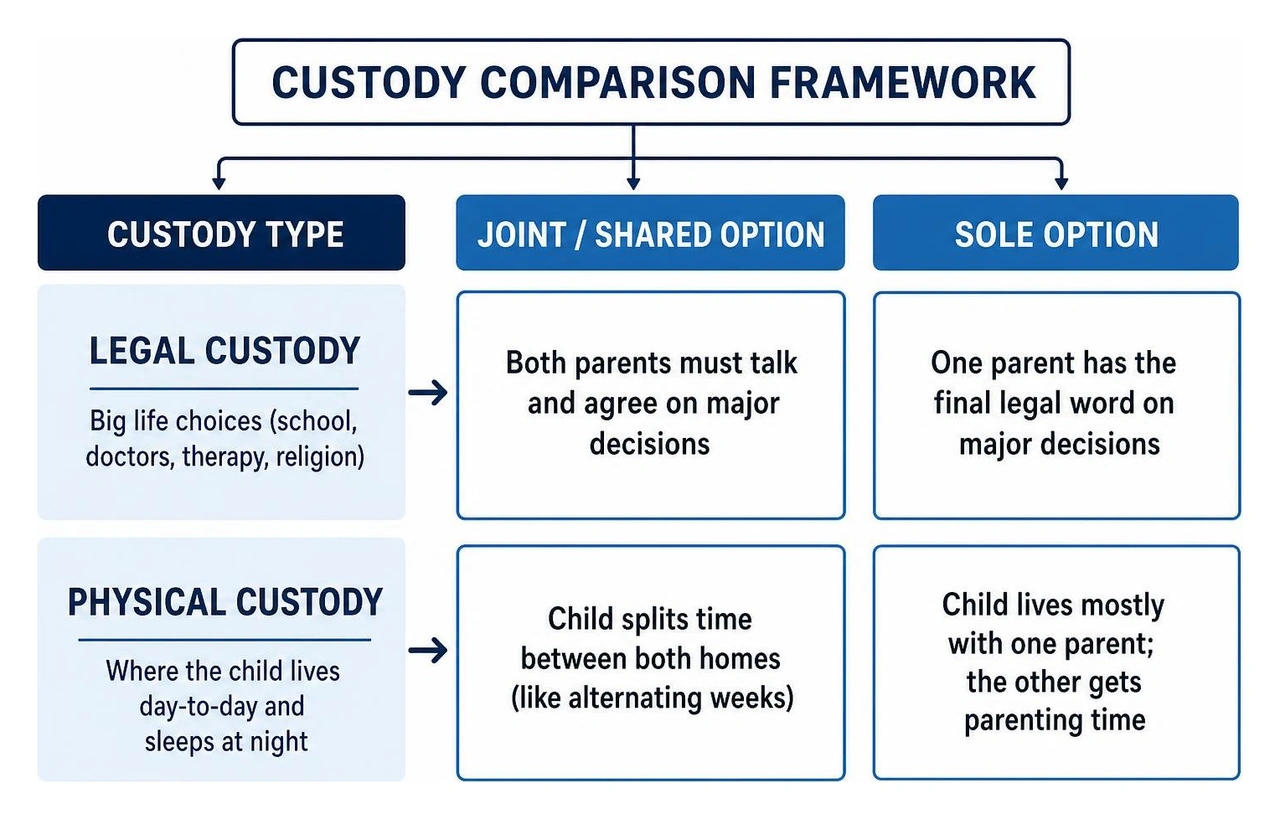
Here is how both types compare in everyday life:
| Custody Type | What It Covers | Joint / Shared Option | Sole Option |
|---|---|---|---|
| Legal Custody | Big life choices (school, doctors, therapy, religion) | Both parents must talk and agree on major decisions | One parent has the final legal word on major decisions |
| Physical Custody | Where the child lives day-to-day and sleeps at night | Child splits time between both homes (like alternating weeks) | Child lives mostly with one parent; the other gets parenting time |
Before any judge signs an order, both parents start with equal rights under the law. Learning the basics of understanding joint vs sole custody in New York helps you pick the right goals. Other states follow similar basic ideas, as seen in the California Courts child custody guidelines.
Legal Custody and Decision-Making Authority
Legal custody gives you the right to make big life choices for your child. This does not mean arguing over what cereal to buy for breakfast. It covers major choices:
- Picking schools, tutors, and special education programs
- Choosing doctors, surgeons, dentists, and medications
- Selecting mental health therapists or family counselors
- Guiding religious education and practices
- Enrolling in major sports leagues or costly extracurricular activities
Sometimes parents agree on most things but get completely stuck on one topic, like vaccines or religion. When that happens, judges do not always have to strip one parent of all rights. Courts can use "spheres of authority." This means Mom might make school decisions while Dad makes sports decisions.
We saw this in the Pennsylvania appellate ruling on medical decision-making in Layton-Herron v. Litke. The court gave one parent sole authority over childhood medical choices and vaccines because it served the child's health, even while the parents shared other rights. Similarly, the Nebraska Supreme Court ruled in Munsell v. Munsell that having sole legal custody lets a parent guide major education and health paths, but it does not let them block the other parent from basic religious activities during normal visits unless there is real, proven harm.
Physical Custody and Residential Placement
Physical custody (often called residential placement) is all about where your child sleeps at night.
- Primary Physical Custody: The child lives with one parent for most of the week. That parent's home is the child's primary address for school registration. The other parent receives scheduled parenting time (visitation).
- Shared Physical Custody: The child spends substantial time living in both homes. This could be a 50/50 split with alternating weeks, or a 2-2-5-5 schedule.
- Split Custody: In rare cases with multiple children, one child lives primarily with one parent while a sibling lives with the other. Courts rarely do this unless there is a very strong reason.
Physical custody also sets strict boundaries for moves. A parent cannot pack up the kids and move far away without permission from the other parent or the court.
How Family Courts Determine the Best Interest of the Child
Every custody decision in family court comes down to one core rule: the best interests of the child. Judges do not make decisions to reward Mom or punish Dad. They look strictly at what living arrangement will keep the child safe, happy, and healthy.

Understanding how custody is decided in Suffolk County Family Court helps you see what actually sways a judge. As we explain in our guide on what judges actually look for in a custody case, judges care about daily routines and real proof, not angry accusations.
Evaluating Parental Fitness and Home Stability
To figure out what is best for a child, family court judges look at several practical factors:
- Who has been the primary caregiver? Who cooks meals, helps with homework, takes the child to the doctor, and knows the teacher's name?
- Home stability: Does the parent have a safe, clean, and stable home? Does the child have their own bed and a quiet space to study?
- Parental cooperation: Can the parents talk politely and share information? Does one parent try to cut the other out of the child's life?
- Mental and physical health: Are both parents emotionally and physically able to care for a child day in and day out?
- Child's preference: For older children (usually ages 10 to 12 and up), a judge may listen to what the child wants in a private meeting, though the child does not get the final vote.
Addressing Domestic Violence, Abuse, and Coercive Control
Nothing changes a custody case faster than domestic violence, child abuse, or coercive control. Family courts take safety very seriously.
When abuse is present, courts will not force a standard 50/50 shared schedule. As shown in the Iowa Supreme Court domestic violence custody analysis in Hines-Miller v. Teter, a history of domestic assault against a partner creates a major risk for children. A child does not even need to see the physical violence for it to harm their well-being and shift primary custody to the safe parent.
In high-risk cases, judges can order:
- Temporary orders of protection (restraining orders)
- Professional supervised visitation at a neutral center
- Strict exchange rules (such as drop-offs at a local police station)
- Monitored communications using special co-parenting apps
Courts must also separate real safety fears from false claims. Some controlling parents try to use the court system as a weapon by filing endless petitions. Family judges work closely with court attorneys and evaluators to uncover the truth and protect the at-risk parent.
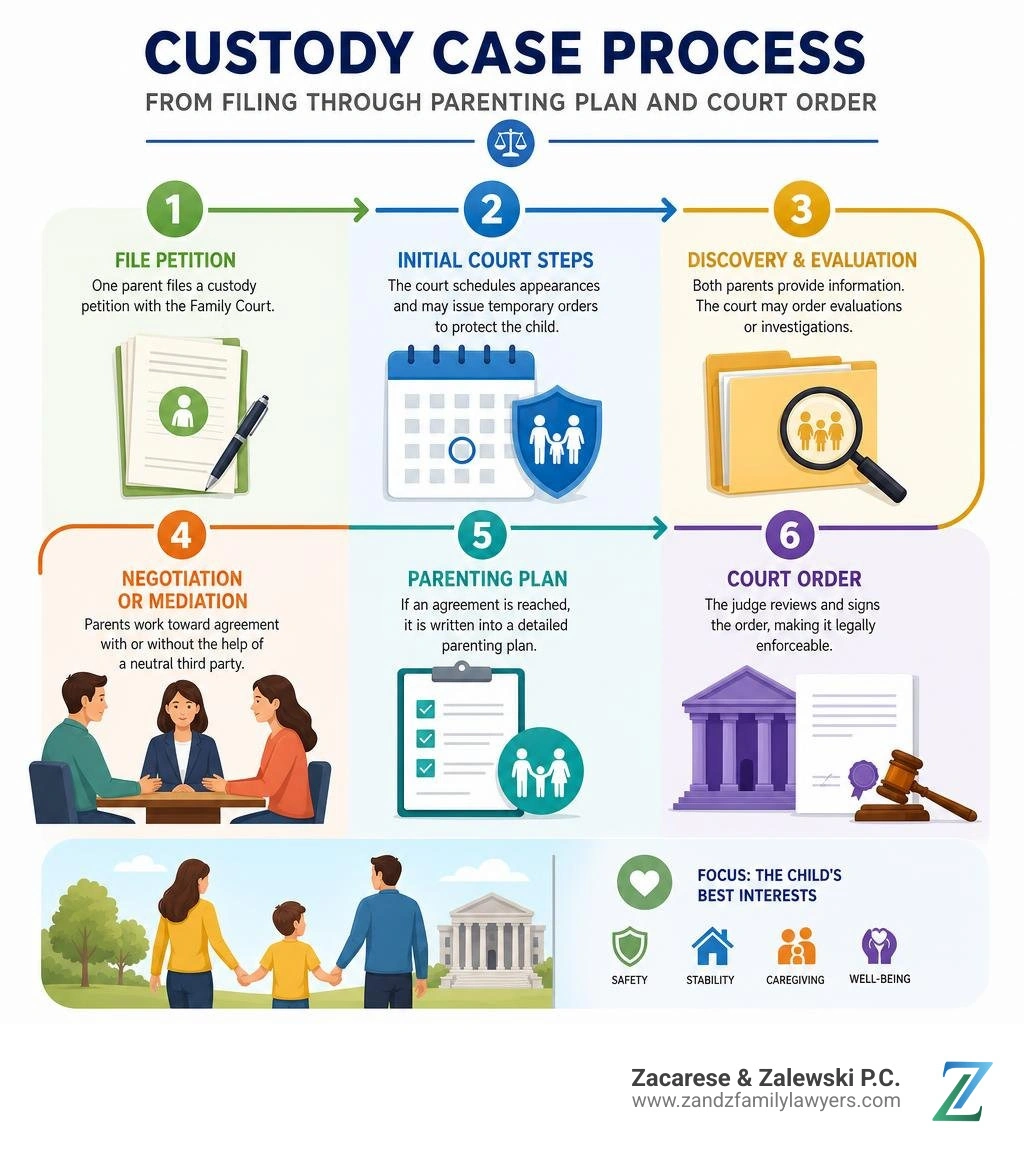
Step-by-Step Procedure in Modern Custody Cases
Filing or answering custody cases involves a clear court process. Knowing what steps come next keeps you from feeling lost.

Most cases follow this clear path:
- Filing the Petition: One parent files a formal request for custody or visitation in Family Court.
- Serving the Papers: The other parent is formally served with the court summons and petition.
- First Appearance: Both parents go to court, meet the judge or court attorney, and set temporary rules for parenting time while the case moves forward.
- Court Evaluations & Conferences: The court may appoint an Attorney for the Child (AFC) or order a social worker evaluation to check home conditions.
- Settlement or Trial: Parents try to reach an agreement. If they cannot, the case goes to a full trial where the judge hears witness testimony and issues a final order.
Under the Uniform Child Custody Jurisdiction and Enforcement Act (UCCJEA), you must file in your child's "home state." That is the state where your child has lived for at least six straight months before filing. If a parent unlawfully runs off with a child to another state or country, courts can issue emergency location orders. We saw this in the High Court judgment in DD v. EE, where emergency court orders and international rules were used to track down and protect abducted children.
Responding When Served with Family Court Papers
If a process server hands you custody paperwork, do not ignore it. In New York, ignoring court papers is the biggest mistake parents make in family court.
If you do not show up to your court date or fail to file a formal answer, the judge can enter a default judgment. That means the other parent gets everything they asked for, and you lose your say.
When you get served:
- Read the date, time, and courthouse location carefully (such as the Suffolk County Family Court in Central Islip or Riverhead).
- Gather your records: school grades, doctor visits, text messages, and calendar notes showing your parenting time.
- Talk to a lawyer immediately so you can file an Answer and any Counterclaims to protect your rights.
Managing Dispute Resolution in High-Conflict Custody Cases
Not all cases need a messy courtroom battle. Many parents work out their plans through confidential mediation or lawyer settlement talks. This saves time, reduces stress, and keeps you in control of your schedule instead of leaving choices to a judge.
However, mediation is not safe or recommended if there is domestic violence, severe bullying, or active substance abuse. In those situations, you need a high-conflict custody parenting time lawyer who can stand up for you in court, question hostile witnesses, and present clear evidence to the judge.
Structuring Parenting Plans, Visitation, and Future Modifications
A good parenting plan is like a strong fence—it prevents everyday arguments by making the rules clear. Your plan should cover regular weekdays, alternating weekends, school breaks, summer vacations, and major holidays.
Reviewing options for visitation cases helps parents build schedules that fit their child's age:
| Parenting Schedule Style | Best Used When... | How It Works |
|---|---|---|
| Scheduled Parenting Time | Most regular family cases | Set days and exact pickup/drop-off times (e.g., every other weekend from Friday at 5 PM to Sunday at 6 PM). |
| Reasonable / Open Access | Parents get along great and have flexible work | Parents agree on visits as they go. (Warning: this often breaks down if communication turns sour). |
| Supervised Visitation | Safety, long absences, or abuse are concerns | Visits happen only with an approved family member or a paid professional supervisor present. |
| Virtual Parenting Time | One parent lives far away or travels for work | Scheduled FaceTime, Zoom, or video calls so the parent stays involved during the week. |
Establishing Safe Visitation and Virtual Contact Provisions
When building a parenting plan, safety and clear communication come first:
- Set exact pickup spots: Use neutral, public places like a library parking lot or school if exchanges are tense.
- Include virtual visits: Video calls give kids a great way to stay in touch with a traveling or long-distance parent. Set fixed days and times (like Tuesdays and Thursdays at 6:30 PM for 15 minutes) so calls do not interrupt homework or bedtime.
- Use co-parenting apps: Tools like TalkingParents or OurFamilyWizard keep all messages in a court-approved log. This stops late-night fighting and gives the judge a clear written record if someone breaks the rules.
Modifying Court Orders in Post-Judgment Custody Cases
Life changes as kids grow up. A schedule made for a toddler may not work for a teenager in high school.
To change a final custody order in New York, you cannot just say you want a new plan. You must prove two legal steps:
- A substantial change in circumstances has happened since the last order was signed (such as a major job change, a move, or a breakdown in care).
- The change you are asking for is in the best interests of the child.
As highlighted in the New York custody modification ruling in Matter of Siara Q. v. Thomas R., isolated fights or unproven CPS calls might show a change in circumstances, but they do not mean the court will automatically strip a good parent of custody. Instead, courts prefer tailored solutions—like giving one parent final medical decision-making power—to fix specific problems while keeping both parents involved.
If you are dealing with a major life change, working with a modify custody agreement lawyer ensures your court petition meets New York's strict legal standards.
Frequently Asked Questions About Child Custody
What is the biggest mistake parents make during a custody case?
The biggest mistake parents make during a custody case in family court is letting anger take over. This includes withholding the child from the other parent without a court order, sending nasty text messages, posting drama on social media, or badmouthing the other parent in front of the kids. Judges hate seeing children caught in the middle. The parent who acts reasonable, follows temporary orders, and supports the child's relationship with the other parent almost always looks better in court.
Can a father receive full legal and physical custody?
Yes, absolutely. New York custody law is completely gender-neutral. Mothers do not get an automatic advantage, and fathers have the exact same parental rights. When asking if a father can get full custody in New York family court, the answer comes down to proof. If a father proves he is the primary caregiver, provides a stable and safe home, and meets all of the child's daily needs, the court will award him full custody.
What steps should you take if a parent refuses to return a child after visitation?
If a parent withholds a child past their scheduled time, do not try to take matters into your own hands or start a physical fight. Understanding what happens if a parent doesn't return a child after visitation will help you act fast:
- Reach out in writing (text, email, or parenting app) asking for the child's immediate return.
- If they refuse and there is an active custody order, call local law enforcement and ask for a welfare check or police assistance with the court order in hand.
- Have your attorney file an emergency violation and enforcement petition in Family Court to hold the non-compliant parent in contempt.
Protecting Your Parental Rights and Securing Your Child's Future
When your family's future is on the line, you cannot afford guesswork. We strongly warn parents against using online AI tools or generic internet templates to write custody agreements. Generic AI forms miss local court rules, skip critical holiday exchange terms, and fail to protect against future disputes. A poorly drafted robotic document can cause confusion and ruin a family's life for years. Only a human attorney with deep local Suffolk County legal insight, real trial experience, and genuine empathy can truly protect your parental rights and your child's well-being.
At Zacarese & Zalewski P.C., we handle family law differently. Many traditional law firms bill you by the hour. Every time you call, send an email, or get stuck waiting in the courthouse hallway, your bill climbs higher. When cases get complicated, those firms often demand more retainer money or abandon clients who run out of cash right before a hearing.
We believe that is wrong. Steven Zalewski is one of the most well-known family court trial lawyers in Suffolk County. He uses a transparent flat-fee model designed to give you peace of mind:
- Pre-Trial Flat Fee: This single flat fee covers all investigation, paperwork, negotiations, motions, and all court appearances leading up to trial-no matter how many times your case is called or how many times we must appear in court for you.
- Set Trial Fee: If your case cannot be settled and must go to a full trial, a transparent, predetermined Trial Fee is due 30 days before trial begins.
- Payment Plans Available: We believe quality legal protection should be manageable, which is why we offer flexible payment plans.
Whether your case is heard at the Suffolk County Family Court in Central Islip or Riverhead, or you visit our main office in Islandia, our legal team is ready to stand by your side. We provide clear, plain-English answers, same-day communication, and fearless trial representation.
If you are facing a custody battle, need to modify an existing order, or have questions about our flat fee custody cases, reach out to us today.
Steven Zalewski is dedicated to fighting for what matters most: your children.
📱 Cell: (516) 660-4354📧 Email: steve@zandzfamilylawyers.com🏛 Address: 1601 Veterans Memorial Highway, Suite 500, Islandia, NY 11749
i guarantee you will be heard
Ready to Take the Next Step?
At Zacarese & Zalewski P.C., when something isn’t right, say something—and we’ll do something about it with you.
Our flat-fee structure is clear: one flat fee for pre-trial work, and a trial fee only if your case goes to trial or a hearing. Call now and a professional will return your call quickly; if we miss you, we'll call back the same day.