
When you speak, I guarantee you will be heard
Zacarese & Zalewski P.C.
Ultimate Checklist for Custody Hearing Preparation
Call now: 516-660-4354
"He didn't just win my case. He gave me back my future, my peace of mind, and my ability to breathe again."
From the very first conversation, he changed everything. He didn't just see a case, he saw me, and treated me like family. His knowledge of the law was unmatched, but what truly set him apart was his humanity. If you are looking for a lawyer, stop searching right now.


How to Prepare for a Custody Hearing

A custody hearing is a court meeting where a judge decides how parents will share care and decision-making for their child. To prepare, read every court notice, gather records that show your child's needs and your role in their daily life, and write down the schedule you want. Bring organized copies of your records for the court and the other parent. Be ready to explain why your plan is good for your child, not just why you prefer it.
In Suffolk County, your first appearance may not be a full trial. Check the notice so you know what the court expects that day.

Key terms for custody hearing:
Understanding Custody Proceedings and Legal Standards
Walking into a family courtroom can feel scary. Understanding the legal rules makes the whole process much easier. When parents cannot agree on a schedule, a judge must step in to make decisions.
In Suffolk County Family Court, judges focus on what keeps your child safe, happy, and supported. To learn the basics of how local judges evaluate these cases, you can read our guide on how custody is decided.
Before looking at the legal tests, let us look at the two main parts of custody:
| Custody Type | What It Means | Common Choices |
|---|---|---|
| Legal Custody | The right to make major life choices for the child. | Joint (shared choices) or Sole (one parent decides). |
| Physical Custody | Where the child lives on a day-to-day basis. | Primary (lives mostly with one parent) or Shared (equal time). |
Legal Custody vs. Physical Custody Arrangements
Legal custody covers big decisions. These include where your child goes to school, what medical care they receive, and their religious training. If parents share joint legal custody, they must talk and agree on these big choices. If one parent has sole legal custody, that parent makes the final call.
Physical custody—often called residential custody—is about where your child sleeps at night. A parenting plan lays out the exact schedule for school weeks, weekends, holidays, and summer vacations. If there are safety worries, such as a history of neglect, a judge might order supervised visits. This means another adult or a professional center must be present while the parent visits the child.
How Courts Apply the Best Interests of the Child Standard
Judges in New York do not pick a favorite parent. They use a legal rule called the best interests of the child. This means the judge looks at what environment will help the child thrive.
When looking at your family, the judge checks:
- Who has been the primary caregiver feeding, bathing, and helping the child every day
- The emotional bond between each parent and the child
- Each parent's home stability and daily routine
- Any history of domestic violence, drug abuse, or child neglect
- Each parent's willingness to encourage a warm relationship with the other parent
Showing the judge that you support your child's relationship with the other parent is critical. Judges dislike when parents try to turn a child against the other parent.
Key Differences Between an Initial and Final Custody Hearing
Your case will involve several steps. Preparing for your first family court appearance is very different from preparing for a full trial.
At the first appearance, the judge often sets up temporary rules (called pendente lite orders). These temporary rules keep life stable for your child while the case is open. If there is an immediate danger, a parent can ask for an emergency order without waiting weeks. You can also review the official New York custody and visitation guidelines to see how courts manage these initial steps. A final hearing or trial only happens if parents cannot reach an agreement. At a final trial, both sides present formal evidence, call witnesses, and follow strict rules of evidence.
Please note: Do not rely on AI tools like ChatGPT to write your custody agreements or legal petitions. Generic computer programs do not know the specific local rules of Suffolk County Family Court. They miss important details that can hurt your parental rights for years. You need a real human attorney with local experience and genuine empathy to protect your family's future.
The Comprehensive Evidence and Document Checklist
Going to court without organized paperwork is like building a house without tools. Judges appreciate parents who bring neat, clear proof rather than emotional complaints.
Good family court trial preparation means putting your documents into labeled binders. You should bring three copies of everything: one for the judge, one for the other parent's attorney, and one for yourself.

Essential Evidence to Bring to Your Custody Hearing
Gather records that prove your day-to-day involvement in your child's life:
- School Records: Report cards, attendance logs, and notes from parent-teacher conferences.
- Medical Records: Doctor visit summaries, vaccination records, and dental logs showing you take them to appointments.
- Activity Records: Sports schedules, music lesson sign-ups, and receipts for extracurricular activities.
- Daily Care Logs: A simple calendar or journal showing when you cared for the child, cooked meals, and helped with homework.
- Witness Statements: Contact details for teachers, babysitters, neighbors, or coaches who see you parent firsthand.
Authenticating Electronic Evidence and Communication Logs
Text messages, emails, and co-parenting app logs can be great evidence, but you must present them properly:
- Print full message conversations so the court sees the complete context, not just one cropped line.
- Make sure dates, timestamps, phone numbers, and names are visible.
- Never alter or edit digital messages.
- Save copies of voicemails and digital photos with clear dates.
Financial Disclosures, Affidavits, and Tax Documentation
Money matters are an important part of custody cases. You must show the court that you can provide a safe, stable home:
- Financial Affidavits: Complete forms detailing your monthly income and living expenses.
- Proof of Income: Recent pay stubs, W-2 forms, and tax returns.
- Tax Rules: The parent with primary physical custody usually claims the child for tax purposes. Under current rules in 2026, the Child Tax Credit is indexed for inflation after rising to $2,200 per child in 2025. If parents agree to alternate years claiming the child, they must sign IRS Form 8332.
- Fee Waivers: Filing fees for custody cases typically run between $200 and $400. If you cannot afford court fees, you can ask the clerk for a fee waiver form.
Navigating the Custody Hearing Process: What to Expect in Court
Knowing how a court session runs will help calm your nerves. Reviewing what to expect at your first custody hearing gives you a head start.
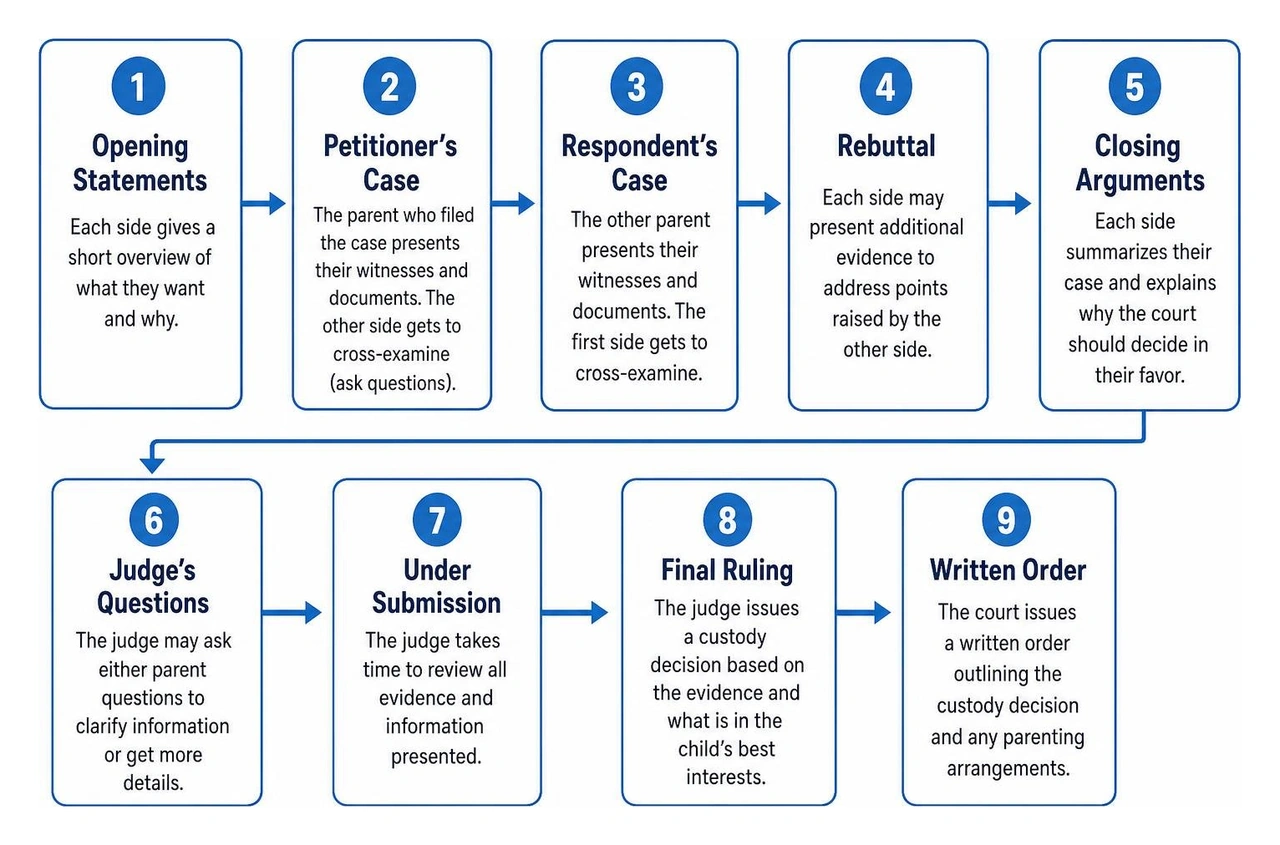
Step-by-Step Anatomy of a Courtroom Hearing
A standard hearing follows a clear order:
- Opening Statements: Each side gives a short overview of what they want and why.
- Petitioner's Case: The parent who filed the case presents their witnesses and documents. The other side gets to cross-examine (ask questions).
- Respondent's Case: The other parent presents their witnesses and records, followed by cross-examination.
- Child's Attorney Input: If an attorney represents the child, they share their observations and legal positions.
- Closing Arguments: Both sides summarize why their plan serves the child's best interests.
- Judicial Ruling: The judge issues a written decision right away or sends it by mail later.
The Role of Guardians Ad Litem, Evaluators, and In-Camera Interviews
In many cases, the judge appoints an Attorney for the Child (AFC) or a Guardian ad Litem (GAL). This person's job is to protect your child's legal rights and share what the child wants.
The court may also order a home study or a mental health evaluation. A social worker visits both homes, speaks with the child, and writes an independent report for the judge.
Judges often hold an in-camera interview. This is a private talk between the judge and your child in the judge's office (chambers). Parents are not allowed in the room so the child can speak freely without feeling pressured. A court reporter writes down every word, but the transcript remains strictly confidential.
Essential Courtroom Etiquette, Demeanor, and Presentation
How you act in the courtroom tells the judge a lot about your character.
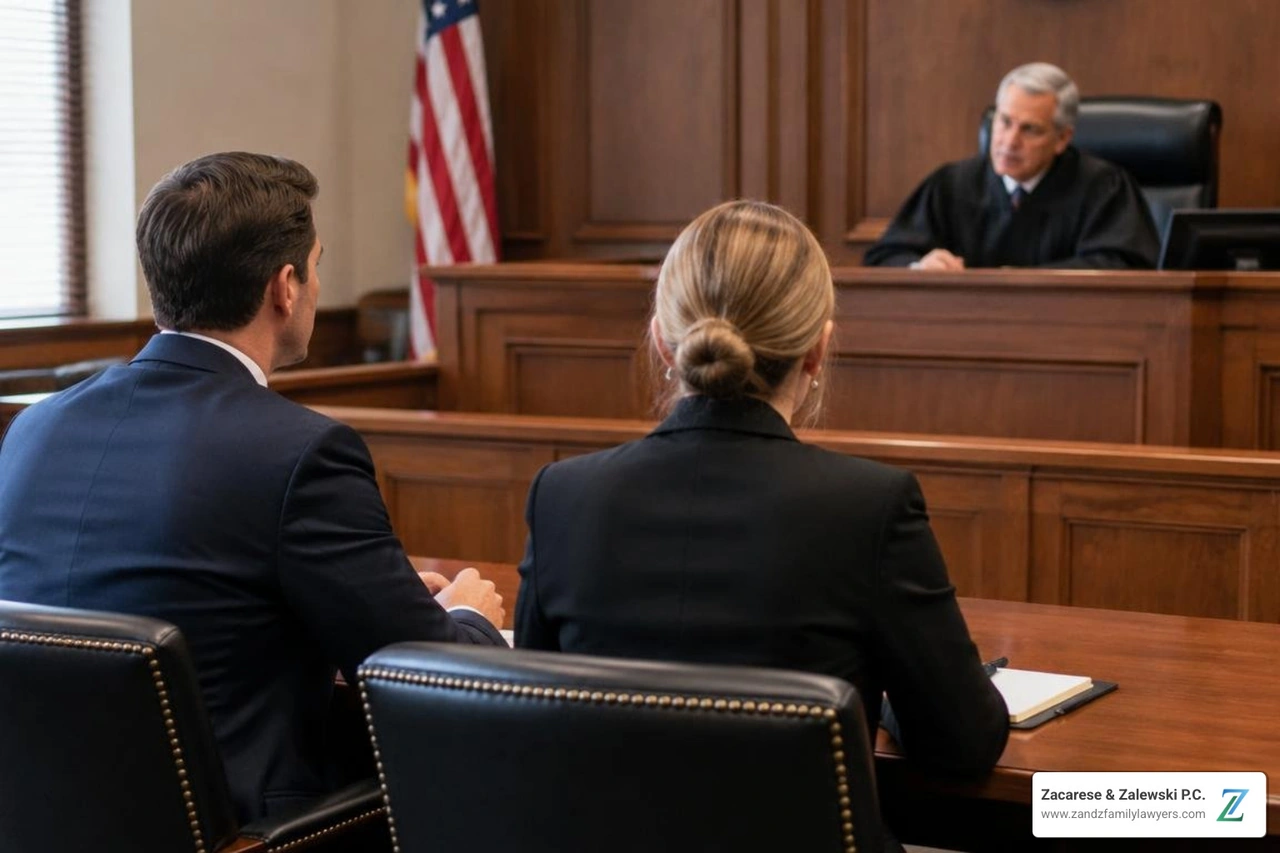
Follow these simple rules:
- Dress Neatly: Wear business clothes, just like you would for an important job interview. Avoid hats, shorts, and graphic t-shirts.
- Show Respect: Always call the judge "Your Honor." Stand up when the judge enters or leaves the courtroom.
- Stay Calm: Never roll your eyes, sigh, or interrupt when the other parent is speaking. Keep your emotions in check.
- Arrive Early: Give yourself plenty of time to park, get through security, and find your courtroom in Islandia, Central Islip, or Riverhead.
At Zacarese & Zalewski P.C., we believe you deserve legal support without surprise bills. Steven Zalewski is one of the most well-known family court trial lawyers in Suffolk County. We work on a transparent flat-fee model that covers all court appearances, no matter how many times we go before the judge.
Our simple two-part structure includes a Pre-Trial Fee that covers all work and appearances leading up to trial, and a set Trial Fee due 30 days before the scheduled trial date. Unlike other law firms that switch to expensive hourly rates or drop clients when cases get tough, Steve never abandons a client because money runs out. We also offer manageable payment plans to fit your family's budget.
Alternative Pathways, Temporary Relief, and State Variations
Not every family needs a full trial. Most custody cases settle through negotiation or mediation.
Settlement Conferences and Court-Directed Resolution
During a settlement conference, parents and their attorneys meet with a court referee or mediator to work out a compromise. If you reach an agreement, you can draft a consent order. Once the judge signs this document, it becomes a legally binding court order without the stress of a public trial. In states like Pennsylvania, parents often start with conciliation conferences, and in Ohio, courts use early case management meetings to encourage settlement.
New York Timelines and Interstate Jurisdictional Rules
Every state has specific rules for scheduling:
- In New York, courts work hard to move custody cases forward quickly, though complex trials can take several months.
- Under Rule 5:8-6: Trial of Custody Issue in New Jersey, the court must set a trial date within six months of the responsive pleadings.
- In Michigan, objection hearings take 30 to 60 minutes, and parents have 14 days to challenge an emergency order.
- In Ohio, the custody process can take between 3 months and 2 years from start to finish.
If a parent moves to another state, the Uniform Child Custody Jurisdiction and Enforcement Act (UCCJEA) applies. Under the UCCJEA, the child's legal "home state" is where they lived for at least six straight months before filing. The federal Parental Kidnapping Prevention Act ensures that courts in other states respect and enforce the home state's custody order.
Post-Hearing Procedures: Enforcement, Modification, and Appeals
Once the judge signs the final order, both parents must follow it completely. If your situation changes or problems arise, you have legal options. Working with an experienced Suffolk County family court hearing lawyer ensures your rights remain protected.
Handling Order Violations and Contempt of Court
If the other parent refuses to follow the schedule or blocks your visits, do not take matters into your own hands. You can file a Violation Petition or a Petition for Contempt of Court.
If the judge finds the other parent in willful violation, the court can:
- Award you make-up parenting time
- Order the violating parent to pay your attorney fees
- Impose financial fines
- In severe or repeated cases, order jail time or modify custody
Modifying Orders and Filing Timely Appeals
As children grow, life changes. You can ask the court to change an existing custody order if there has been a major change in your child's life.
Common reasons include:
- A parent's job relocation
- Safety concerns or changing medical needs
- A schedule that no longer works with school hours
If you believe the judge made a legal mistake during your trial, you can file an appeal. Keep strict deadlines in mind: in New York and Pennsylvania, an appeal must be filed within 30 days of receiving the order, while in Virginia, you have only 10 days.
Frequently Asked Questions about Custody Hearings
How long does a custody hearing usually take?
A simple conference or settlement hearing may only take 15 to 30 minutes. In Pennsylvania, standard hearings last between two and six hours. Contested trials with multiple witnesses, experts, and complex evidence can take a full day or stretch across several sessions over a few months.
Can my child speak directly to the judge during the hearing?
Children rarely testify in open court in front of their parents. Instead, judges conduct private in-camera interviews in their chambers. The judge talks gently with the child to understand their feelings and daily life without putting them in the middle of adult conflict.
What should I do if the other parent violates a custody order?
Keep a detailed log of every missed visit, late arrival, or denied phone call. Save all text messages and emails. If a parent refuses to return the child, you can call local police to make an incident report, and then file an enforcement petition in family court right away.
Conclusion
Preparing for a court date requires patience, clear paperwork, and a steady focus on your child's needs. When you understand the legal standards and present organized records, you give your family the best chance at a bright future.
Whether you need help preparing evidence or want strong courtroom advocacy, our team at Zacarese & Zalewski P.C. is here for you. We provide dedicated child custody representation across Long Island, including the Suffolk County Family Courts in Islandia, Central Islip, and Riverhead. Contact us today to speak with our compassionate team and set up a consultation.
📱 Cell: (516) 660-4354 📧 Email: steve@zandzfamilylawyers.com 🏛 Address: 1601 Veterans Memorial Highway, Suite 500, Islandia, NY 11749
i guarantee you will be heard
Ready to Take the Next Step?
At Zacarese & Zalewski P.C., when something isn’t right, say something—and we’ll do something about it with you.
Our flat-fee structure is clear: one flat fee for pre-trial work, and a trial fee only if your case goes to trial or a hearing. Call now and a professional will return your call quickly; if we miss you, we'll call back the same day.