
When you speak, I guarantee you will be heard
Zacarese & Zalewski P.C.
Mother Knows Best? The Truth About Who Gets Sole Custody
Call now: 516-660-4354
"He didn't just win my case. He gave me back my future, my peace of mind, and my ability to breathe again."
From the very first conversation, he changed everything. He didn't just see a case, he saw me, and treated me like family. His knowledge of the law was unmatched, but what truly set him apart was his humanity. If you are looking for a lawyer, stop searching right now.


Do Mothers Get Full Custody? The Short Answer

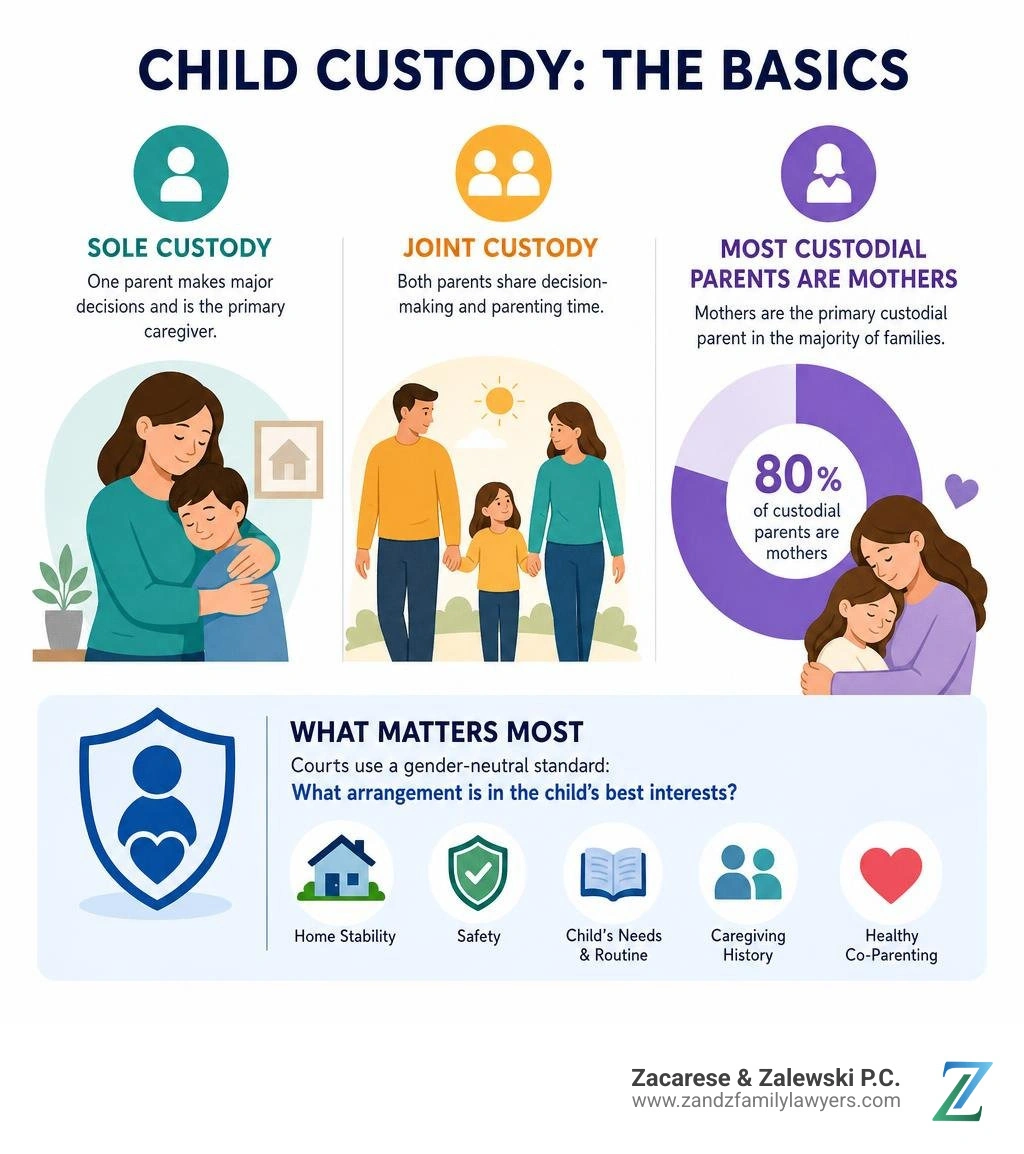
No. Mothers do not automatically get full custody. In New York and across the country, family courts must use a gender-neutral standard: what arrangement is in the child’s best interests?
A mother may receive sole legal custody, sole physical custody, or both when the facts support it. But a father can also receive full custody. Courts look at safety, each parent's caregiving history, the child's routine and needs, home stability, and each parent's ability to support a healthy relationship with the other parent.
Mothers remain the majority of custodial parents - about 80% in recent U.S. Census data - but that number includes many agreements made outside a courtroom. It does not mean judges automatically favor mothers.
If you are seeking sole custody, focus on clear proof:
- Your day-to-day care for the child
- A safe, stable home and routine
- School, medical, and childcare records
- Any documented abuse, neglect, substance use, or safety risks
- Your willingness to follow orders and support safe parenting time
For Suffolk County parents, custody disputes can feel personal, costly, and confusing. Steven Zalewski, one of the most well-known family court trial lawyers in Suffolk County, helps parents understand what a judge is likely to consider and prepare a child-focused case.
Legal Reality: Do Mothers Get Full Custody Automatically?
Many parents walk into court thinking the law picks the mother first. Years ago, old rules like the "tender years doctrine" made judges assume young kids belonged with mom. Today, those outdated rules are gone. Modern family law is gender-neutral. Both mothers and fathers start on equal footing under the law.
When people wonder do mothers get full custody in every case, the answer in 2026 is a clear no. Judges look at facts, not gender. Yet, national data shows that mothers are the primary custodial parent in roughly 80 percent of families. Why does this happen if the law is neutral?
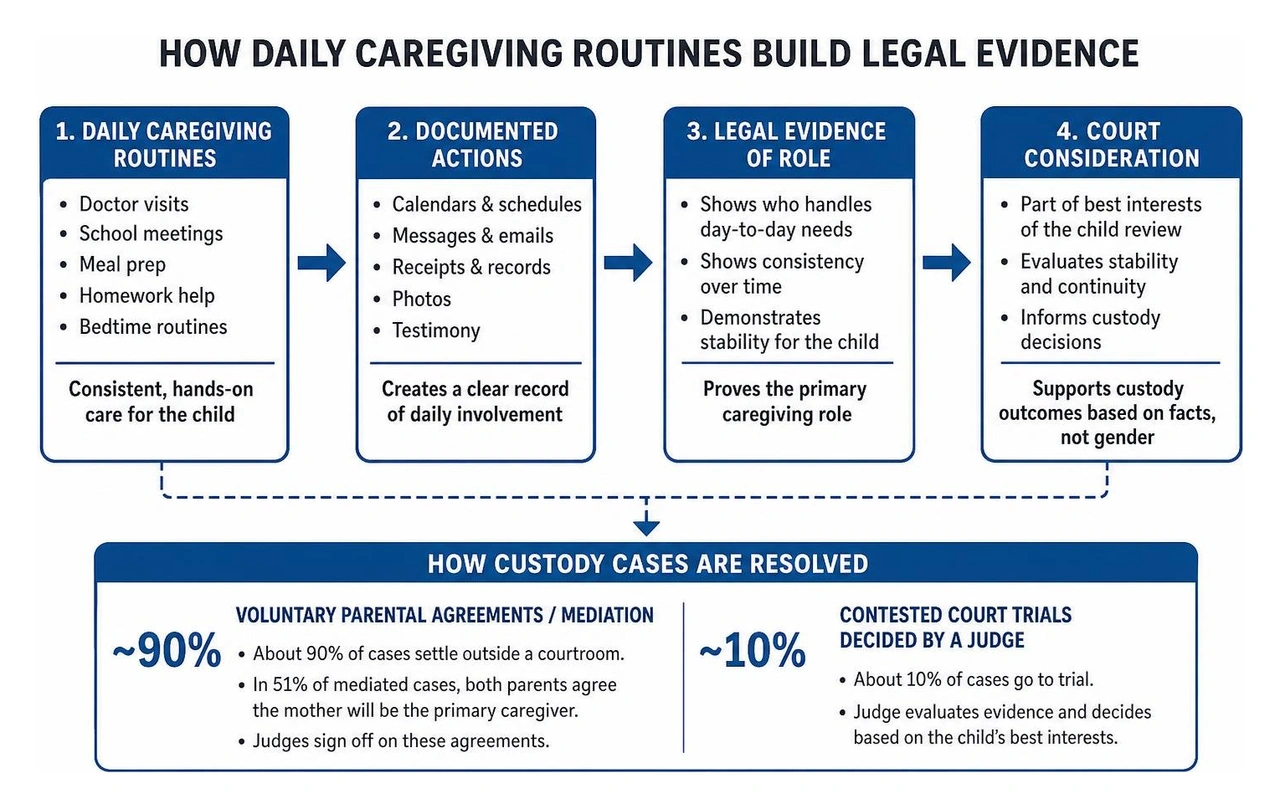
Around 90 percent of custody cases settle outside a courtroom. Parents make voluntary agreements through talks or mediation. In 51% of mediated cases, both parents agree that the mother will be the primary caregiver. When parents agree, judges sign off. So, high numbers reflect family choices, not judicial bias.
Sole vs Joint Custody: Understanding Physical and Legal Rights
To understand custody, you must look at its two main parts: legal custody and physical custody.
- Legal Custody: This gives a parent the power to make major life choices for the child. It covers schooling, healthcare, and religious upbringing. Sole legal custody means one parent decides alone. Joint legal custody means both parents must agree on big choices.
- Physical Custody: This is where the child lives day to day. Sole physical custody means the child lives primarily with one parent while the other gets parenting time. Shared physical custody means the child splits time between both homes.
Learning what does joint custody truly mean helps parents see that shared legal custody is common even when one parent has the child during the school week.
Why Do Mothers Get Full Custody More Often Statistically?
Mothers often handle day-to-day routines like doctor visits, school meetings, and meal prep. When couples split, courts try to keep the child's daily life steady.
Economic differences also play a role. Census data shows 46.5% of custodial mothers receive help from public assistance programs, compared to 24.1% of custodial fathers. A detailed academic study on gender bias in custody rulings found that lower-income mothers often keep custody because they have been the primary hands-on caregiver, proving that daily time with the child matters more than money.
The Best Interests of the Child: What Judges Actually Evaluate
When parents cannot agree, a judge steps in. In New York, the judge follows one rule: the child's best interests. This is not about what is fair to the parents. It is about what environment helps the child grow up safe and happy.
Understanding how custody is decided in Suffolk County Family Court helps parents prepare for hearings in Islandia, Central Islip, or Riverhead.
Core Evaluation Factors: Primary Caregiver, Stability, and Child Preference
Judges look at practical daily life:
- Primary Caregiver History: Who wakes the child, makes breakfast, helps with homework, and goes to parent-teacher nights?
- Emotional Bonds: How close is the child to each parent?
- Home Stability: Can each parent provide a clean, safe bedroom, consistent routines, and food?
- Co-Parenting Support: Does the parent encourage love for the other parent, or do they try to block visits?
- Child's Preference: When kids reach ages 12 to 14, judges may listen to their wishes, though the child does not get the final vote.
- Independent Reports: The court often appoints an attorney for the child or a Guardian ad Litem to run home visits and advise the judge.
Impact of Domestic Violence, Substance Abuse, and Parental Alienation
Safety comes first. If there is a history of domestic violence, the court takes it seriously. Violence or severe substance abuse creates a legal barrier to getting custody. Judges can order drug tests, require protective orders, or mandate supervised visits.
Courts also look down on parental alienation. If one parent tells lies to make the child hate the other parent, the judge may take custody away from the dishonest parent. You can learn more about how a judge decides who gets custody in Suffolk County Family Court by looking at safety and stability records.
Unmarried Mothers, Paternity Rights, and State-by-State Differences
When an unmarried woman gives birth, she is the only legal parent at that moment. She has natural sole legal and physical custody until paternity is legally proven.
Fathers who want custody must act quickly. Exploring unmarried father custody rights in New York shows that an unmarried dad must gain legal standing before asking a judge for parenting time.
Custody Rights for Unmarried Mothers and Paternity Establishment
An unmarried mother holds all decision-making power until a father signs an Acknowledgment of Paternity or a court enters an Order of Filiation.
Once paternity is established through genetic testing or court filings, the father has full legal standing. He can then ask for joint custody or visitation. Knowing how to establish paternity and protect your rights in New York is the first step for any unmarried dad seeking time with his child.
State-by-State Comparison: Texas, California, Illinois, Georgia, and New York
Custody rules differ across state lines:
| State | Automatic Custody for Unmarried Mothers | Key Legal Standard / Framework | Child Preference Age |
|---|---|---|---|
| New York | Yes, sole custody until paternity is legally set. | Best Interests of the Child; focus on stability. | Considered at 12–14+ based on maturity. |
| Texas | Yes, sole managing conservatorship at birth. | Joint Managing Conservatorship is presumed once paternity is set. | Judge may interview child age 12+. |
| California | Yes, full legal and physical custody at birth. | Gender-neutral best interests; frequent contact encouraged. | Court considers input at age 14+. |
| Illinois | Yes, full custody until paternity is established. | Illinois 2026 Legal Guide: Allocation of Parental Responsibilities across 17 factors. | Considered around age 12+; no fixed age. |
| Georgia | Yes, out-of-wedlock mother holds sole custody. | Father must formally legitimate the child in court to gain rights. | Child can choose at age 14, subject to judge review. |
| Massachusetts | Yes, full custody under M.G.L. c. 209C. | Massachusetts 2026 Legal Guide: 9 best-interest factors; domestic violence creates presumption against custody. | Evaluated around age 12–14+. |
Can a Father Win Custody, and When Do Mothers Lose It?

Fathers can and do win custody battles. While fathers made up only 16 percent of custodial parents in 1994, that number grew to about 20 percent by 2018. More importantly, census and legal reports on fathers winning custody show that when a father actively seeks custody and proves he has a stable, safe home, he wins custody or shared physical time over 70% of the time.
In our local courts, judges look at who provides the best care. Read our guide on can a father get full custody in New York Family Court to see how courts weigh these claims. Fathers have equal protection under the law, as outlined in our overview of legal rights for fathers in New York.
How Can a Father Get Full Custody Over a Mother?
A father can secure full custody if he shows that living with him is best for the child. He can do this by proving:
- He is the primary caregiver who manages doctor visits, school, and daily routines.
- The mother struggles with untreated mental health issues, severe drug or alcohol abuse, or neglect.
- He provides a stable, safe living space in areas like Islandia, Central Islip, or Riverhead.
- He actively supports the child's bond with the mother, while she tries to block visits.
When Do Mothers Get Full Custody Modified or Revoked?
A mother can lose full custody if her home becomes unsafe or if life circumstances change drastically. To change an existing court order, a parent must file a petition showing a "substantial change in circumstances."
Judges may modify custody if a mother:
- Repeatedly refuses court-ordered visitation to the father without safety reasons.
- Relocates far away without court approval or the father's consent.
- Exposes the child to domestic violence, neglect, or substance abuse.
- Engages in severe parental alienation.
For a full breakdown of how to handle court modifications, check out our comprehensive custody cases guide 2026.
Why Clear Legal Guidance Matters
Family court cases can be stressful. Some parents try to save money by using AI computer programs to write their custody agreements. This is a dangerous mistake. Generic computer forms miss critical local details, ignore county court rules, and create confusing schedules. A bad document can ruin a family's life for years. Only a human attorney with deep Suffolk County legal insight and true empathy can protect your children and your future.
At Zacarese & Zalewski, we do things differently. Traditional law firms bill clients by the hour. When a case gets complicated, those firms increase their fees or abandon clients who run out of funds. We believe you deserve better.
Steven Zalewski is one of the most well-known family court trial lawyers in Suffolk County, and our firm operates on a clear, upfront flat-fee structure:
- Pre-Trial Flat Fee: This covers all legal work, communications, paperwork, and court appearances leading up to your trial—no matter how many times we appear in Suffolk County Family Court.
- Trial Flat Fee: A set, predictable fee due 30 days before trial if your case does not settle.
- Payment Plans Available: We offer flexible payment plans so you can get experienced legal representation without unexpected bills.
Frequently Asked Questions About Maternal Custody
Can an unmarried mother deny visitation to the father?
If paternity has not been established by a court order or signed acknowledgment, an unmarried mother has sole legal authority. However, once paternity is legally established, she cannot block visits without violating court orders. Withholding visits without a safety risk can hurt her custody case.
At what age can a child choose which parent to live with?
A child cannot legally choose where to live until they turn 18. In New York, when a child reaches ages 12 to 14, judges may hold an interview in their chambers (called an in camera hearing) to listen to the child's thoughts. The judge weighs this along with all other best-interest factors.
How can a mother improve her chances of getting full custody?
A mother should keep a daily log of caregiving duties, save school and medical records, maintain a calm, stable home, and support safe visitation with the father. Working with a skilled Suffolk County custody lawyer focused on children's best interests ensures that your evidence is organized and presented clearly to the court.
Conclusion
The idea that mothers always get full custody is a myth. Family courts in Suffolk County focus on the child's best interests, not parental gender. Whether you are a mother protecting your daily caregiving role or a father seeking equal parenting time, success comes down to solid evidence, child-focused plans, and experienced legal guidance.
To learn more about your options, read our guide on understanding joint vs sole custody in New York. When you are ready for clear, plain-English legal help with upfront flat fees, reach out to Steven Zalewski and our team.
📱 Cell: (516) 660-4354 📧 Email: steve@zandzfamilylawyers.com 🏛 Address: 1601 Veterans Memorial Highway, Suite 500, Islandia, NY 11749
i guarantee you will be heard
Ready to Take the Next Step?
At Zacarese & Zalewski P.C., when something isn’t right, say something—and we’ll do something about it with you.
Our flat-fee structure is clear: one flat fee for pre-trial work, and a trial fee only if your case goes to trial or a hearing. Call now and a professional will return your call quickly; if we miss you, we'll call back the same day.