
When you speak, I guarantee you will be heard
Zacarese & Zalewski P.C.
The Ultimate Guide to Understanding a Domestic Restraining Order
Call now: 516-660-4354
"He didn't just win my case. He gave me back my future, my peace of mind, and my ability to breathe again."
From the very first conversation, he changed everything. He didn't just see a case, he saw me, and treated me like family. His knowledge of the law was unmatched, but what truly set him apart was his humanity. If you are looking for a lawyer, stop searching right now.


What Is a Domestic Restraining Order — and Do You Need One?

A domestic restraining order is a legal court order that tells an abusive person to stop contact with you, stay away from your home, and in many cases, leave the house entirely. Here is what you need to know at a glance:
What it does:
- Forces the abuser to stay a set distance away from you, your home, your job, and your children's school
- Bans all contact — calls, texts, emails, and messages through others
- Can award you temporary custody of your children
- Can require the abuser to hand over firearms
- Can order temporary child or spousal support
Who can get one:
- Spouses and former spouses
- Dating partners (current or former)
- Co-parents
- Close family members
- In California, anyone aged 12 or older can file on their own
How fast can you get one:
- A judge can approve a temporary order the same day you file — sometimes within hours
- There is no court fee to file
What happens if it is violated:
- The abuser can be arrested on the spot
- Criminal charges and jail time are possible
The process can feel overwhelming — especially when children, shared property, or custody are involved. But understanding how these orders work is the first step toward protecting yourself and your family.
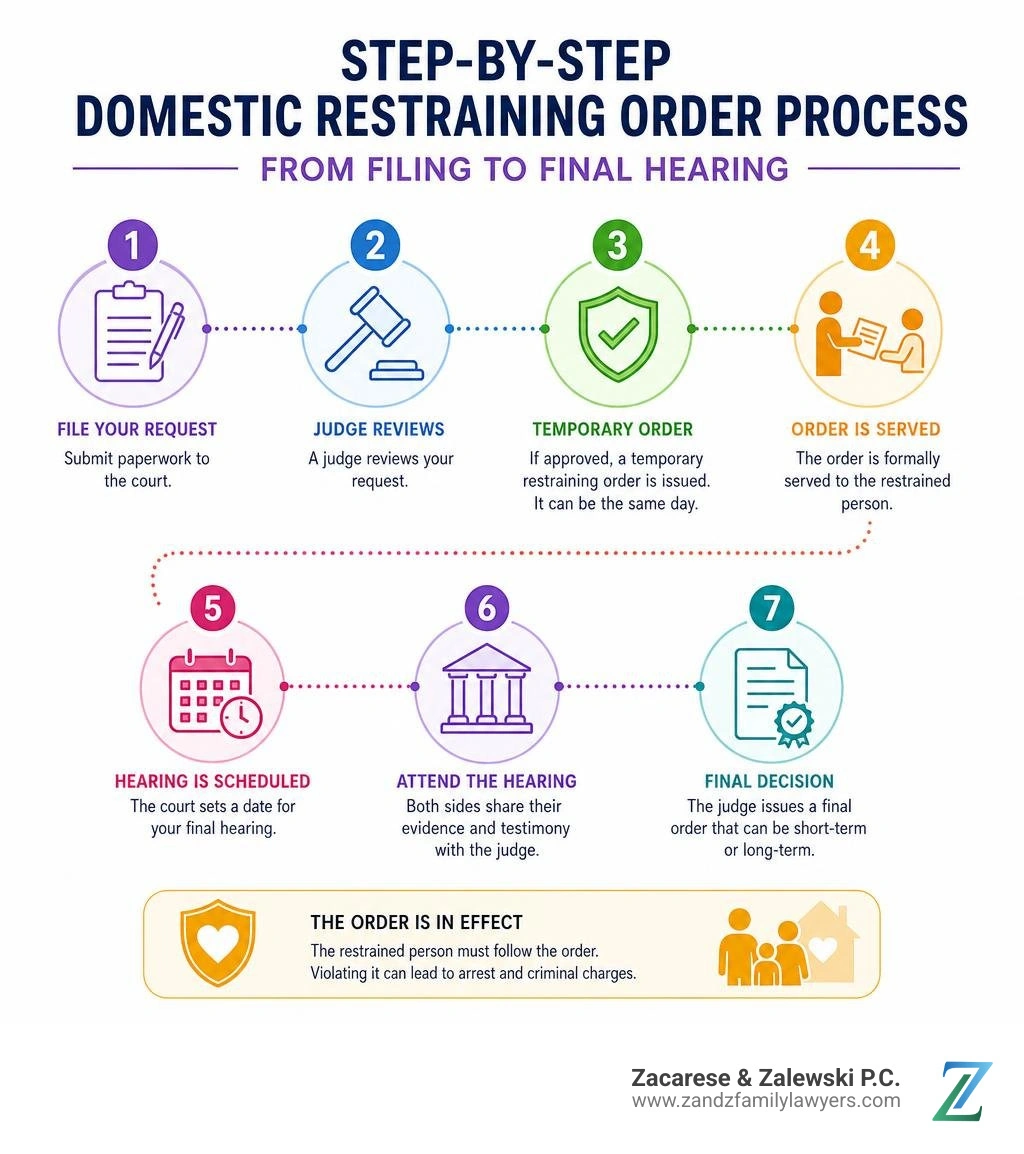
What is a Domestic Restraining Order and Who Can Get One?

When safety is on the line, the legal system has tools to help you. A domestic restraining order (often called an Order of Protection in New York) is a piece of paper signed by a judge. It tells an abuser that they must stay away from you or face immediate arrest.
But who exactly can get one of these orders? It is not just for married couples. The law is designed to protect people in many different kinds of relationships. If you want to know if your specific situation fits, you can learn more about whether an order of protection can be filed regardless of the relationship.
In general, these protective orders are meant for people who have a close personal or family connection. This is different from a standard civil restraining order, which you might use against a neighbor or a stranger who is harassing you. To get a domestic order, you must have a "qualifying relationship" with the person hurting or threatening you.
For detailed rules on how different states handle these forms, you can read the Domestic Violence Restraining Orders in California | California Courts | Self Help Guide.
Who Qualifies for a Domestic Restraining Order?
To qualify for this type of protection, you and the other person must fall into one of these groups:
- You are married or used to be married.
- You are dating or used to date.
- You have a child together.
- You are closely related by blood or marriage (like parents, siblings, or in-laws).
- You live together or used to live together as a family unit.
What if you are under 18? Many people do not know that minors can ask for help too. For example, in California, anyone who is 12 years or older can file for a domestic restraining order on their own without needing a parent's permission. In other states, emancipated minors or pregnant teens can file just like adults.
If you are ready to see what the actual paperwork looks like, you can view the official DV-100 Request for Domestic Violence Restraining Order form.
Types of Abuse Covered Under the Law
Many people think you can only get a restraining order if someone physically hits you. That is a common myth. The law recognizes that abuse comes in many forms. You do not have to wait for physical violence to ask a court for help.
The law covers several types of abusive behavior:
- Physical Violence: Hitting, kicking, pushing, choking, or throwing things.
- Threats of Harm: Saying they will hurt you, your children, or your pets.
- Emotional and Verbal Abuse: Constant harassment, stalking, or destroying your property.
- Coercive Control: Tracking your movements, isolating you from friends, or threatening your immigration status.
- Financial Isolation: Blocking your access to bank accounts, taking your money, or preventing you from keeping a job.
- Digital Harassment: Sending 50 text messages a day, tracking you with GPS, or posting private things about you online.
- Pet Protection: Threatening or harming your family pets. Yes, a judge can actually include your dog or cat in the restraining order so the abuser cannot take or hurt them!
How to Apply for a Temporary Restraining Order (TRO)

If you are in immediate danger, you cannot wait weeks for a full court trial. That is where a Temporary Restraining Order (TRO) comes in. A TRO is a fast-acting shield. It gives you immediate protection while you wait for your main court date.
To start this process, you must file a petition with the court. If you are wondering about the exact steps to do this, you can read our guide on how to file for an order of protection in family court.
When you file, you will also fill out a petition explaining what happened. For a look at how some states structure these petitions, you can check out the Wisconsin CV-402 Petition for TRO and/or Petition and Motion for Injunction Hearing (Domestic Abuse).
Step-by-Step Guide to Requesting a Temporary Domestic Restraining Order
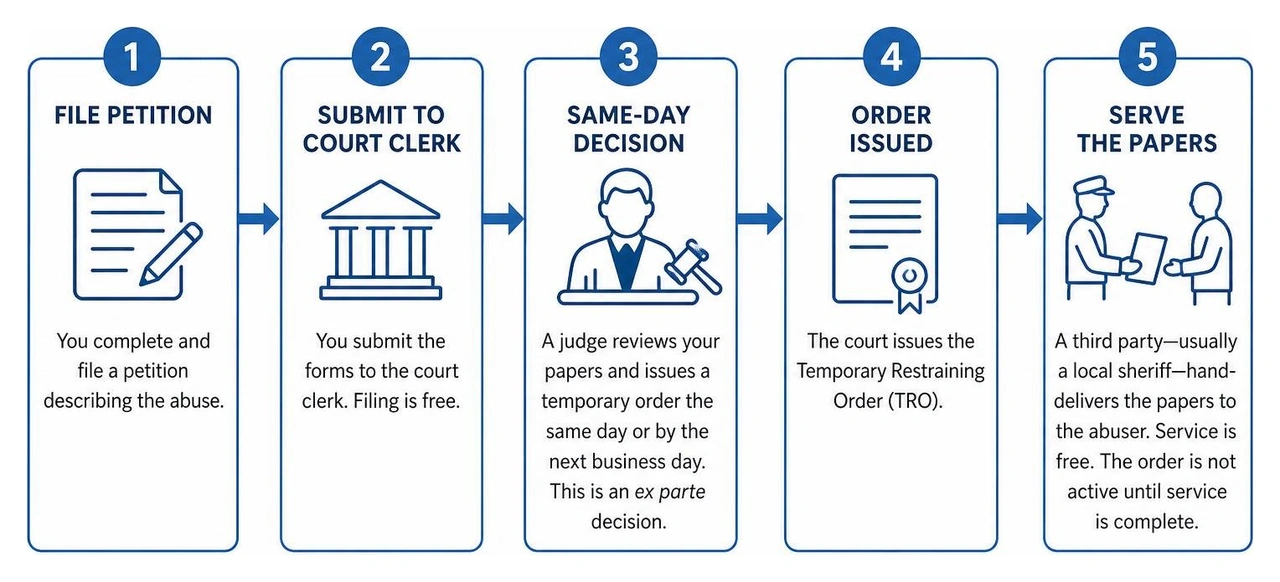
Securing emergency protection usually follows a simple path:
- Fill Out the Forms: You will write down exactly what the abuser did. Be as detailed as possible. Use specific dates, times, and descriptions of the abuse.
- Submit to the Court Clerk: There is no court fee to file for a domestic restraining order. It is completely free.
- The Same-Day Decision: A judge will review your papers. In places like California, the judge will make a decision the very same day or by the next business day. You do not even have to see the abuser for this step; it is called an ex parte decision, meaning the judge decides based only on your paperwork.
- Serve the Papers: The temporary order is not active until the abuser knows about it. A third party—usually a local sheriff—must hand-deliver the papers to the abuser. This service is also free.
For an example of what an emergency order looks like once a judge signs it, you can view this EX PARTE DOMESTIC VIOLENCE ORDER OF PROTECTION.
What Protections Can Be Included in the Order?
A domestic restraining order is highly customizable. A judge can check different boxes on the forms to give you specific types of relief.
Depending on your situation, your order can include:
- No-Contact Rules: The abuser cannot call, text, email, or message you on social media. They cannot even ask a friend to send you a message.
- Stay-Away Limits: The abuser must stay a certain distance (usually 100 yards or 300 feet) away from you, your home, your job, and your kids' school.
- Move-Out Orders: The judge can order the abuser to pack their bags and leave a shared home immediately, even if their name is on the lease or deed.
- Temporary Child Custody: The judge can give you temporary custody of your children to keep them safe until the final hearing.
- Firearm Surrender: The abuser will be ordered to immediately hand over all firearms and ammunition to law enforcement.
To see how these protections are written into official orders, you can look at the Washington FL All Family 150 Restraining Order or the Oregon FAPA Restraining Order.
What Happens at the Final Hearing and Beyond?
A temporary order only lasts for a short time—usually about two to three weeks. To get long-term protection, you must attend a final hearing. This is a formal court date where both you and the abuser have a chance to speak to the judge.
This hearing is a critical moment. To understand what a judge can and cannot do for you during this process, read about orders of protection and what they can and can't do in New York Family Court.
At the hearing, you must present evidence of the abuse. This can include:
- Screenshots of threatening text messages or emails
- Photos of injuries or damaged property
- Police reports or medical records
- Witness testimony from people who saw or heard the abuse
Here is a quick look at how temporary and final orders compare:
| Feature | Temporary Restraining Order (TRO) | Final Restraining Order (FRO) |
|---|---|---|
| How you get it | Filled out paperwork; judge decides same day | Full court hearing; both sides present evidence |
| Does abuser have to be there? | No | Yes (or must have been given legal notice) |
| How long it lasts | 10 to 30 days (until the hearing) | 1 to 5 years (or permanent, depending on the state) |
| Firearm restrictions | Yes, temporary surrender | Yes, federal and state bans apply |
| Child custody & support | Temporary/Emergency rules | Long-term custody and support plans |
How Long Do Final Orders Last and Can They Be Renewed?
If the judge rules in your favor at the final hearing, they will issue a final protective order. How long this order lasts depends entirely on what state you are in:
- California: A final order can last up to 5 years.
- New Jersey: A Final Restraining Order (FRO) is permanent and lasts forever unless a judge officially changes it.
- North Carolina: A permanent order lasts for up to 1 year, but you can renew it for up to 2 years at a time.
- New Hampshire: A final order lasts for up to 1 year, with the option to extend it for up to 5 years.
If your order is about to expire and you still feel unsafe, you can file a motion to renew it. You must do this before the original order expires.
What Are the Consequences of Violating an Order?
A domestic restraining order is not just a piece of paper—it has teeth. If the restrained person violates any part of the order, they are committing a crime.
If they show up at your house or send you a text, you should call 911 immediately. The police can arrest them on the spot. In New Hampshire, for example, violating an order can lead to up to one year in jail and a fine of up to $2,000.
If you are currently involved in a court case, it is very important to keep your record clean. To make sure you do not make any mistakes, read our list of what you should avoid doing during an active family court case.
What to Do If an Order Is Filed Against You
If someone has filed a domestic restraining order against you, you must take it very seriously. Even if you believe the claims are completely false, ignoring the paperwork will only make things worse. If you do not show up to the court hearing, the judge will likely grant everything the other person asked for in your absence.
First, read the papers carefully. They will tell you exactly what you are allowed and not allowed to do, and when you need to appear in court. You must follow every single rule in the temporary order immediately. If it says you cannot contact the other person, do not call them to "talk things over." Doing so can get you arrested.
To understand how these court cases work from the other side, you can read about family offense proceedings under Article 8.
During this time, you must also hand over any firearms you own if the order requires it. At the final hearing, you will have the chance to present your side of the story, bring your own evidence, and cross-examine witnesses. Having an experienced family law attorney by your side is the best way to protect your rights.
Frequently Asked Questions About Orders of Protection
What is the difference between a civil restraining order and a criminal protective order?
A civil restraining order (or family court order) is something you file for yourself in civil court. You do not need police involvement or criminal charges to get one.
A criminal protective order is issued by a criminal court judge, usually after the abuser has been arrested for a crime like domestic assault.
These two orders can exist at the same time. Having a civil order is highly recommended because if the criminal case gets dismissed, your civil order will still keep you protected. To learn more about how these cases are filed, check out what is an order of protection or O Docket.
Can I get child support or custody through a restraining order?
Yes! A judge in family court can make temporary decisions about child custody, visitation, and financial support as part of a domestic restraining order. This ensures you and your children have a safe place to live and the money you need to survive.
If the abuser fails to pay the ordered support, they can face serious penalties. For more details, read can I go to jail for not paying child support.
What resources are available for domestic violence victims?
If you are dealing with abuse, you do not have to walk this path alone. There are free, confidential resources available 24/7 to help you make a safety plan and find shelter:
- National Domestic Violence Hotline: Call 1-800-799-SAFE (7233) or text "START" to 88788.
- Youth Support: Text "LOVEIS" to 22522 for specialized teen dating abuse support.
- Local Crisis Centers: Most counties have local shelters that offer free legal advocates to help you fill out restraining order paperwork.
Conclusion: The Zacarese & Zalewski Advantage
Navigating a domestic restraining order in Suffolk County can feel like walking through a storm. Whether you need to secure immediate protection for your family or defend yourself against false allegations, you should not do it alone.
At Zacarese & Zalewski P.C., we do things differently. Steven Zalewski, Esq. is one of the most well-known family court trial lawyers in Suffolk County. We help clients in Islandia, Central Islip, Riverhead, and all surrounding areas with rapid-response, compassionate legal support.
The "True" Flat Fee Promise
Most law firms claim to offer affordable services, but then they hit you with hidden hourly fees the moment your case gets complicated. We do not believe in trapping our clients. We offer a "True" Flat Fee model:
- Pre-Trial Fee: This single flat fee covers absolutely everything leading up to your trial—no matter how many times we have to stand by your side in court.
- Trial Fee: A single set fee due 30 days before your trial begins.
- Payment Plans: We offer flexible payment plans to make sure you can afford the quality defense you deserve. We never leave a client behind because they ran out of money.
A Warning About AI in Family Law
It might be tempting to use AI tools like ChatGPT to draft your legal agreements or separation paperwork. Please, do not do this.
AI lacks the human touch, empathy, and deep understanding of Suffolk County Family Court rules. Using a robotic, generic document can create major errors that ruin your family's life and custody arrangements for years to come. You need a real, local human trial lawyer who knows the local judges and the local system.
If you need help today, we offer fast, same-day responses. Let us help you protect what matters most. Explore our services for Orders of Protection Lawyer Smithtown, find out about our Flat Fee Orders of Protection, or view our complete list of services at Practice Areas - Orders of Protection.
�� Email: steve@zandzfamilylawyers.com
�� Address: 1601 Veterans Memorial Highway, Suite 500, Islandia, NY 11749
i guarantee you will be heard
Ready to Take the Next Step?
At Zacarese & Zalewski P.C., when something isn’t right, say something—and we’ll do something about it with you.
Our flat-fee structure is clear: one flat fee for pre-trial work, and a trial fee only if your case goes to trial or a hearing. Call now and a professional will return your call quickly; if we miss you, we'll call back the same day.