
When you speak, I guarantee you will be heard
Zacarese & Zalewski P.C.
Securing a Domestic Violence Protective Order for Peace of Mind
Call now: 516-660-4354
"He didn't just win my case. He gave me back my future, my peace of mind, and my ability to breathe again."
From the very first conversation, he changed everything. He didn't just see a case, he saw me, and treated me like family. His knowledge of the law was unmatched, but what truly set him apart was his humanity. If you are looking for a lawyer, stop searching right now.


When You Need Protection: Understanding the Domestic Violence Protective Order
A domestic violence protective order is a civil court order that legally requires an abusive person to stay away from you, stop contacting you, and in some cases, leave your home. If you are in Suffolk County and need one, here is the short version of what you need to know:
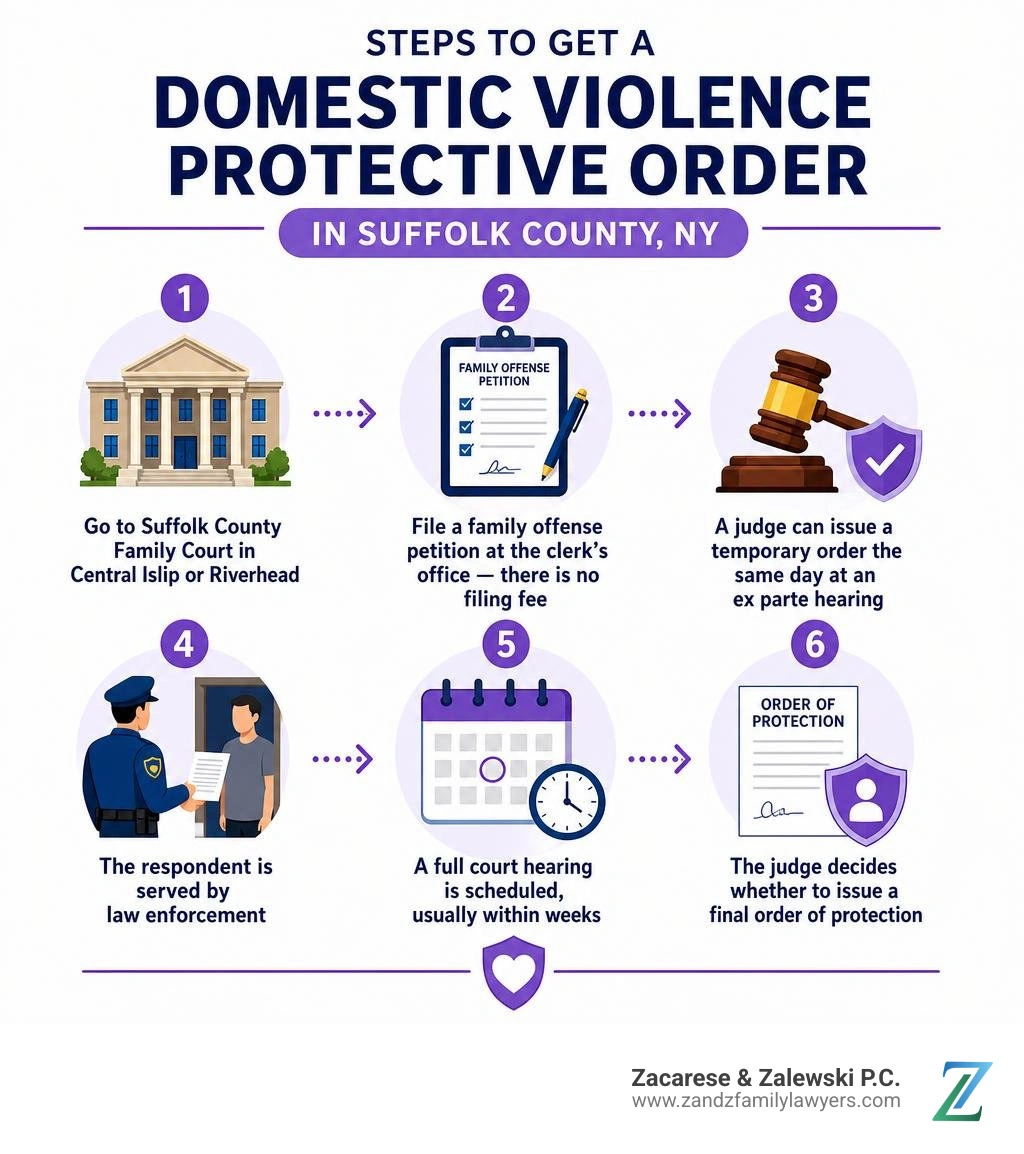
How to get a domestic violence protective order in Suffolk County:
- Go to Suffolk County Family Court in Central Islip or Riverhead
- File a family offense petition at the clerk's office — there is no filing fee
- A judge can issue a temporary order the same day at an ex parte hearing
- The respondent is served by law enforcement
- A full court hearing is scheduled, usually within weeks
- The judge decides whether to issue a final order of protection
Leaving an abusive situation — or even just trying to set a legal boundary — is one of the hardest things a person can do. The legal process can feel just as overwhelming as the situation itself.
You should not have to figure this out alone.
Orders of protection can cover more than most people realize. They can remove an abuser from your home, protect your children, restrict firearm possession, and even cover your pets. But getting the right protections in place requires filing the right paperwork, saying the right things to a judge, and knowing what to ask for.
One small detail left out of your petition can mean the difference between getting an order and being sent home without one.
That is why having an experienced Suffolk County family court attorney by your side — someone who knows the local courts in Central Islip and Riverhead — matters more than most people expect.
What is a Domestic Violence Protective Order in New York?
In New York, when people talk about a domestic violence protective order, they are usually talking about an "Order of Protection." If you file this in Family Court, it starts with what we call a family offense petition. This process is handled under a specific part of New York law known as Article 8 of the Family Court Act.
When you file this petition, the court opens what is called an "O Docket." To learn more about this specific court label, you can read our guide on What is an Order of Protection or O Docket.
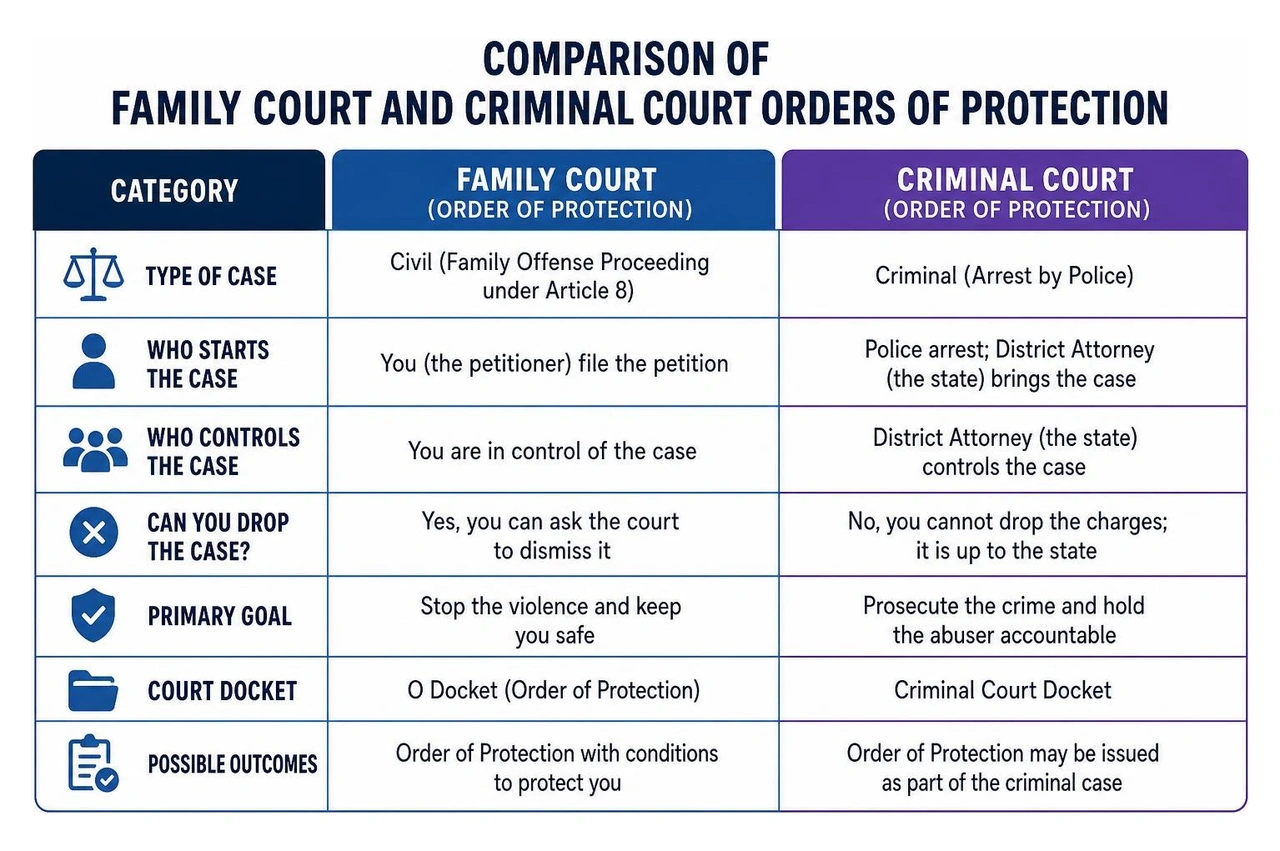
It is important to know that you can get an order of protection from two different places: Family Court or Criminal Court.
- Family Court: This is a civil court. You are the one in control of the case. You can ask to file the case, and you can also ask to drop it if you choose. The goal here is to stop the violence and keep you safe, not to send the other person to jail right away.
- Criminal Court: This court handles cases where the police have arrested the abuser. In criminal court, the District Attorney (the state) runs the case. You do not have the power to drop the charges on your own.
To help you see the differences clearly, we have put together this simple comparison:
If you want to understand how the civil process works in detail, you can read more about Family Offense Proceedings Under Article 8.
How to File for a Domestic Violence Protective Order in Suffolk County
Filing for a domestic violence protective order in Suffolk County means navigating our local court system. We have two main family court buildings where these cases are heard: the court in Central Islip and the court in Riverhead.
The filing process is completely free. The court clerks cannot charge you any fees to file your petition. To get started, you must fill out the paperwork and submit it to the clerk of the court.
For a step-by-step breakdown of how this works, check out our helpful guide on How Do I File for an Order of Protection in Family Court. If you are starting the process at the very beginning of the year, you might also find our advice on How Do I Get an Order of Protection at the Start of the Year in Suffolk County highly useful.
Step 1: Preparing Your Petition for a Domestic Violence Protective Order
Your petition is the most important document in your case. This is where you write down exactly what happened. You must list specific dates, times, and details of the abuse.
Vague statements like "he was mean to me" or "she threatened me" are often not enough. A judge needs to see the exact words used and the specific actions taken. You should detail physical abuse, threats of violence, stalking, and harassment. For example, if the person called you 50 times in a single day to scare you, write that down.
While New York has its own forms, looking at templates like the PO 040 Protection Order can help you understand the kind of strict, clear restraints and details courts look for when drafting these orders.
Step 2: Going to Suffolk County Family Court in Central Islip or Riverhead
Once you hand in your paperwork, you will have what is called an "ex parte" hearing. "Ex parte" is just a legal term that means the other person is not there. The judge will read your petition and ask you a few questions.
If the judge believes you are in immediate danger, they will issue a temporary order of protection right then and there. This temporary order will protect you until a full court hearing can be held.
After the temporary order is signed, local law enforcement (like the Suffolk County Sheriff's Department) must personally serve the paperwork to the other person. The order does not officially protect you until they have been served.
Starting a fresh chapter of your life in safety is hard, but it is possible. Read our thoughts on When a Fresh Start Requires Protection: Orders of Protection in Suffolk County to see how we help clients through this emotional step.
What Protections Can an Order of Protection Provide?
A domestic violence protective order can do a lot more than just tell someone to "stay away." It is a powerful legal tool that can reshape your living situation to keep you safe.
Depending on your situation, a judge can order the abuser to:
- Stop committing any family offenses (like harassment, stalking, or assault).
- Stay completely away from you, your home, your school, and your job.
- Move out of a shared home immediately, even if their name is on the lease or deed (this is called a "move-out order").
- Have no contact with you at all, including no texts, no phone calls, no emails, and no messages through other people.
To get a complete picture of how these rules work, you can read our detailed article on Orders of Protection: What They Can and Can't Do in New York Family Court.
Child Custody, Pets, and Firearm Restrictions
When you have children, your safety and their safety are tied together. A Family Court judge can use a protective order to make temporary decisions about child custody and visitation. This keeps your children safe while you wait for a longer-term custody case to go through court.
If you have children and are filing for protection, you may need to fill out custody-related paperwork like the Domestic Violence Protection UCCJEA Declaration to let the court know where the children have lived and who has cared for them.
Additionally, a protective order can:
- Protect Your Pets: Abusers often threaten family pets to control their victims. The court can give you sole possession of your household pets and order the abuser to stay away from them.
- Restrict Firearms: Under federal and state laws, someone with an active protective order against them is usually banned from owning or carrying guns. The judge can order them to surrender all firearms to the police immediately.
Navigating the Court Process and Hearings with a Suffolk County Trial Lawyer
After the temporary order is served, both sides must come to court for a full hearing. This is where the other person has a chance to tell their side of the story.
This hearing is a real trial. You must present evidence, such as text messages, photos of injuries, police reports, or medical records. You may also need to have witnesses testify.
Because the rules of evidence are strict, representing yourself can be very difficult. Having a skilled trial lawyer who knows the local judges and courts in Suffolk County can make a massive difference. If you live in Smithtown, Central Islip, or surrounding areas, you can learn more about how we help by visiting our pages for a Suffolk County Orders of Protection Attorney for Family Offense Cases and our Orders of Protection Lawyer Smithtown page.
The Danger of Using AI to Draft Your Domestic Violence Protective Order
In July 2026, it is easier than ever to access AI tools like ChatGPT. It might be tempting to use AI to draft your court petition or write up a custody agreement.
Please do not do this.
AI is a computer program. It does not know the local rules of the Suffolk County Family Court. It does not understand the human empathy and care needed for your unique family. AI often creates generic, "robotic" documents that leave out critical details.
One missing detail or poorly phrased sentence in an AI-drafted document can cause a judge to deny your protective order. It can also ruin your family's custody arrangements for years to come. Only a real human attorney who understands New York law can truly protect your future.
The True Flat-Fee Advantage for Your Court Hearings
Most law firms charge by the hour. They might tell you they have a flat fee, but as soon as the case gets complicated or you have to go back to court extra times, they start sending you hourly bills. Some firms will even abandon you in the middle of a case if you run out of money.
We do things differently. We believe in total transparency.
We offer a "True" Flat Fee model. This means your flat fee covers all of your court appearances for that stage of the case, no matter how many times we have to stand before a judge in Central Islip or Riverhead. We will never leave you behind because of money.
- Pre-Trial Fee: This covers all of our work, meetings, and court dates leading up to a trial.
- Trial Fee: This is a single, set fee due 30 days before your scheduled trial date.
- Payment Plans: We offer flexible payment plans to make sure you can get the high-quality legal help you deserve.
To see our straightforward pricing, check out our pages on Flat Fee Orders of Protection and Flat Fee Domestic Violence Cases.
Frequently Asked Questions About Orders of Protection
What happens if the respondent violates the protective order?
If the abuser violates any part of the order (like calling you or coming to your home), it is a crime. You should call the police immediately. The police can arrest the abuser on the spot.
In New York, violating an order of protection can lead to criminal contempt charges, jail time, and fines. To learn more about what happens when these rules are broken, read our article on Breaking an Order of Protection: What Happens in Family Court. You can also read about how these criminal matters intersect with family law on our Domestic Violence Cases page.
How long does a final order of protection last in New York?
In New York Family Court, a final order of protection usually lasts for up to two years. However, if there are "aggravating circumstances" (like the use of a weapon or a history of physical abuse), the judge can make the order last for up to five years.
If you still feel unsafe when the order is about to expire, you can ask the court to renew it. For more details on timelines, please read How Long Does an Order of Protection Last in New York Family Court and How Long Can an Order of Protection Last.
To give you an idea of how New York compares to other states, here is how long final orders can last across the country:
- North Carolina: Up to 1 year (can be renewed for up to 2 years at a time).
- Maryland: Up to 1 year.
- New Hampshire: Up to 1 year (can be extended up to 5 years).
- California: Up to 5 years.
Can I get a protective order if we don't have an intimate relationship?
To get an order of protection in Family Court, you must have a specific relationship with the abuser. This includes:
- People related by blood or marriage.
- People who are legally married or divorced.
- People who have a child together.
- People who are or have been in an "intimate relationship" (this includes dating partners).
If you do not have one of these relationships (for example, if you are being harassed by a neighbor or a stranger), you cannot file in Family Court. Instead, you would need to seek protection through Criminal Court or seek other civil remedies. For a deeper look at this rule, read Can an Order of Protection Be Filed Regardless of the Relationship.
Conclusion
Your safety and peace of mind are worth protecting. If you are facing domestic abuse, you do not have to walk through the legal system alone.
At Zacarese & Zalewski P.C., Steve Zalewski and our team are here to stand by your side. As one of the most well-known family court trial lawyers in Suffolk County, Steve knows how to navigate the courts in Central Islip and Riverhead to get you the protection you need. We offer plain-English communication, rapid same-day responses, and a true flat-fee model so you never have to worry about surprise bills.
If you are ready to take the first step toward safety, visit our main page on Orders of Protection or contact us directly using the information below. We are ready to help you.
📧 Email: steve@zandzfamilylawyers.com
🏛 Address: 1601 Veterans Memorial Highway, Suite 500, Islandia, NY 11749
i guarantee you will be heard
Ready to Take the Next Step?
At Zacarese & Zalewski P.C., when something isn’t right, say something—and we’ll do something about it with you.
Our flat-fee structure is clear: one flat fee for pre-trial work, and a trial fee only if your case goes to trial or a hearing. Call now and a professional will return your call quickly; if we miss you, we'll call back the same day.