
When you speak, I guarantee you will be heard
Zacarese & Zalewski P.C.
Free Legal Help: Finding a Pro Bono Family Court Lawyer
Call now: 516-660-4354
"He didn't just win my case. He gave me back my future, my peace of mind, and my ability to breathe again."
From the very first conversation, he changed everything. He didn't just see a case, he saw me, and treated me like family. His knowledge of the law was unmatched, but what truly set him apart was his humanity. If you are looking for a lawyer, stop searching right now.


How a Family Court Attorney Pro Bono Works and Who Qualifies

Pro bono means a lawyer takes your case for free. You do not pay for their time or legal advice. Volunteer attorneys take these cases to help people who cannot afford a private lawyer.
Finding a family court attorney pro bono is a big help, but these programs have very strict rules. Right now in October 2026, the demand for free legal help is much higher than the supply. Studies show that legal aid programs serve only one person out of every five who need civil legal help. That means four out of five people are turned away.
To get help, you must qualify under specific income rules. Most legal aid groups use the federal poverty guidelines. Often, your gross household income must be at or below 125% of the federal poverty level. In some regional areas, nearly a quarter-million people qualify under these pro bono legal aid income standards.
You must also prove where you live. Most groups only help people who live in their exact county or service area. If you make even a few dollars over the income limit, they must turn you away. Many parents wonder about handling a custody or support case without a lawyer when they cannot get free aid.
Qualifying for a Family Court Attorney Pro Bono Based on Income and Case Type
Legal aid groups look closely at your finances. Some programs set their cutoff at 50% of the state median income. If your income falls below these lines, they may waive small intake fees.
Programs also look at the type of case you have:
- Domestic violence: Emergency protective orders and safety matters almost always get top priority.
- Child custody: Cases involving child safety or sudden, major changes in your child's life get high priority.
- Uncontested divorce: Some groups help with divorce, but only if both sides already agree on everything. Many programs follow strict guidelines for uncontested civil matters and will not take cases with fighting over property or custody.
- Child support: Help is often limited to simple modifications when a parent has a sudden loss of income.
The Intake and Volunteer Matching Process for a Family Court Attorney Pro Bono
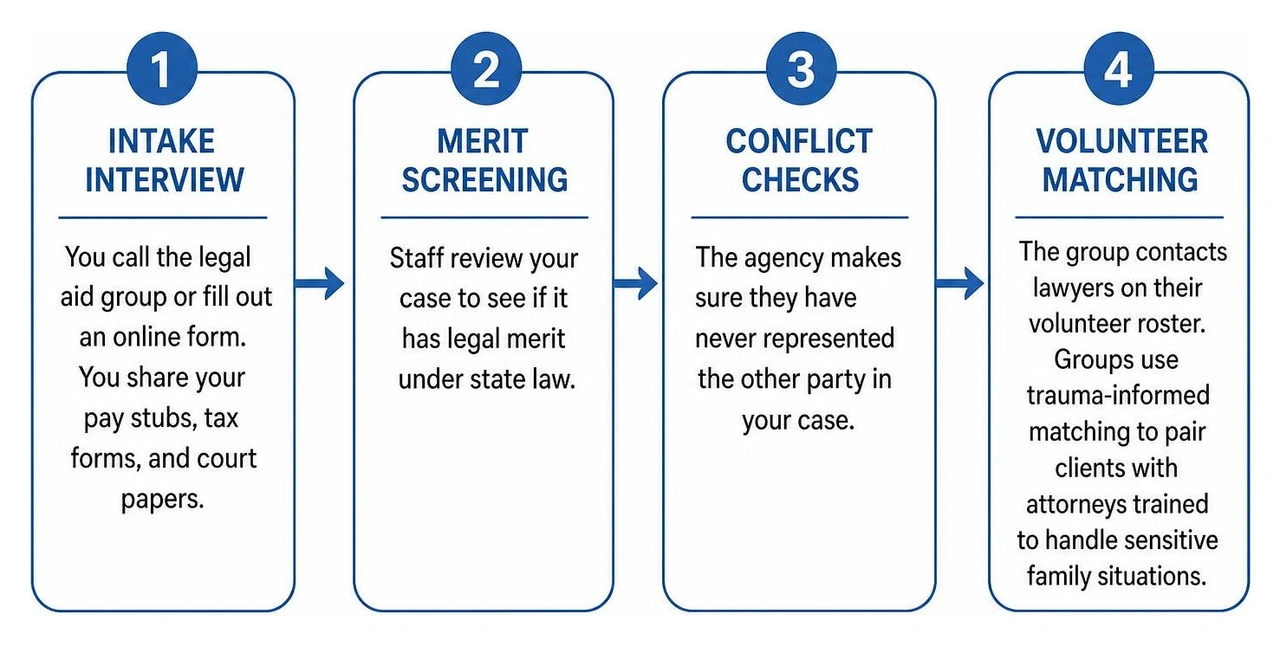
Getting matched with a lawyer takes several steps:
- The Intake Interview: You call the legal aid group or fill out an online form. You share your pay stubs, tax forms, and court papers.
- Merit Screening: Staff review your case to see if it has legal merit under state law.
- Conflict Checks: The agency makes sure they have never represented the other party in your case.
- Volunteer Matching: The group contacts lawyers on their volunteer roster. Groups like the Texas Advocacy Project use trauma-informed pro bono matching to pair clients with attorneys trained to handle sensitive family situations.
Types of Family Law Matters Handled by Pro Bono Attorneys
Pro bono lawyers take on several types of family court cases:
- Custody and Visitation: Protecting parental rights and setting up safe visitation schedules.
- Guardianship Petitions: Helping grandparents or relatives care for children when parents cannot.
- Child Support Modifications: Adjusting payments after a job loss or disability.
- Child Welfare Defense (CPS): Defending parents against child abuse or neglect claims.
In child welfare cases, having a lawyer makes a huge difference. For example, in administrative family defense programs, over 75% of appealed child protection agency indicated findings are overturned when parents have pro bono counsel. These cases take serious work. Volunteer attorneys in specialized family defense programs spend an average of 95 hours (with a median of 59 hours) on a single case.
If you face child welfare investigations in Long Island, make sure you understand the importance of representation in Suffolk County CPS cases.
State Rules, Volunteer Frameworks, and Scope Limitations
Every state sets its own rules for volunteer lawyers. For instance, Kansas Supreme Court Rule 1404 lets retired, inactive, or corporate attorneys give free or low-cost legal help through approved groups. Other states have similar approved provider lists.
Bar associations encourage pro bono work by offering perks to lawyers:
- Continuing Legal Education (CLE): Many states give lawyers free CLE credits for volunteering.
- Malpractice Insurance: Organizations often provide free malpractice insurance to cover the volunteer's work.
- Mentorship and Resources: Programs share sample forms and match new lawyers with experienced mentors.
Programs like volunteer attorney programs and court requirements in Florida require volunteers to commit to a set number of hours. Other groups provide volunteer legal support services with office space and staff support.
Even with a free lawyer, you might still face out-of-pocket costs. Clients are usually responsible for court filing fees, process server costs, and expert fees unless the court grants an official fee waiver (often called "Poor Person Relief").
Alternatives When You Do Not Qualify for Pro Bono Family Legal Aid
If your income is slightly too high for legal aid, you still have good options.
A Warning About AI and Online Form Bots
When money is tight, you might feel tempted to use artificial intelligence tools like ChatGPT to write your custody agreement, child support petition, or separation paperwork. Please do not do this.
AI tools are computer programs. They do not know the local rules of Suffolk County Family Court. They do not know the judges in Central Islip or Riverhead, and they cannot understand the emotional needs of your children. Generic, robotic AI documents often leave out vital legal protections. Fixing a broken AI agreement later in court can cost thousands of dollars more than doing it right the first time. Only a human attorney with empathy and real courtroom experience can keep your family safe.
At Zacarese & Zalewski P.C., we believe you should always know what your case will cost. Steven Zalewski is one of the most well-known family court trial lawyers in Suffolk County. He handles cases across Islandia, Central Islip, and Riverhead.
Instead of confusing hourly retainers where money disappears fast, Steve uses an honest, two-part flat-fee structure:
- Pre-Trial Fee: This set price covers every single court appearance, phone call, document, and negotiation leading up to trial—no matter how many court dates it takes.
- Trial Fee: If your case cannot settle and must go to a full trial, this is a single, clear fee due 30 days before the scheduled trial date.
Many other law firms switch back to high hourly rates or drop clients in the middle of a case when things get messy. Steve never leaves a client behind because they ran out of money. We also offer payment plans to keep your defense manageable.
To learn more about our approach, check out our guides on:
- Flat fee family court representation explained
- How flat fee family court lawyers work in New York
- Affordable custody lawyer flat fee options
- Finding an affordable family lawyer near me
- Understanding what a flat fee includes
- The truth about family court flat fees
- Cost of a family court lawyer in Suffolk County
- Suffolk County flat fee family court lawyer
Frequently Asked Questions About Pro Bono Family Court Representation
Are pro bono family court attorneys completely free of all costs?
The lawyer's time and legal advice are 100% free. However, courts charge fees for filing petitions, processing index numbers, and serving papers on the other party. If you cannot afford these fees, your lawyer can help you file a "Poor Person Relief" petition asking the judge to waive them.
What can I do if legal aid denies my family law application?
First, ask if you can appeal their decision, especially if you have high medical bills or sudden debt that lowers your usable income. If you still do not qualify, consider flat-fee private attorneys who offer payment plans.
How long does it take to get matched with a volunteer lawyer?
It can take several weeks or even months to get matched with a volunteer. In emergency situations involving domestic violence or immediate danger to a child, legal aid groups can often speed up intake and file emergency orders within 24 to 48 hours.
Conclusion: Navigating Your Family Court Legal Options
Every parent and child deserves equal access to justice in family court. If you qualify for free legal aid, apply as early as possible so a volunteer lawyer can prepare your case. If you earn too much for legal aid but cannot risk handling your case alone, look for private representation with honest, upfront pricing.
We are here to protect your family and your rights without any billing surprises. If you need help with a custody battle, support issue, or CPS case, reach out to us today for a consultation with an experienced family law attorney in Suffolk County, NY.
📱 Cell: (516) 660-4354
📧 Email: steve@zandzfamilylawyers.com
🏛 Address: 1601 Veterans Memorial Highway, Suite 500, Islandia, NY 11749
i guarantee you will be heard
Ready to Take the Next Step?
At Zacarese & Zalewski P.C., when something isn’t right, say something—and we’ll do something about it with you.
Our flat-fee structure is clear: one flat fee for pre-trial work, and a trial fee only if your case goes to trial or a hearing. Call now and a professional will return your call quickly; if we miss you, we'll call back the same day.