
When you speak, I guarantee you will be heard
Zacarese & Zalewski P.C.
Know Your Legal Rights in Grandparent Visitation Battles
Call now: 516-660-4354
"He didn't just win my case. He gave me back my future, my peace of mind, and my ability to breathe again."
From the very first conversation, he changed everything. He didn't just see a case, he saw me, and treated me like family. His knowledge of the law was unmatched, but what truly set him apart was his humanity. If you are looking for a lawyer, stop searching right now.


What Grandparents Rights Cases Mean for Parents

Grandparents do not get visitation automatically. In New York, they may ask a court for visits if a parent has died or if family circumstances give them a legal basis to file. The court then looks at the child's best interests while giving weight to a fit parent's decision.
For a Suffolk County parent, a petition does not mean you must give up control of your child's schedule. For a grandparent, a close bond alone may not settle the case. The facts, the child's needs, and New York law all matter. Visitation and custody are different requests, with different legal hurdles. Understanding your rights in grandparents rights cases can help you prepare.
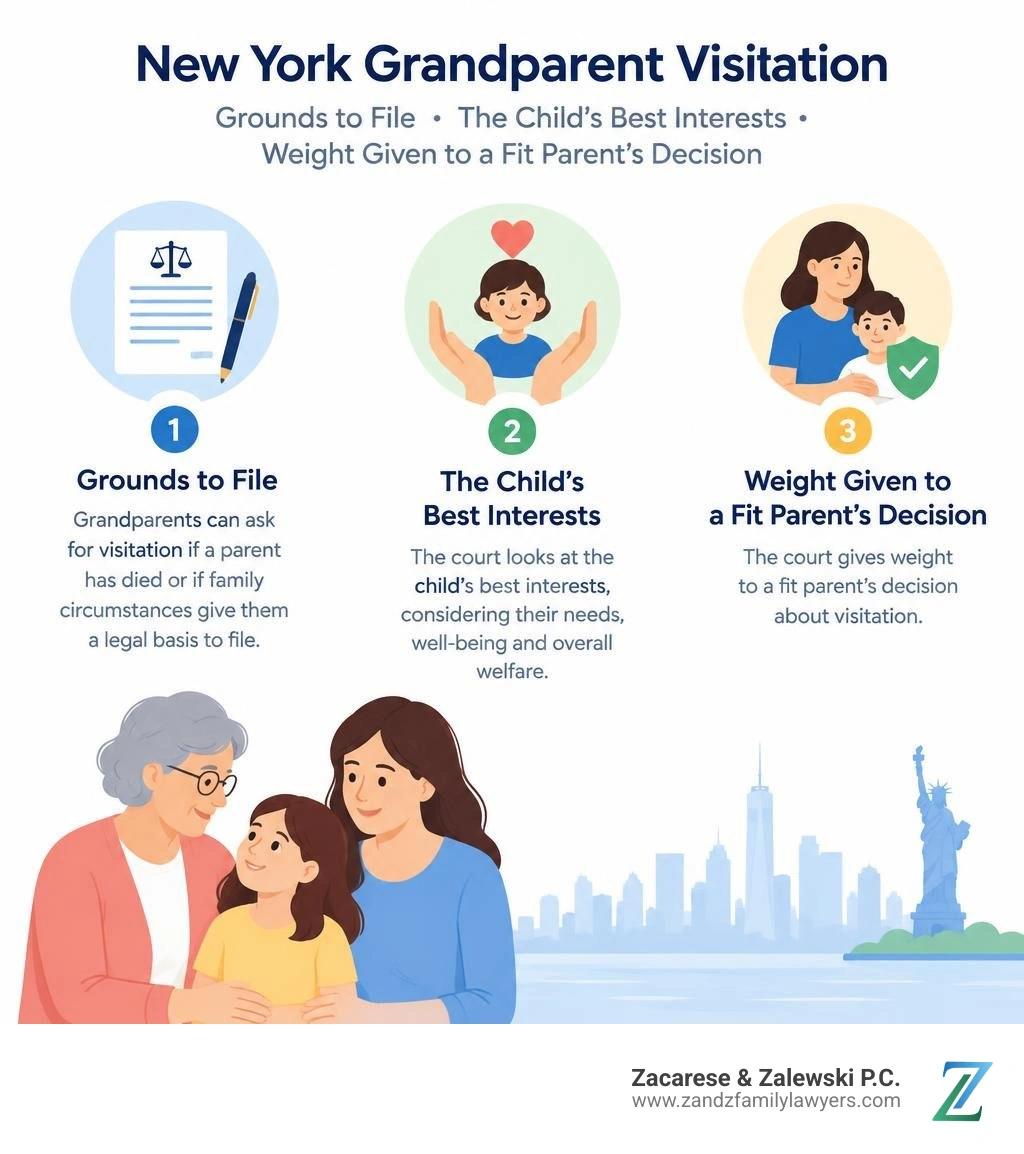
Grandparents rights cases terms made easy:
The Constitutional Balancing Act in Grandparents Rights Cases
When family disagreements reach the courtroom, judges must balance two competing interests. On one side is a grandparent’s desire to maintain a loving relationship with their grandchild. On the other side is a parent’s fundamental right under the United States Constitution to raise their children as they see fit.

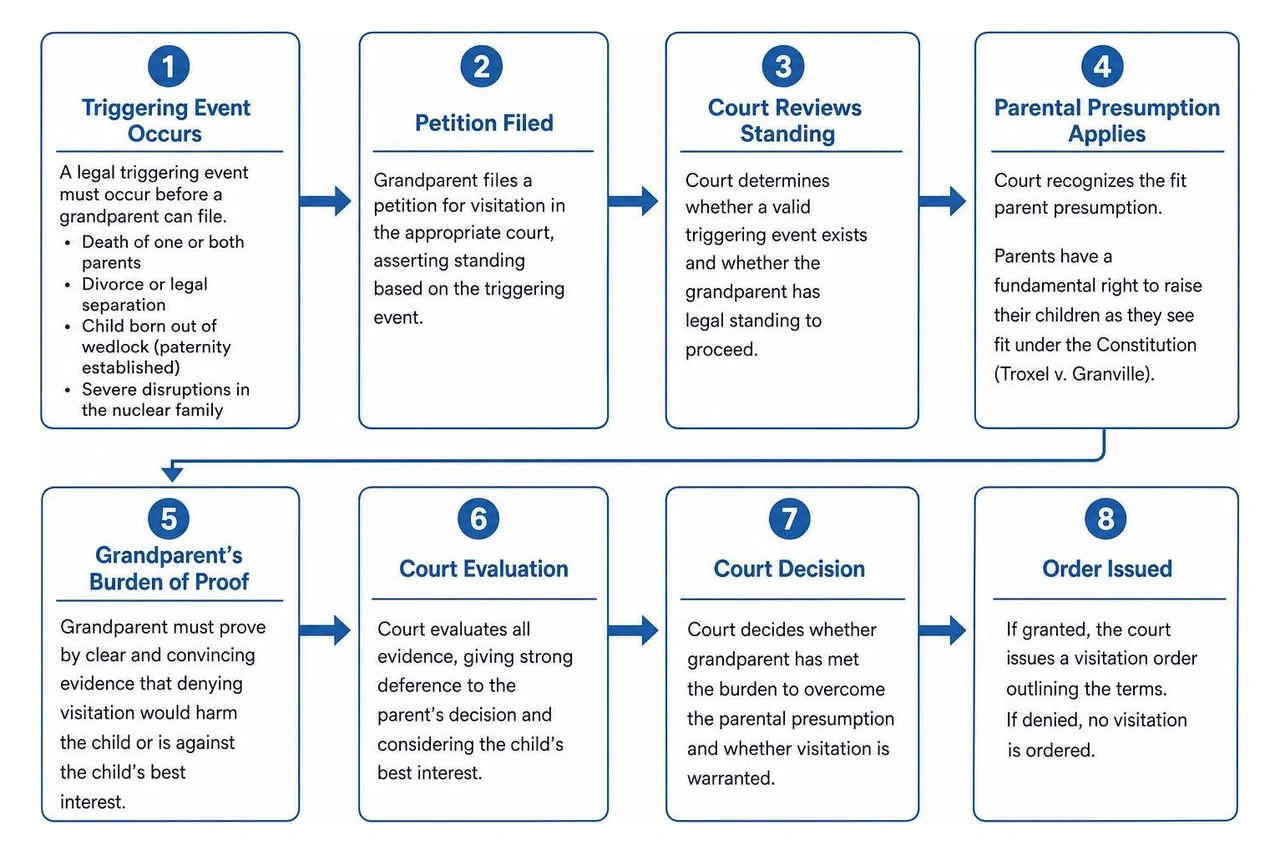
The United States Supreme Court set the ground rules for the entire country in the landmark case Troxel v. Granville (2000). The Fourteenth Amendment guarantees that parents have a fundamental liberty interest in the care, custody, and control of their children. This means the government cannot easily step into private family life to overrule a fit parent. When a dispute arises, the law gives strong deference to parents rights over grandparents.
Parental Presumption and the Clear and Convincing Evidence Standard
Under the law, courts assume that a fit parent acts in their child's best interest. This is known as the "fit parent presumption." To overcome this strong presumption, grandparents must meet a high burden of proof. In most states, they cannot simply show that visits would be nice or fun; they must prove by clear and convincing evidence that the parent’s decision harms the child or goes against the child’s best interest.
Many people wonder: is grandparent visitation a right? Legally speaking, it is not an automatic absolute right. It is a statutory privilege that courts grant only when very specific legal standards are satisfied.
The Role of Triggering Events in Grandparent Petitions
Grandparents cannot just file a court petition because they had an argument with their adult children. Before a judge will even hear the case, a legal "triggering event" must occur. Triggering events give the grandparent legal standing to open a case.
Common triggering events include:
- The death of one or both parents
- Divorce or legal separation of the parents
- A child born out of wedlock (when paternity is established)
- Severe disruptions in the nuclear family
If you live on Long Island, knowing can grandparents file for visitation in Suffolk County starts with identifying whether a valid legal trigger exists under New York Domestic Relations Law § 72.
Key State Rulings Shaping Grandparent Visitation and Custody
Across the country, different states handle grandparent visitation and custody through their own statutes and supreme court decisions.
| State | Governing Statute / Rule | Legal Requirement to Grant Visitation |
|---|---|---|
| Wisconsin | Wis. Stat. § 767.43(3) | Clear and convincing proof that fit parent's decision is not in child's best interest. |
| Georgia | OCGA § 19-7-3(d) | Clear and convincing evidence of actual harm to the child if denied. |
| Kentucky | KRS 405.021 | Strict definition of biological grandparents; early waiver of standing defenses. |
| Ohio | R.C. 2151.42(B) | Court must formally find a parent unsuitable before granting custody to non-parents. |
| New York | DRL § 72 | Standing via death of parent or equity, followed by best-interest review. |
Landmark Precedents in State Grandparents Rights Cases
Two major state supreme court rulings demonstrate how courts protect parental autonomy against overly broad visitation laws:
- Wisconsin (Michels v. Lyons): Under Wis. Stat. § 767.43(3), Wisconsin’s Grandparent Visitation Statute applies to nonmarital children whose parents have not married. In Michels v. Lyons (see also the Wisconsin Supreme Court text), the Wisconsin Supreme Court held that grandparents must overcome the presumption favoring fit parents with clear and convincing evidence. The court applied strict scrutiny, holding that the law was unconstitutional as applied when it overrode fit parents who set reasonable boundaries (such as objecting to safety concerns like riding horses without helmets).
- Georgia (Patten v. Ardis): In Patten v. Ardis, the Georgia Supreme Court struck down a portion of the 2012 Grandparent Visitation Rights Act (OCGA § 19-7-3(d)). The statute allowed courts to order visitation following a parent's death without requiring a clear showing of harm to the child. The court ruled that state interference requires clear and convincing evidence that denying visits would directly harm the child's health or welfare.
Recent Custody and Standing Decisions in Grandparents Rights Cases
Standing and suitability rules also decide custody battles:
- Kentucky (Whitley v. Shelton): In the 2025 ruling Whitley v. Shelton, the Kentucky Court of Appeals affirmed that KRS 405.021 limits visitation petitions to biological grandparents, excluding step-grandparents. The court also highlighted the standing waiver doctrine—parties must raise lack-of-standing objections immediately, or they forfeit the defense.
- Ohio (Court Must Find Parent Unsuitable): In October 2026, the Supreme Court of Ohio made headlines in Court Must Find Parent Unsuitable Before Granting Custody of Child to Grandparents. The court ruled that juvenile courts cannot transfer child custody to grandparents without an express finding in that proceeding that the natural parent is unsuitable.
- New York: Similarly, New York requires a showing of parental unfitness or extraordinary circumstances before custody can be awarded to non-parents. Understanding what extraordinary circumstances mean for grandparent custody in Suffolk County is essential for anyone facing a custody petition in Islandia, Central Islip, or Riverhead.
Critical Evidence and Courtroom Realities: The Rhode Island Dispute
Real-world family court battles often involve deep emotional distress and complex evidence. In one prominent Rhode Island case, a widowed father fought his late wife's parents over visitation rights to his young daughter. The father shared his journey after the court ruled in his favor in an interview where the dad speaks out after winning grandparents' visitation rights case.
When family relationships break down, situations can leave grandparents caught in the middle when contact with a grandchild is cut off. In the Rhode Island matter, recorded conversations played a central role in exposing deep tensions between the father and the grandparents.
Medical Conduct, Contempt Orders, and Evidentiary Impact
The Rhode Island battle turned largely on concerns regarding medical boundaries. The father presented evidence that the grandparents—who were medical professionals whose licenses later expired after closing their practice—had engaged in intrusive medical conduct with the child, including an incident involving forced medication.
Although the family court judge did not issue a formal medical malpractice ruling, the evidence showed that the grandparents undermined the father’s parental authority. During the litigation, the father was temporarily held in contempt and fined $2,500 for refusing to resume temporary visits due to safety worries. The court upheld the father's right to protect his child, proving that family courts must prioritize safety and parental rights over grandparents' demands when evaluating grandparents rights.
Why You Need Real Human Legal Experience (Not Generic AI)
When facing a sensitive custody or visitation issue, some people turn to AI tools like ChatGPT to draft agreements or find legal answers. Do not use AI for family law issues, custody agreements, or separation agreements.
Generic AI chatbots do not know local court rules, do not understand nuanced family dynamics, and frequently generate generic clauses that miss critical legal protections. A robotic template cannot advocate for you before a judge or protect your child's long-term emotional well-being. Only an experienced human attorney who understands Suffolk County Family Court can protect your family.
At Zacarese & Zalewski P.C., Steven Zalewski is recognized as one of the most well-known family court trial lawyers in Suffolk County, regularly appearing in courts across Islandia, Central Islip, and Riverhead.
Unlike many firms that charge unpredictable hourly rates or walk away when a case becomes difficult, Steve operates on an honest flat-fee model:
- Pre-Trial Fee: Covers every appearance, conference, and motion leading up to trial.
- Trial Fee: A single set fee due 30 days before the scheduled trial date.
- No Hidden Surprise Bills: The flat fee covers all your court appearances, no matter how many dates are required. Steve never leaves a client behind because they ran out of money.
- Flexible Payment Plans: Accessible options designed to fit your family's budget.
Frequently Asked Questions About Grandparent Rights
Can a fit parent completely cut off grandparent visitation?
Yes. If a parent is fit and there is no court order in place, they have the legal right to decide who spends time with their child. To override that decision, a grandparent must file a petition and prove by clear and convincing evidence that visitation serves the child's best interests or that denying visits causes real harm. If you need representation, consult a knowledgeable grandparents visitation attorney in Suffolk County.
What qualifies as an extraordinary circumstance for grandparents seeking custody?
Custody requires a much higher standard than visitation. Grandparents must prove extraordinary circumstances, such as prolonged parental abandonment, persistent neglect, severe untreated substance abuse, or extended unassisted caregiving where the parent surrendered control. Learn more about what are extraordinary circumstances for grandparents to get custody in NY.
How do courts evaluate holiday visitation disputes involving grandparents?
Family courts respect parental authority regarding major family holidays. Judges rarely order rigid holiday visitation for grandparents if it disrupts the child's immediate family schedule. Review grandparents holiday visitation rights in Suffolk County and what the law actually allows to understand local court trends.
Conclusion
Whether you are a parent defending your right to raise your child or a grandparent seeking to preserve an essential bond, navigating family court requires clear advice and dependable courtroom advocacy. Understanding your options in grandparent custody and visitation matters ensures you protect your loved ones effectively.
📱 Cell: (516) 660-4354 📧 Email: steve@zandzfamilylawyers.com 🏛 Address: 1601 Veterans Memorial Highway, Suite 500, Islandia, NY 11749
i guarantee you will be heard
Ready to Take the Next Step?
At Zacarese & Zalewski P.C., when something isn’t right, say something—and we’ll do something about it with you.
Our flat-fee structure is clear: one flat fee for pre-trial work, and a trial fee only if your case goes to trial or a hearing. Call now and a professional will return your call quickly; if we miss you, we'll call back the same day.