
When you speak, I guarantee you will be heard
Zacarese & Zalewski P.C.
Understanding Retainer Fees When You Hire a Family Lawyer
Call now: 516-660-4354
"He didn't just win my case. He gave me back my future, my peace of mind, and my ability to breathe again."
From the very first conversation, he changed everything. He didn't just see a case, he saw me, and treated me like family. His knowledge of the law was unmatched, but what truly set him apart was his humanity. If you are looking for a lawyer, stop searching right now.


What a Lawyer Retainer Fee Means for Your Family Case

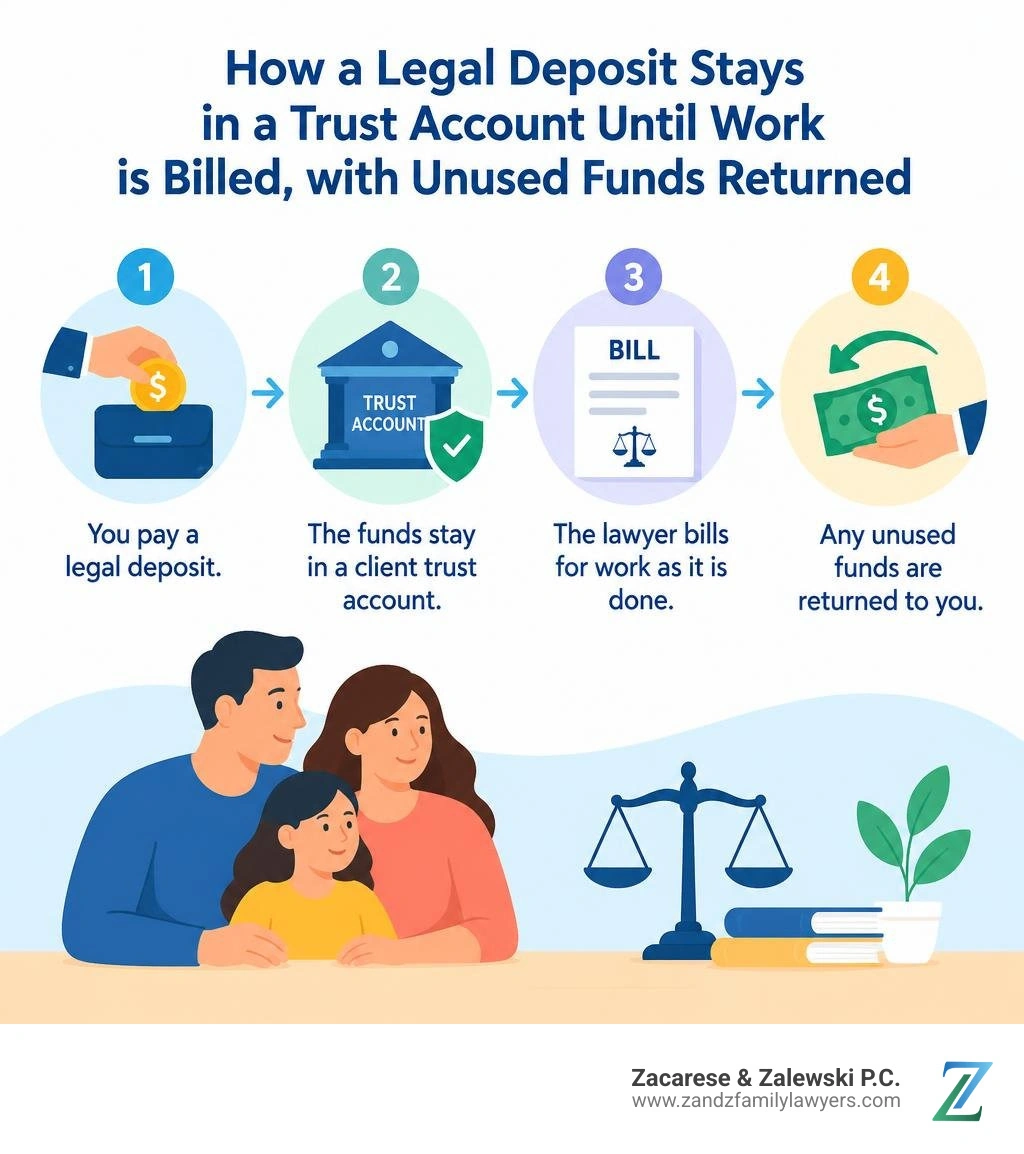
A retainer fee for a lawyer is often an upfront deposit for future legal work. The lawyer holds the unused money in a client trust account, bills for work as it is done, and returns any unearned balance when the case ends. The deposit is not a promise of the total cost. If it runs out, you may owe more.
For a custody, support, or CPS matter, ask whether the payment is a refundable deposit or a fee for the lawyer’s availability. Get the billing and refund terms in writing before you pay. Zacarese & Zalewski P.C. offers upfront flat-fee pricing for family-law matters in Suffolk County.
Essential retainer fee lawyer terms:
- family law specialist
- lawyer family law
- family court lawyers rochester ny
How a Retainer Fee Lawyer Manages and Bills Your Money

When you hire a traditional hourly attorney, they usually ask for a deposit before starting work. Many people think this initial payment is the complete price for their case. In reality, it acts like a security deposit on an apartment. The money belongs to you until the attorney actually earns it by working on your legal matter.
To manage your funds properly, law firms must follow strict accounting rules. They place your upfront funds into a special bank account called an Interest on Lawyers' Trust Account (IOLTA). An attorney cannot use this money for daily office rent or payroll. In fact, a firm's overhead costs generally eat up 35 percent to 50 percent of the fees they bring in, but your unearned deposit must stay completely separate from operating cash.
As the legal team drafts petitions, speaks with opposing counsel, or stands in court, they track their time. Most hourly firms track their day in 6-minute blocks (one-tenth of an hour). A short 7-minute phone call is rounded up to 12 minutes on your invoice. At the end of each billing cycle, the law firm sends you an itemized bill. Once that bill is produced, they move the earned amount out of the trust account and into their business account. The Wex overview of retainer agreements notes that these formal contracts define how services are tracked, how deposits are handled, and how your rights are protected throughout representation.
The Main Types of Retainer Fees in Legal Practice
Not all deposits work the same way. Knowing which contract you are signing helps you avoid surprises:
- Security Retainer / Advance Fee Retainer: This is the most common setup in family law. You pay a lump sum upfront. The money sits in escrow, and the attorney draws it down as they log billable hours. Any unused portion must go back to you once your case ends.
- General Availability Retainer: This is a fee paid solely to make sure an attorney is on call and will not take a case against you. The attorney keeps this money immediately, but they still bill extra for any actual hours spent working.
- Evergreen Retainer: With this setup, your agreement requires you to maintain a set minimum balance in your trust account. For example, if you pay a $4,000 deposit with a $1,500 evergreen floor, the firm will ask you to deposit more cash the moment your balance drops to $1,500.

How Trust Accounts and Bar Rules Protect Your Deposit
State bar associations enforce strict ethical standards regarding client funds. An attorney who mixes client trust money with their own operating funds faces severe disciplinary action.
Under established State Bar guidelines on legal fees and billing, your lawyer must provide transparent accounting of how your money is spent. If a dispute over an invoice arises, the contested amount must remain safe inside the trust account until the disagreement is resolved. Furthermore, if you decide to change counsel or if your matter settles early, the law requires the firm to refund all unearned money promptly.
The Hidden Risks and Escalating Costs of Traditional Retainers

Hiring an hourly attorney can quickly become a major financial worry during an already difficult life event. Initial retainers usually range between $1,000 and $5,000, with family court cases often starting between $2,000 and $5,000. For highly contested matters, upfront retainers can quickly exceed $10,000.
When you look at the average cost of custody cases, you begin to see how quickly billable hours add up. A simple phone call to ask a quick question can cost $40 or $60. If your lawyer sits in a courthouse hallway for three hours waiting for your case to be called, you are billed for every single minute of that waiting time.
You should also be careful about trying to cut costs with shortcut tools. Some parents try using artificial intelligence programs like ChatGPT to draft custody agreements or separation paperwork. Generic, robotic computer programs miss critical personal details and cannot understand local court rules. A flawed AI-generated agreement can cause lasting harm to your family's future. You need a real human attorney who understands local family dynamics, has real empathy, and knows the court rules inside and out.
What Happens When Your Retainer Fee Lawyer Runs Out of Funds?
A traditional retainer can vanish quickly after a few court appearances, document filings, and phone calls. When that balance hits zero, you receive an urgent notice requiring another payment.
If you are facing a situation where you cannot afford more hourly charges, understanding how to handle an attorney asking for more money mid-case is critical. Many traditional firms will stop working on your file or file a formal motion to withdraw as your counsel if you cannot replenish your trust balance.
Experiencing an attorney walking away mid-case leaves you stranded right when you need help most. Worse yet, many hourly firms demand a separate "trial retainer" of $5,000 or more if your matter cannot be settled at a conference, leaving parents scrambling for funds right before a major hearing.
The Honest Flat-Fee Alternative: Total Cost Certainty for Family Court
We believe families going through court need honesty and financial peace of mind. Steven Zalewski is one of the most well-known family court trial lawyers in Suffolk County. He created an honest flat-fee model designed to give parents complete cost certainty.
| Feature | Traditional Hourly Retainer | Steven Zalewski's Honest Flat Fee |
|---|---|---|
| Price Predictability | Unpredictable; hourly costs continue to rise | 100% fixed, transparent upfront price |
| Court Appearances | Billed per hour, including waiting in hallways | All appearances covered at no extra charge |
| Billing Increments | 6-minute rounding charges for calls and emails | Zero ticking clocks or surprise bills |
| Trial Preparation | Surprise trial retainers often exceeding $5,000 | Set Trial Fee due 30 days before trial date |
| Risk of Abandonment | Lawyer may withdraw if your money runs out | Steve stays on your case and never leaves you behind |
| Payment Options | Large lump-sum replenishments required | Flexible payment plans are always available |
We provide flat fee family court representation explained in simple, plain language. Under our system, your fee covers all necessary court appearances, no matter how many times the judge adjourns your matter or how many conferences are needed. We practice representation without per-appearance billing in Suffolk County so you never have to worry about the cost of a long court day.
Our pricing uses a simple two-part structure:
- Pre-Trial Fee: This single flat fee covers everything leading up to a trial, including all petition drafting, discovery, phone consultations, negotiation conferences, and every court appearance.
- Trial Fee: If your case cannot be resolved through settlement and must go to a formal trial, our Trial Fee is a single set fee due 30 days before the scheduled trial date.
Unlike other firms that switch back to hourly billing or walk away when a case gets difficult, Steve never leaves a client behind because they ran out of money. We offer dedicated representation across Suffolk County Family Court, including the courthouses in Central Islip, Riverhead, and our nearby offices in Islandia. Payment plans are always available to help fit your budget.
Comparing an Upfront Flat Fee to a Retainer Fee Lawyer
Studies show that 71 percent of legal clients want the option to pay with clear flat fees, yet only about half of law firms offer them. An upfront flat fee shifts the financial risk away from you and onto the law firm.
When you look at the real costs of family court lawyers in Suffolk County, open-ended hourly retainers can quickly spiral out of control. With our approach, you know the entire investment from day one. You can learn more about how flat fee family court lawyers work across New York to see how removing hourly billing creates a better, more supportive partnership between you and your attorney.
Key Questions to Ask Before Signing Any Fee Agreement
Before you sign any legal contract or pay a deposit, take time to ask these vital questions:
- What does this initial payment cover? Ask if the money is an advance deposit held in trust or a flat fee that covers the complete stage of your case.
- What happens if the money runs out? Find out if the firm will stop working or demand another large payment if your case takes longer than expected.
- Do you charge extra for routine communications? Find out whether you will be billed for every phone call, email, or text update.
- What are your court appearance rates? Ask if you will be charged for travel time and waiting time in the courthouse hallway.
- What is your trial experience? You should know if your attorney is ready to take your case all the way through a hearing. Learn more about questions to ask lawyers regarding actual trial experience.
- What is excluded from the fee? Read about understanding what flat fee pricing actually covers so you know how third-party expenses, like court filing fees or process servers, are handled.
Frequently Asked Questions About Lawyer Retainer Fees
Is a lawyer retainer fee refundable if my case settles early?
Yes, under American Bar Association ethics rules and state bar regulations, any unearned money held in an advance fee trust account belongs to you. If your family law matter reaches a prompt settlement or you decide to end representation before all the funds are billed, the lawyer must reconcile the account and return the remaining balance to you.
How much does an average family law retainer cost?
Most traditional family law retainers fall between $2,000 and $5,000 for standard child custody, child support, or divorce proceedings. However, if there are high-conflict disagreements, emergency hearings, or complex business assets involved, initial retainers often exceed $10,000. To understand how these expenses add up over time, review our guide on the true financial scope of child custody litigation.
What is the difference between a retainer and a flat fee?
An hourly retainer is simply a down payment deposited into an escrow account from which an attorney bills their time in fractional increments. The total cost is unknown and can grow indefinitely. A transparent flat fee is a fixed, clear price for legal representation that covers your legal services without surprise bills or hourly tracking.
Conclusion
Facing a custody, support, or family court matter is challenging enough without worrying about an unpredictable hourly bill. At Zacarese & Zalewski P.C., we provide honest, compassionate legal help with zero hidden surprises. If you need a trusted flat fee family court lawyer in Suffolk County NY who will stand by your side from start to finish, contact us today to discuss your case and learn more about our simple payment plans.
📱 Cell: (516) 660-4354 📧 Email: steve@zandzfamilylawyers.com 🏛 Address: 1601 Veterans Memorial Highway, Suite 500, Islandia, NY 11749
i guarantee you will be heard
Ready to Take the Next Step?
At Zacarese & Zalewski P.C., when something isn’t right, say something—and we’ll do something about it with you.
Our flat-fee structure is clear: one flat fee for pre-trial work, and a trial fee only if your case goes to trial or a hearing. Call now and a professional will return your call quickly; if we miss you, we'll call back the same day.