
When you speak, I guarantee you will be heard
Zacarese & Zalewski P.C.
Step into Family Court Knowing Exactly What to Expect
Call now: 516-660-4354
"He didn't just win my case. He gave me back my future, my peace of mind, and my ability to breathe again."
From the very first conversation, he changed everything. He didn't just see a case, he saw me, and treated me like family. His knowledge of the law was unmatched, but what truly set him apart was his humanity. If you are looking for a lawyer, stop searching right now.


What to Expect at a Custody Hearing: The Main Types of Proceedings

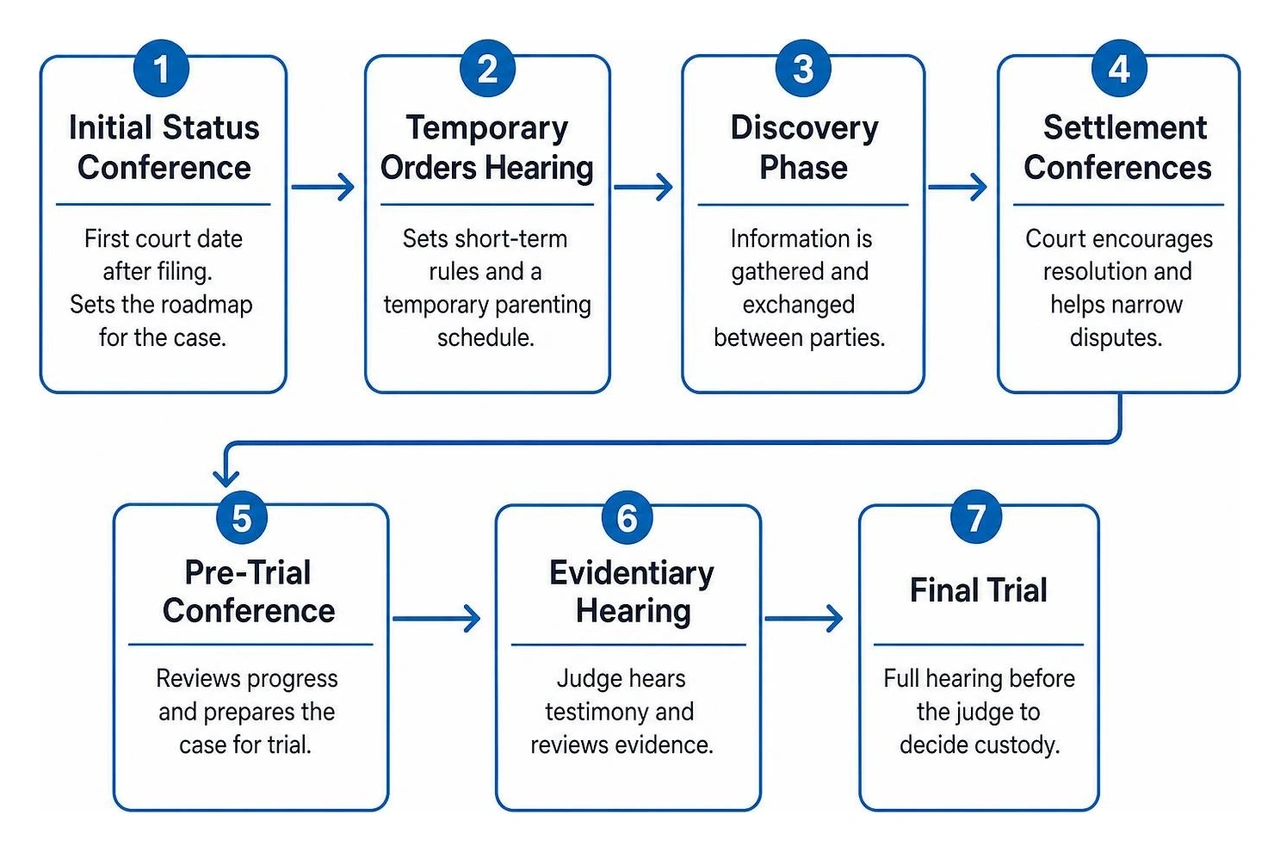
At a custody hearing, you can expect the judge to first address short-term needs, such as temporary parenting schedules and safety rules, then move toward settlement conferences or a full trial where the judge weighs the best interests of your child. Walking into a courthouse can feel intimidating. Whether your case is heard at the Suffolk County Family Court in Central Islip or out in Riverhead, knowing the roadmap makes a world of difference. Courts handle custody disputes in stages, and not every court date involves an intense trial.
Understanding what happens at your first custody hearing helps set realistic expectations. In smaller courts, your initial hearing might occur about three months after filing, while in larger courts, the wait can be five months or longer. The type of proceeding scheduled determines what the judge expects to accomplish on that day.
What to Expect at a Custody Hearing for Temporary Orders
The court often begins by addressing short-term needs. A temporary order hearing sets the rules while your case moves forward. If there is an urgent safety concern, a parent may file an emergency motion for immediate relief. In standard cases, the judge establishes a temporary parenting schedule to maintain daily stability for your child.
Temporary orders protect the child's routine—covering school drop-offs, weekend visits, and basic child support—until the court can hold a full hearing.
| Feature | Temporary Custody Orders | Final Custody Orders |
|---|---|---|
| Primary Purpose | Provide immediate stability during litigation | Establish long-term legal and physical custody |
| Duration | Lasts until the next court order or trial | Permanent until legally modified |
| Evidence Required | Basic affidavits, school schedules, urgent facts | Comprehensive exhibits, witness testimony, cross-examination |
| Modification Standard | Adjusted by judge as case details unfold | Requires proving major changes in your child's life |
Full Evidentiary Hearings and Final Custody Trials
When parents cannot reach an agreement, the case heads to a trial, also called a full evidentiary hearing. While most initial court dates last under two hours, contested trials with multiple witnesses can span full days or multiple sessions. Preparing for trial can take a year or more.
During the trial, both sides give opening statements, enter formal exhibits into the record, and conduct direct and cross-examination of witnesses. The judge reviews all admissible evidence before issuing a final ruling. Solid family court trial preparation is essential to ensure that your side of the story is properly presented under the rules of evidence outlined for official Custody and Visitation Hearings.
Who Is in the Courtroom and How Decisions Are Made
Entering the courtroom, you will see several key professionals working together to manage the proceeding:
- The Family Court Judge or Court Attorney-Referee: The judicial officer who hears testimony, reviews evidence, and makes legal rulings.
- The Court Clerk: The administrative officer who tracks exhibits, manages case files, and calls cases onto the court calendar.
- The Court Officer (Bailiff): The law enforcement officer responsible for courtroom security, maintaining decorum, and swearing in witnesses.
- The Court Reporter: The professional who records every spoken word to create the official legal transcript.
Key Roles: Guardian ad Litem and the Attorney for the Child
In contested cases, the judge often appoints an independent professional to ensure the child's interests are protected. It is vital to understand the difference between these roles when learning how custody is decided in Suffolk County Family Court:
- Attorney for the Child (AFC): Represents the child's stated wishes directly in court, acting as their dedicated legal advocate.
- Guardian ad Litem (GAL): An independent investigator appointed by the court to examine the family situation, conduct home visits, speak with teachers, and report what arrangement best serves the child.
- Custody Evaluator: A licensed mental health professional or social worker who conducts psychological assessments and submits detailed evaluations to the judge. These evaluations can range from several thousand to tens of thousands of dollars depending on complexity.
How Judges Weigh the Best Interests of the Child
Judges do not decide custody based on which parent seems angrier or who has a bigger house. Instead, they apply the legal standard known as the "best interests of the child." To understand what judges actually look for in a custody case, consider the key factors evaluated during hearings:
- Caregiving History: Who primarily handles daily routines, meal preparation, bedtime schedules, and medical visits.
- Emotional Bonds: The quality of the child's connection with each parent and their siblings.
- Home and School Stability: Keeping the child in their familiar school district, extracurricular activities, and community setting.
- Parental Cooperation: Which parent actively encourages a healthy, ongoing relationship between the child and the other parent.
- Safety and Well-being: Any verified history of domestic violence, substance abuse, or neglect.
How to Prepare Your Evidence, Documents, and Witnesses
The outcome of a custody hearing relies on clear, organized facts rather than emotional accusations. Keeping your paperwork well-structured helps present your everyday involvement clearly to the judge.

Useful guidance on gathering records is available through state resources on child custody and parenting time.
Digital Evidence, App Logs, and the Dangers of AI in Custody Cases
Digital proof plays a central role in modern family court. Text messages, emails, and logs from co-parenting applications can confirm missed pickups or demonstrate an unwillingness to cooperate. When presenting digital evidence:
- Print full conversation threads showing complete context, dates, timestamps, and phone numbers.
- Avoid cropped screenshots, which can be challenged or excluded as incomplete under hearsay rules.
- Keep a simple timeline of key dates so you can reference events quickly during your testimony.
A Warning About AI in Family Law:Do not rely on artificial intelligence tools like ChatGPT to draft custody petitions, parenting plans, or separation agreements. Generic, robotic AI systems do not understand the specific local rules of Suffolk County Family Court. They miss critical nuances regarding legal custody, decision-making authority, and tax exemptions—such as the child tax credit of $2,200 per qualifying child. A generic AI prompt cannot replace an experienced attorney who understands local court practices and protects your family's future.
Preparing Your Testimony and Selecting Credible Witnesses
When testifying, keep your answers calm, direct, and focused on your child's daily needs. Avoid arguing with the opposing lawyer during cross-examination. Answer only the question asked, and speak truthfully.
When selecting witnesses, choose individuals who have personally observed your parenting rather than friends offering general character statements:
- Teachers and Daycare Providers: Can testify about attendance, homework completion, and who attends parent-teacher conferences.
- Pediatricians or Counselors: Can confirm regular medical care and emotional well-being.
- Coaches or Extracurricular Leaders: Can verify consistent involvement in community activities.
Essential Documents Checklist to Bring to Court:
- Certified copies of birth certificates and existing court orders
- Complete school report cards and attendance records
- Medical, dental, and counseling records
- Printed co-parenting communication logs with clear timestamps
- Proof of income, pay stubs, and recent tax returns
- A proposed daily parenting plan and holiday schedule
Courtroom Etiquette and Hearing Day Procedures
How you present yourself in court matters. Arrive at least 45 minutes early to clear security checkpoints and locate your assigned courtroom. Reviewing what happens at your first family court hearing in Suffolk County will help you feel prepared.
- Dress Appropriately: Dress in clean, professional attire, similar to what you would wear to an important job interview.
- Addressing the Court: Always address the judge or referee as "Your Honor." Stand when speaking, and never interrupt the judge, attorneys, or witnesses.
- Device Policies: Turn off or silence your mobile phone before entering the courtroom. Taking photos or recording audio is strictly prohibited.
- Composure: Keep your reactions neutral. Do not sigh, roll your eyes, or shake your head when the other parent is testifying.
Step-by-Step Walkthrough: What to Expect at a Custody Hearing on Court Day
- Arrival and Check-In: Pass through the metal detectors at the courthouse entrance, locate your assigned courtroom, and check in with the court officer or clerk.
- Waiting Area: Wait quietly in the hallway or designated waiting room until your case name and docket number are called.
- Entering the Courtroom: Take your seat at the assigned table alongside your legal counsel.
- Case Call and Arguments: The judge reviews the status of the case, hears arguments from both attorneys, and listens to recommendations from the child's attorney.
- Orders and Next Steps: The judge issues a temporary ruling or schedules future dates for discovery, conferences, or trial.
Settlement Conferences and Out-of-Court Resolutions
Most custody matters are resolved outside of a contested trial. Courts frequently order parents to participate in mediation or settlement conferences. In mediation, a neutral third party helps both parents create a workable parenting plan. If you reach an agreement, the terms are written into a formal consent order signed by the judge, avoiding the stress and financial cost of an extended trial.
Clear Legal Pricing and Finding the Right Family Trial Lawyer
Litigating a custody dispute can be costly. Initial court filing fees generally range from $200 to over $400, and ongoing hourly legal fees can add up quickly. Many traditional law firms bill by the hour, which can lead to unpredictable monthly invoices. When cases become complicated, some firms demand extra retainers or withdraw from representation if funds run low.
At Zacarese & Zalewski P.C., we do things differently. Steven Zalewski is one of the most well-known family court trial lawyers in Suffolk County, regularly representing parents across Islandia, Central Islip, and Riverhead. We operate on a clear, honest flat-fee model designed to provide certainty:
- Pre-Trial Fee: A set flat fee that covers all legal work, document preparation, negotiations, and courtroom appearances leading up to trial—regardless of how many court dates are required.
- Trial Fee: A single, clear fee due 30 days before the scheduled trial date if your case proceeds to a full evidentiary hearing.
- No Abandonment: We never walk away from our clients mid-case because a matter takes additional court appearances.
- Payment Plans Available: Structured payment plans are available to help keep dedicated legal advocacy manageable.
To learn more about case budgeting, explore our breakdown on how much custody cases cost and read our child custody lawyer guide.
Frequently Asked Questions About Custody Hearings
How long does a typical custody hearing take?
Initial status appearances and temporary order conferences usually last between 15 minutes and two hours. However, contested trials with witness testimony can take anywhere from a full day to several sessions spaced over several months.
Will my child have to testify in front of both parents?
In almost all situations, children do not testify in open court. Instead, the judge may conduct a private conversation in chambers, known as an in camera interview. The child's attorney and a court reporter are present, but parents and their lawyers are excluded to protect the child from unnecessary stress.
What happens if I disagree with the judge's final decision?
If you believe the judge made a legal error, you have the right to file an appeal. Strict deadlines apply; in some jurisdictions, notices of appeal must be filed within 10 to 30 days of receiving the written order. If your circumstances experience major changes down the road, you can file a petition to modify the existing order.
Conclusion
Facing a custody hearing does not mean you have to navigate the courtroom alone. By arriving organized, keeping the focus entirely on your child's well-being, and having an experienced trial attorney by your side, you can approach your court dates with confidence.
At Zacarese & Zalewski P.C., we provide honest, flat-fee representation to families across Long Island. For dedicated legal guidance in your family court matter, learn more about our Suffolk County child custody representation.
📱 Cell: (516) 660-4354 📧 Email: steve@zandzfamilylawyers.com 🏛 Address: 1601 Veterans Memorial Highway, Suite 500, Islandia, NY 11749
i guarantee you will be heard
Ready to Take the Next Step?
At Zacarese & Zalewski P.C., when something isn’t right, say something—and we’ll do something about it with you.
Our flat-fee structure is clear: one flat fee for pre-trial work, and a trial fee only if your case goes to trial or a hearing. Call now and a professional will return your call quickly; if we miss you, we'll call back the same day.