
When you speak, I guarantee you will be heard
Zacarese & Zalewski P.C.
Protect Your Child Custody Rights Without Being Married
Call now: 516-660-4354
"He didn't just win my case. He gave me back my future, my peace of mind, and my ability to breathe again."
From the very first conversation, he changed everything. He didn't just see a case, he saw me, and treated me like family. His knowledge of the law was unmatched, but what truly set him apart was his humanity. If you are looking for a lawyer, stop searching right now.


How Unmarried Parents Can Protect Their Custody Rights

In custody battles between unmarried parents, start by confirming who the child's legal parents are. If paternity has not been established, an unmarried father may need to sign a legal acknowledgment or seek a court order. Next, ask the court for a custody and parenting-time order that sets out where the child will live, how major decisions will be made, and when each parent will see the child.
Being named on a birth certificate does not, by itself, create a parenting schedule. In Suffolk County, the court decides disputed custody based on the child's best interests. The rules can differ in other states, so check which court can hear your case before filing.
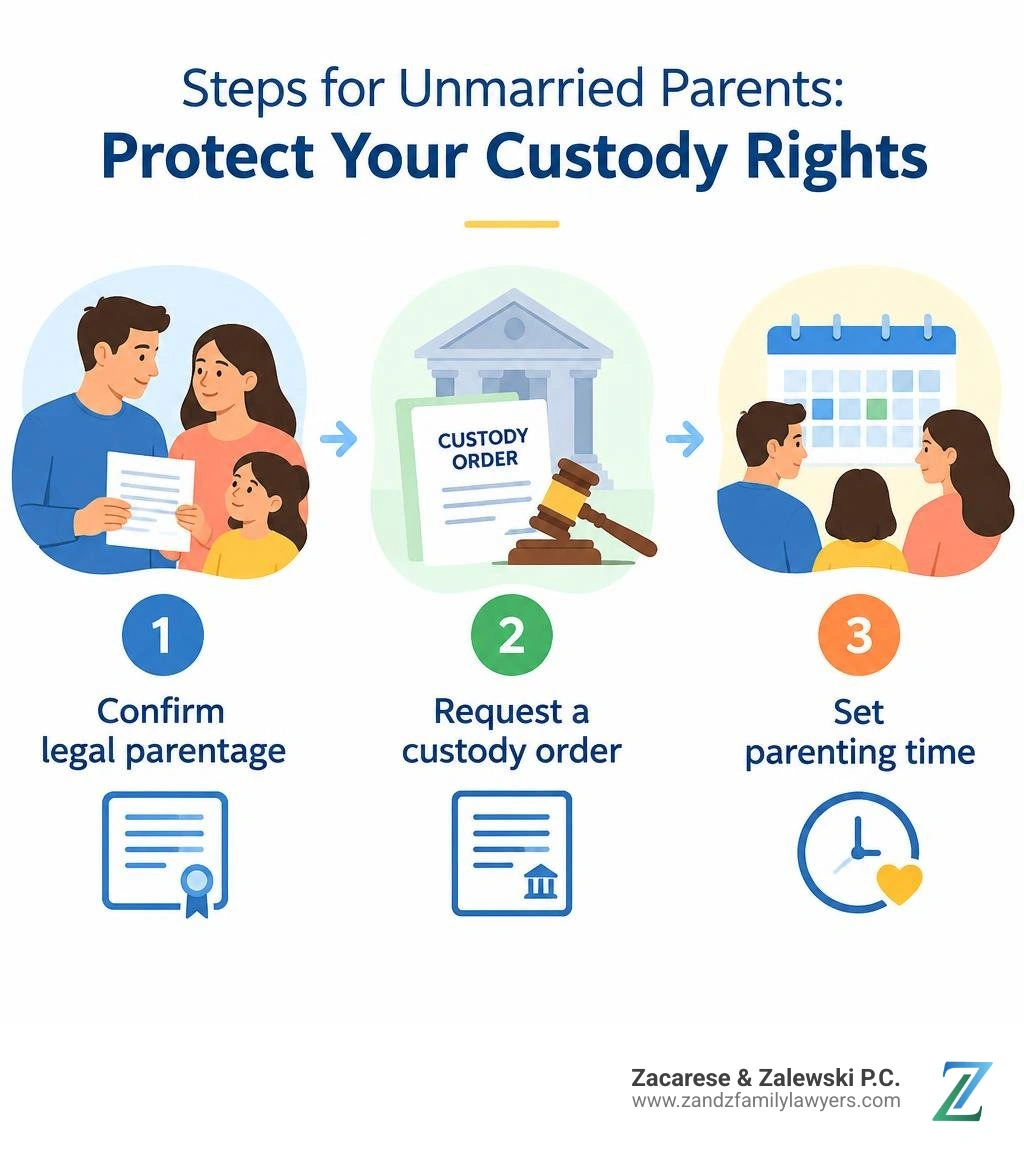
Quick custody battles unmarried parents definitions:
Understanding Legal Ground Rules in Custody Battles: Unmarried Parents vs Married Couples

When married couples split up, the law automatically recognizes both individuals as legal parents from day one. In contrast, legal rules work very differently when parents were never married. Many parents ask, do mothers get full custody right away? In almost every state, the law gives the mother automatic legal and physical custody at birth.
This means an unmarried father does not start with automatic visitation or decision-making rights. Simply writing a name on the birth certificate does not create an enforceable schedule. To understand how these foundational rules function across the country, reviewing an overview of state-by-state custody rules helps clarify what unmarried parents face in court.
Default Custody Presumptions for Unwed Mothers and Fathers
By law, an unwed mother is presumed to hold sole legal and physical custody of her baby. She has the exclusive right to choose where the child lives, pick doctors, and select schools.
An unmarried father has no default legal standing until paternity is established. Even if he provides daily care, buys diapers, and lives in the same home, he cannot legally demand visitation or stop a move without a formal court order. Helpful resources like the custody rights of unmarried parents guide show that fathers must take legal action to gain equal footing.
State Law Variations Across Jurisdictions
Different states handle unmarried custody rules under distinct statutory systems:
| State | Default Maternal Custody | Paternity Methods | Custody Presumption After Paternity |
|---|---|---|---|
| New York | Yes (automatic at birth) | Acknowledgment of Parentage (AOP) or Court Order | Best interests of the child (no gender preference) |
| Texas | Yes (exclusive maternal rights) | Voluntary Acknowledgment (AOP) or SAPCR lawsuit | Presumption of Joint Managing Conservators |
| Ohio | Yes (sole custody by statute) | Sworn statement, child support office (CSEA), or court order | Shared parenting or sole custody based on child's best interest |
| Tennessee | Yes (sole legal & physical custody) | Voluntary Acknowledgment (VAP) or parentage petition | Best interest standard; court order required for rights |
Under the Uniform Child Custody Jurisdiction and Enforcement Act (UCCJEA), a court only has the power to make custody rulings if the child has lived in that state for at least 6 straight months (or since birth for a newborn). Parents dealing with disputes across state lines can review the court guide on contested parenting responsibilities to see how courts determine jurisdiction.
Step 1: Establish Legal Paternity to Secure Parental Standing
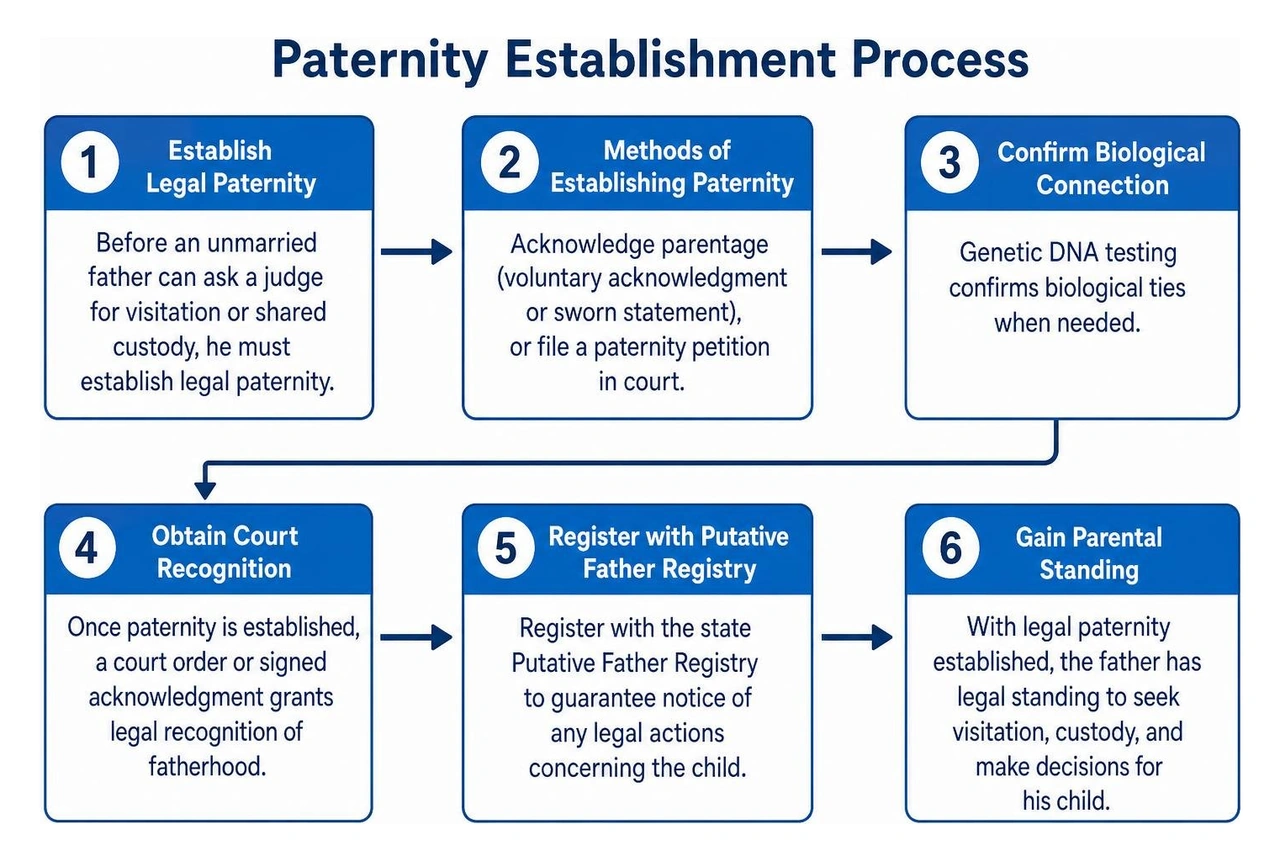
Before an unmarried father can ask a judge for visitation or shared custody, he must establish legal paternity. This gives him legal standing to appear before a judge. You can learn more about establishing paternity in New York to see how genetic DNA testing confirms biological ties.
Knowing how to establish paternity and protect your rights in New York ensures you take the proper procedural steps early. Once paternity is established, a father can register with the state Putative Father Registry to guarantee he receives notice of any legal actions concerning his child.
Resolving Paternity Disputes Before Custody Battles Between Unmarried Parents Begin
Parents can establish paternity voluntarily by signing a Voluntary Acknowledgment of Paternity (or Acknowledgment of Parentage). Under federal rules, either parent has a 60-day window to cancel this form in writing. After 60 days, it can only be challenged in court by proving fraud, extreme pressure, or a major mistake of fact.
If there is any doubt about biological fatherhood, taking an accredited, chain-of-custody DNA test before signing is essential. Check the unmarried parent rights and responsibilities guide to see why at-home DNA test kits are not accepted by judges in official parentage cases.
What Happens If the Father Is Not on the Birth Certificate
If the father's name was left off the birth certificate, he has no legal rights until a judge signs an Order of Filiation. Securing this order allows the state to issue an updated birth certificate.
Establishing legal fatherhood protects the child's right to receive child support, inherit property, and access health insurance or Social Security survivor benefits. To handle this process smoothly, look into unmarried father custody rights in New York or speak with a paternity lawyer in Suffolk County.
Step 2: Establish Legal Decision-Making and Parenting Time in Court

Once parentage is official, parents must address legal custody (who makes major decisions about healthcare, schooling, and religion) and physical custody (where the child lives day-to-day). Parents can read our guide on understanding joint vs sole custody in New York along with the child custody basics resource to understand how shared legal decision-making works.
How Courts Apply the Best Interests of the Child Standard
Judges decide custody disputes by looking at what arrangement best supports the child's health, safety, and happiness. When evaluating the best interests of the child, the court examines:
- Who serves as the primary caretaker (preparing meals, organizing medical care, and helping with school).
- The emotional bond between the child and each parent.
- Each parent's willingness to encourage a loving relationship with the other parent.
- The home stability and daily routine offered by each household.
To see how local judges weigh these factors, explore how custody is decided in Suffolk County Family Court.
Creating Enforceable Parenting Plans and Visitation Schedules
A strong parenting plan contains clear, written rules for weekly overnight schedules, holiday rotations, school breaks, and drop-off logistics. When a father has been absent for an extended time, courts often use a stepped parenting plan. This gradually increases visitation from short daytime visits to full weekend stays as the bond grows.
To learn more about setting up fair schedules, review our overview of father rights in Suffolk County NY Family Court.
Step 3: Handle Child Support, Relocation, and Interstate Jurisdiction
Child support and parenting time are two completely separate legal issues. A parent cannot deny visitation if child support is late, and a parent cannot withhold support if visitation is denied. Interstate custody cases are subject to specific statutory frameworks, as seen in landmark interstate custody case law.
Calculating Child Support and Retroactive Payments
Child support is calculated using state statutory income formulas. In New York, basic support percentages are set by law (such as 17% of combined parental income for one child, 25% for two children, and 29% for three children), plus mandatory add-on costs for unreimbursed healthcare and childcare.
In parentage cases, judges can order retroactive child support dating back to the child's birth, which may include birthing and hospital expenses. You can find detailed breakdowns in our custody cases guide for 2026.
Interstate Custody and Out-of-State Relocation Rules
Under the UCCJEA, the child's home state retains exclusive jurisdiction over custody matters. If a mother has default sole custody and moves out of state before any court case is filed, the father must act quickly. Filing a parentage and custody petition within 6 months allows the home-state court to demand the child's return.
When a parent wants to move away after orders are in place, they must show that major changes in your child's life justify the relocation. If you are facing an out-of-state move, consulting a custody modification lawyer in Suffolk County is critical.
Step 4: Protect Your Rights in Court With Careful Preparation
Going to court requires submitting the right legal paperwork and presenting organized evidence. Working with a dedicated child custody lawyer in Suffolk County ensures that your petitions are drafted properly and served in full compliance with the law.
Key documents needed for a custody case include:
- A formal Petition for Custody and Parenting Time.
- A certified copy of the child's birth certificate or Order of Filiation.
- An Address Confidentiality Affidavit (if safety or domestic abuse concerns exist).
- Financial disclosure affidavits with recent tax returns and pay stubs.
- A detailed proposed parenting plan.
- A trial notebook containing school records, medical logs, and communication records.
Why Generic Online Information May Not Fit Custody Battles for Unmarried Parents
It can be tempting to turn to online search tools or AI platforms like ChatGPT to draft custody agreements or separation paperwork. However, using AI for family law issues is risky. Generic computer-generated documents miss critical local court rules, statutory notice requirements, and the human context of your family's daily life.
A single missing legal clause can result in an unenforceable agreement or cause you to surrender important rights. Only an experienced attorney who understands local family court practice can craft an agreement that truly protects your child. For tailored guidance, review our breakdown on how to establish fathers rights in Suffolk County.
The Value of Experienced Suffolk County Representation and Upfront Flat Fees
Steven Zalewski is widely recognized as one of the most well-known family court trial lawyers in Suffolk County. Whether your case is heard in Suffolk County Family Court in Central Islip or Riverhead, our team provides trusted, plain-English guidance from our main office in Islandia.
We believe legal billing should be simple and transparent. That is why Steven Zalewski uses an honest flat-fee model:
- Pre-Trial Flat Fee: Covers all legal work, document drafting, negotiations, and appearances leading up to trial—no matter how many court dates are required.
- Trial Flat Fee: A single, set fee due 30 days before the scheduled trial date if a settlement cannot be reached.
Unlike traditional law firms that bill by the hour or drop clients mid-case when funds run out, Steve never abandons a client because of financial strain. Flexible payment plans are always available. To see how our firm helps parents secure positive outcomes, read about a father winning custody and explore our guide on legal rights for fathers in New York.
Frequently Asked Questions About Custody Battles for Unmarried Parents
Can a mother legally deny visitation before paternity is established?
Yes. Before legal paternity is established by an official acknowledgment or a judge's order, an unwed mother has default sole legal and physical custody. She can legally restrict visitation until the father establishes parentage and requests an enforceable parenting time order from the court.
Does paying child support give an unmarried father automatic visitation rights?
No. Child support and visitation are completely separate legal matters. Paying child support fulfills a financial duty but does not grant visitation rights. An unmarried father must file a separate custody petition to secure court-ordered parenting time.
What should an unmarried father do immediately after a child is born?
An unmarried father should sign a voluntary parentage acknowledgment form at the hospital if both parents agree on paternity. If paternity is uncertain or contested, he should request a genetic DNA test immediately and file a petition in family court to establish paternity and secure formal parenting time.
Conclusion
Protecting your parental rights when unmarried requires establishing legal parentage quickly, creating a clear parenting schedule, and presenting a strong case focused on your child's well-being. At Zacarese & Zalewski P.C., we provide compassionate legal support and reliable representation backed by our honest flat-fee pricing. If you need assistance with parentage, visitation schedules, or support disputes, reach out to us for dedicated child custody legal representation.
📱 Cell: (516) 660-4354
📧 Email: steve@zandzfamilylawyers.com
🏛 Address: 1601 Veterans Memorial Highway, Suite 500, Islandia, NY 11749
i guarantee you will be heard
Ready to Take the Next Step?
At Zacarese & Zalewski P.C., when something isn’t right, say something—and we’ll do something about it with you.
Our flat-fee structure is clear: one flat fee for pre-trial work, and a trial fee only if your case goes to trial or a hearing. Call now and a professional will return your call quickly; if we miss you, we'll call back the same day.