
When you speak, I guarantee you will be heard
Zacarese & Zalewski P.C.
Understanding What Goes on in a Custody Court Hearing
Call now: 516-660-4354
"He didn't just win my case. He gave me back my future, my peace of mind, and my ability to breathe again."
From the very first conversation, he changed everything. He didn't just see a case, he saw me, and treated me like family. His knowledge of the law was unmatched, but what truly set him apart was his humanity. If you are looking for a lawyer, stop searching right now.


What Happens at a Custody Court Hearing?

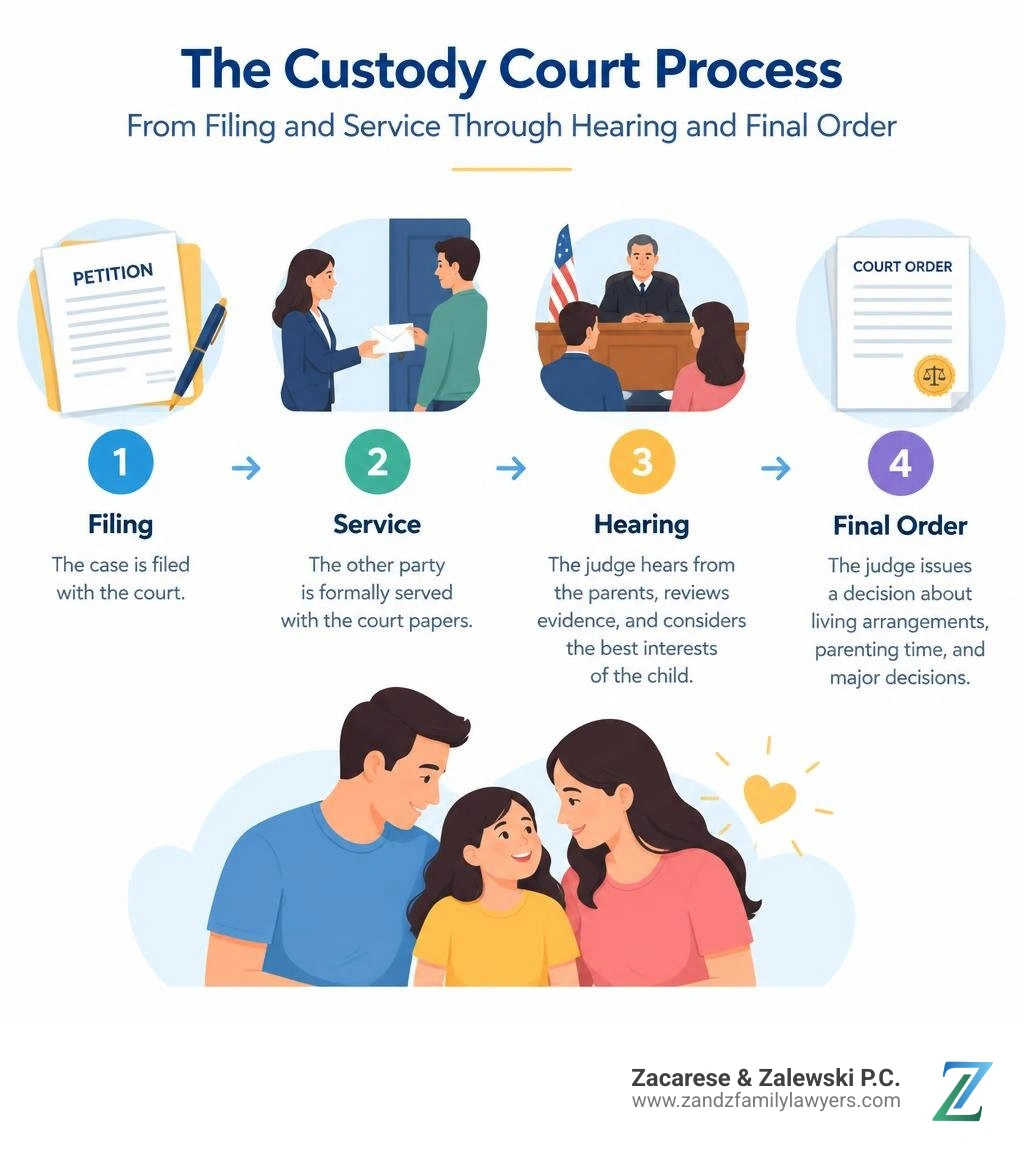
At a custody court hearing, a judge hears from the parents, reviews evidence, and decides what arrangement is best for the child. If the parents cannot agree, each side may give sworn testimony, question witnesses, and present records. The judge may make a temporary decision or issue a final order about where the child lives, parenting time, and who makes major decisions.
If you have a hearing in Suffolk County, read your court papers closely and bring records that show how you care for your child. This guide explains what to expect and how to prepare.
Must-know custody court hearing terms:
Child Custody Basics and the Best Interests Standard

When you walk into a family court, the judge has one main job: making sure your child is safe, loved, and supported. To understand what will happen in court, you first need to know how custody works.
Legal Versus Physical and Sole Versus Joint Arrangements
Custody is divided into two parts: legal custody and physical custody.
- Legal Custody: This is the right to make major life choices for your child. It includes choosing their school, picking their doctors, approving medical treatments, and deciding on religious upbringing.
- Physical Custody (Residential Custody): This refers to where your child lives on a daily basis and who handles day-to-day care.
Both types can be shared or given to one parent:
| Custody Type | Joint Arrangement | Sole Arrangement |
|---|---|---|
| Legal Custody | Both parents must talk and agree on major choices like schools and surgery. | One parent makes all major life choices alone without needing the other's consent. |
| Physical Custody | The child splits time living with both parents on a set schedule. | The child lives with one parent most of the time; the other parent receives visitation time. |
Understanding the difference between joint vs sole custody helps you ask the judge for a realistic plan that protects your connection with your child.
How Judges Weigh the Best Interests of the Child
Courts do not pick a favorite parent based on gender. Under the law, mothers and fathers start on equal footing. Instead, the judge uses the "best interests of the child" standard.
When looking at how custody is decided, the judge considers:
- Who handles the child's daily routines (cooking, bedtime, school drop-offs).
- The emotional bond between each parent and the child.
- The physical and mental health of both parents.
- The stability of each home environment.
- Any history of domestic violence, neglect, or substance abuse.
- Each parent's willingness to encourage a loving relationship between the child and the other parent.
Under official custody and visitation hearing rules, the court focuses on what keeps the child stable and safe.
What to Expect During a Custody Court Hearing

Walking into a courtroom can feel intimidating, but knowing the steps ahead of time helps calm your nerves.
The Standard Order of Proceedings in a Custody Court Hearing
Most standard court appearances last under two hours. However, a fully contested trial with multiple witnesses can take a full day or several court sessions. Learning what to expect at a custody hearing will keep you focused.

- Opening Remarks: Each side (or their attorney) gives a brief overview of what they are asking the court to order.
- The Petitioner's Case: The parent who filed the case calls witnesses and presents documents.
- Cross-Examination: The other parent's lawyer asks questions to challenge that testimony.
- The Respondent's Case: The second parent presents their own witnesses and evidence.
- Rebuttal and Child's Attorney: The attorney representing the child shares their position.
- Closing Arguments: Both sides summarize why their proposed parenting plan serves the child best.
- The Decision: The judge either announces the ruling immediately or issues a written order later.
The Role of Mediators, Evaluators, and Court Referees
Courts often use trained professionals to help resolve disputes before a trial:
- Court Mediators: Many courts encourage or require parents to try mediation. A neutral mediator helps both parents talk through schedules to see if they can reach an agreement without a judge deciding for them.
- Custody Evaluators & Forensic Psychologists: In complex cases, the judge may order a professional evaluation. This expert visits both homes, interviews the parents and child, and gives a report to the court.
- Court Attorney-Referees: In some New York courtrooms, an experienced court attorney-referee hears the testimony and issues decisions just like a judge.
Following general judicial custody hearing steps ensures you cooperate with these court officials throughout the case.
Why an Attorney for the Child Protects Your Child
In New York family courts, the judge often appoints an independent lawyer called the Attorney for the Child (AFC). This lawyer does not work for either parent. Their only job is to represent your child's legal interests and desires.
The child's attorney meets with your child privately. During proper family court trial preparation, parents must remember that anything the child tells their attorney is confidential. The AFC speaks up in court to make sure the judge hears the child's perspective.
Practical Preparation, Evidence, and Courtroom Rules
Judges make rulings based on facts, not rumors. Preparing clear records is the best way to support your testimony.
Document Checklist for Your First Custody Court Hearing
Do not rely on showing a judge text messages on your smartphone screen. Courts require printed physical copies so exhibits can be marked, shown to the other side, and placed into the official court record.
Bring three copies of all documents (one for the judge, one for the other party, and one for yourself):
- Certified school attendance records and report cards.
- Medical charts, immunization logs, and therapy records.
- Printed text message and email threads showing dates, times, and phone numbers.
- Calendar logs showing parenting time, missed visits, and pickup times.
- Pay stubs, tax returns, and sworn financial statements.
- Official affidavits showing where the child has lived for the past five years.
Courtroom Etiquette, Answering Questions, and Pro Se Risks
How you act in court matters just as much as the papers you bring:
- Dress for Business: Wear clean, professional clothes, like you are going to a job interview. Avoid hats, shorts, tank tops, and graphic t-shirts.
- Show Respect: Always call the judge "Your Honor." Stand when the judge enters or leaves the room.
- Stay Calm: Never interrupt the other parent, roll your eyes, or shout out. If you disagree with something, write a note on your legal pad.
- Avoid Hearsay: You can only testify about things you personally saw or heard. You cannot testify about what a neighbor or relative claimed happened unless that person is in court as a witness.
If you are served with custody papers, you must file a written Answer within 30 days. If you represent yourself (called appearing pro se), the court holds you to the exact same strict legal rules as a seasoned trial attorney. Missing a court date or failing to answer can cause the judge to issue a default order against you.
Why You Must Avoid Using AI Tools for Custody Papers
Many parents consider using generic AI tools like ChatGPT to write parenting plans or draft custody petitions. This is a dangerous mistake.
Generic AI software does not know local court rules, cannot evaluate body language, and frequently leaves out critical clauses regarding holidays, school choice, and travel consent. A poorly drafted computer agreement can cause accidental loss of parental rights. Only a real human attorney with genuine empathy and deep local legal experience can properly protect your child's future.
Temporary Orders, Modifications, Enforcement, and Special Rules
Custody cases often involve urgent situations, long-term changes, and unique legal protections.
Emergency Petitions, Temporary Orders, and Modifying Final Judgments
At your first hearing, the judge usually puts a temporary order in place to keep life stable for your child while the case proceeds.
If a child faces immediate danger, severe neglect, or a threat of being taken out of the area, a parent can file for an immediate emergency order. Understanding emergency custody petitions helps protect a child in crisis before a full trial takes place.
Once a final order is signed, it remains in effect until the child turns 18, unless major changes occur. If a parent relocates, changes work shifts, or develops serious health issues, you can work with a custody modification lawyer to ask the court for an updated schedule based on these new life circumstances.
Enforcing Custody Orders and Penalties for Contempt of Court
When a judge signs a custody order, it is a binding legal command. A parent cannot refuse to send the child for visits simply because child support was not paid.
If a parent ignores the schedule, withholds visits, or refuses to return the child, you can hire a custody enforcement lawyer to file a Motion for Contempt or an Order to Show Cause.
Judges can punish order violations by:
- Awarding make-up parenting time to the wronged parent.
- Ordering the violating parent to pay the other side's legal fees.
- Issuing fines.
- Changing the custody arrangement in favor of the cooperative parent.
- Ordering jail time for willful violations.
Military Service, Interstate Relocation, and Dependent Tax Credits
Special rules apply to unique custody circumstances:
- Military Parents: Under the Servicemembers Civil Relief Act, active-duty parents deployed overseas can pause custody proceedings so they do not lose rights while serving the country.
- Interstate Moves: Under the Uniform Child Custody Jurisdiction and Enforcement Act (UCCJEA), a child must live in a state for at least 6 straight months before that state has the power to issue custody orders. Out-of-state orders must be formally registered locally before they can be enforced or changed.
- Taxes and the Child Tax Credit: By default, the parent who has physical custody for the greater number of nights claims the child as a dependent. However, parents can agree—or the court can order—to alternate tax years using IRS Form 8332. Starting in the 2025 tax year, the child tax credit is $2,200 per qualifying child.
Frequently Asked Questions About Family Court
How long does a typical custody case take from start to finish?
A standard custody case generally takes between 3 months and 2 years. Simple cases where parents reach an agreement in mediation wrap up quickly, while cases with home studies, psychological evaluations, and full trials take much longer.
Will my child have to testify in front of both parents in court?
No. Judges avoid placing children between their parents in open court. Instead, if a child is old enough to express a mature preference, the judge speaks with the child privately in the judge's office (called an in-chambers or in-camera interview). Only the judge, the child, and the child's attorney are present.
What happens if I miss my scheduled court date?
If you fail to appear at your scheduled hearing, the judge can dismiss your petition or enter a default judgment granting everything the other parent requested. If an unavoidable emergency happens, you must contact the courtroom clerk immediately before your case is called.
Conclusion
Navigating family court can be stressful, but you do not have to walk through it alone. Steven Zalewski is widely recognized as one of the most dedicated family court trial lawyers in Suffolk County. Whether your case is heard at the Suffolk County Family Court in Central Islip or Riverhead, our firm provides compassionate, aggressive representation.
We believe every parent deserves transparent legal support without surprise bills. That is why we use an honest, two-part flat-fee model:
- Pre-Trial Flat Fee: Covers all preparation, meetings, motions, and court appearances leading up to trial—no matter how many court dates are required.
- Set Trial Fee: A single set fee due 30 days before your scheduled trial date if your case does not settle.
Unlike other firms that switch to expensive hourly billing or drop clients when cases get complicated, Steve never leaves a client behind because they ran out of money. Flexible payment plans are always available.
If you are facing a hearing, contact our trusted Suffolk County custody lawyers today.
📱 Cell: (516) 660-4354
📧 Email: steve@zandzfamilylawyers.com
🏛 Address: 1601 Veterans Memorial Highway, Suite 500, Islandia, NY 11749
i guarantee you will be heard
Ready to Take the Next Step?
At Zacarese & Zalewski P.C., when something isn’t right, say something—and we’ll do something about it with you.
Our flat-fee structure is clear: one flat fee for pre-trial work, and a trial fee only if your case goes to trial or a hearing. Call now and a professional will return your call quickly; if we miss you, we'll call back the same day.