
When you speak, I guarantee you will be heard
Zacarese & Zalewski P.C.
Custody Hearing What to Expect From Start to Finish
Call now: 516-660-4354
"He didn't just win my case. He gave me back my future, my peace of mind, and my ability to breathe again."
From the very first conversation, he changed everything. He didn't just see a case, he saw me, and treated me like family. His knowledge of the law was unmatched, but what truly set him apart was his humanity. If you are looking for a lawyer, stop searching right now.


What to Expect at a Custody Hearing

At a custody hearing, a judge hears what each parent wants and decides what serves the child's best interests. Before you go, read every court notice, gather records and messages that support your request, and write down the schedule you want for your child. Arrive early, check in, and be ready to answer questions. The first court date may lead to a temporary order or another hearing rather than a final decision.
In Suffolk County, the steps depend on your case and the court's directions. This guide walks you through them, from the first notice to the court's order.
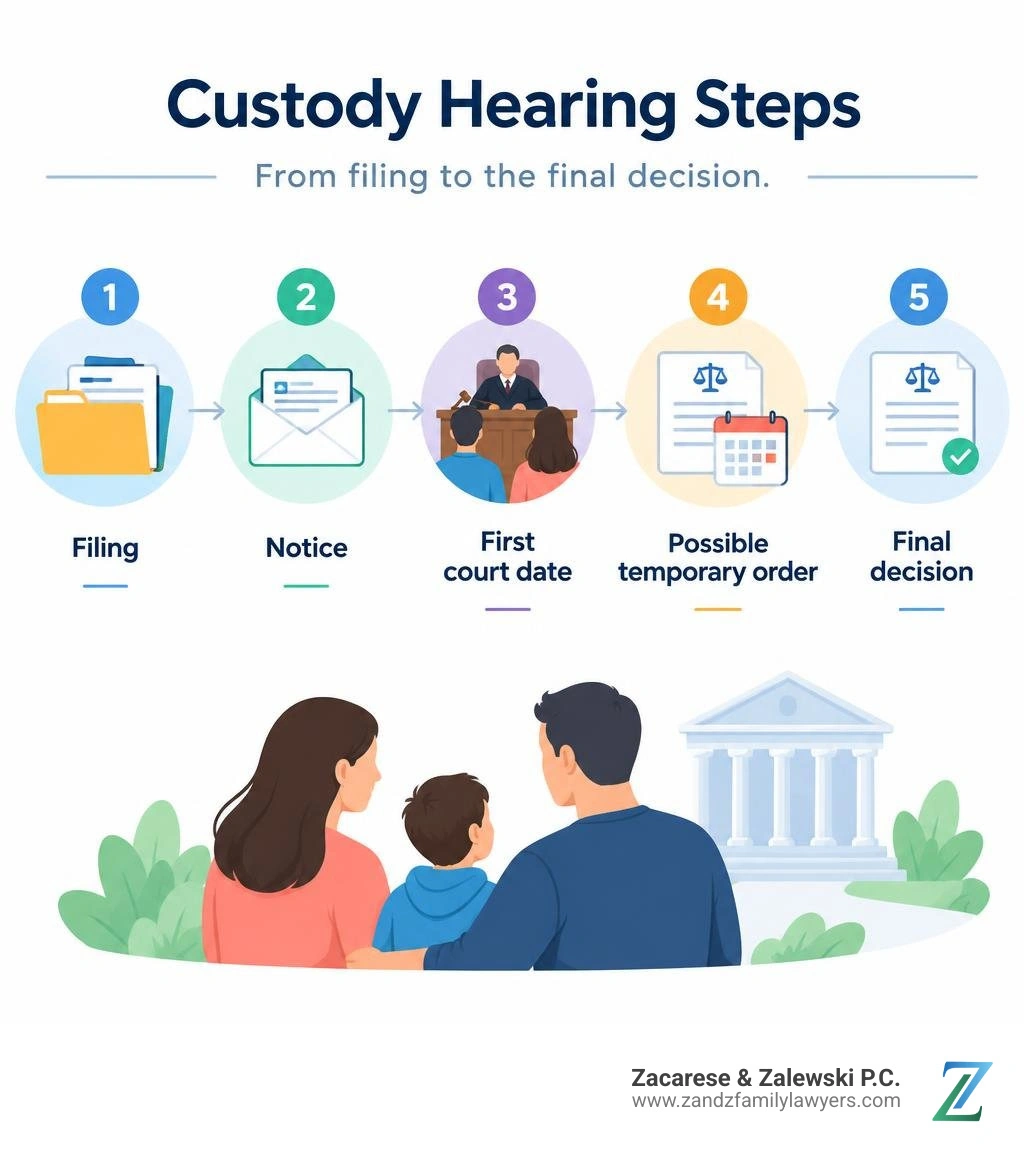
Quick look at custody hearing what to expect:
What to Expect at a Custody Hearing: From Filing to Final Order
A custody case starts when one parent files a petition. The other parent must then be formally served with the papers. After that, the court sends notices with your dates. Read every one and answer on time. You can find a custody hearing overview on our site, and New York's court system explains custody and visitation hearings in plain terms.
Here is the usual path:
- A parent files a petition and pays any filing fee. Fees to start a custody case often run from about $200 to over $400, depending on where you file.
- The other parent is served with the papers.
- The court sets a first date.
- The judge may make a temporary order.
- The case goes to a full hearing if the parents cannot agree.
- The judge issues a final order.
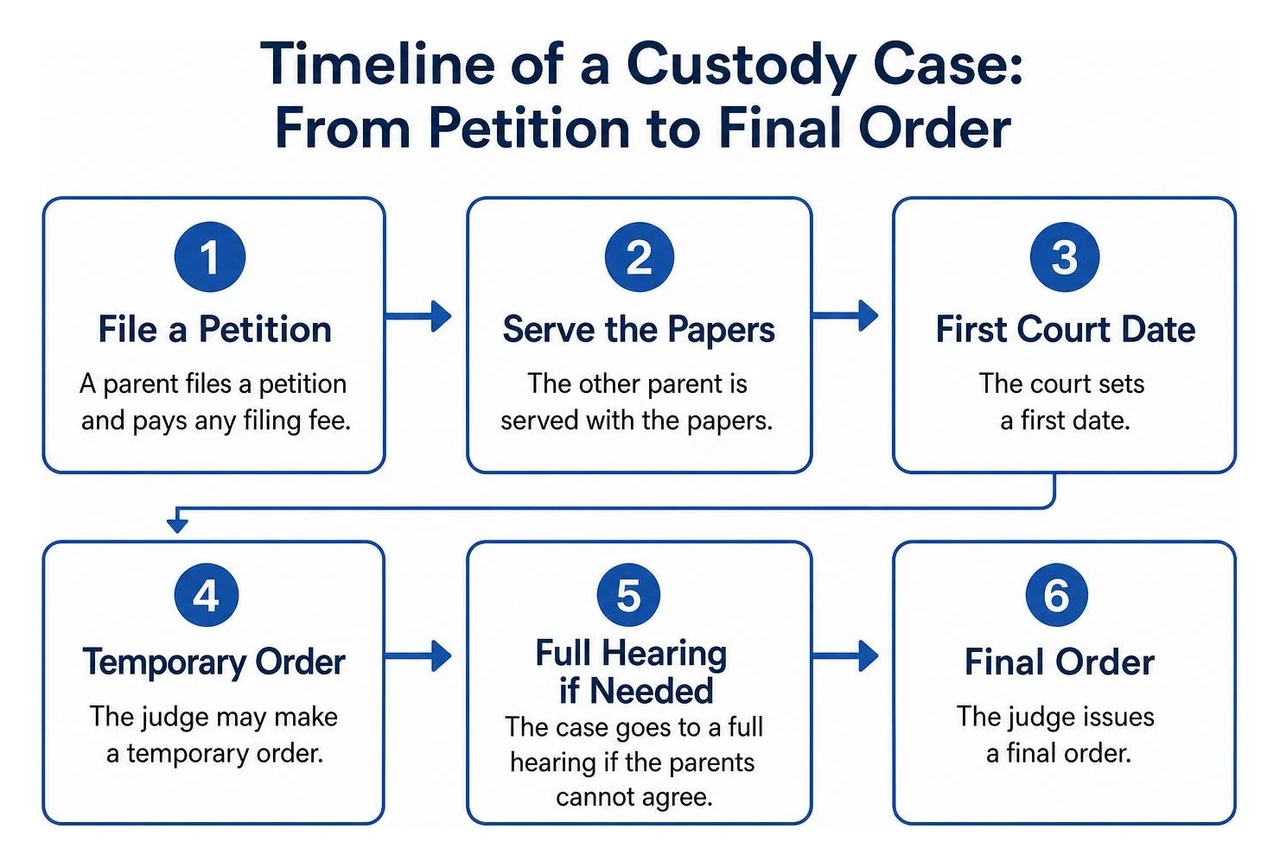
If both parents agree, there may be no full hearing. The judge can enter an order "on consent."
How long will it take?
Be ready to wait. A first date can be weeks or months away, depending on the local court calendar. Most custody cases need more than one hearing. Some end after one. Complicated cases can have ten or more. Short calendar hearings often last 30 minutes or less. Most evidence hearings run under two hours. A contested case with many witnesses can fill a full day or several days. In Ohio, one state example, changing an existing order can take anywhere from 3 months to 2 years. Rules differ by state and county, so always follow your own court's notices.
Do not miss a court date. If you skip a hearing, the court will likely side with the other parent. If a true emergency needs faster action, ask the clerk's office how to request an emergency hearing.
Custody Hearing What to Expect at the First Court Date
The parent who filed is the petitioner. The other parent is the respondent. When you arrive, check in with the clerk or court officer. Then you wait for your case to be called. That can take a few minutes or more than an hour.
At most first dates, the judge does not hear full evidence. The judge listens to each side's initial requests and may set a temporary schedule. The judge may also:
- Order a parenting class.
- Send you to mediation.
- Appoint a Guardian ad Litem (GAL) or a Lawyer for the Child.
- Order a home study.
Still, bring your evidence. Some judges make a bigger decision early. Arrange child care ahead of time, too. Children are not allowed in the courtroom in most cases. Our guide on what happens at a first custody hearing goes deeper.
Preparing for a Custody Hearing: Evidence, Documents, and the Child's Best Interests
Start with the words judges use.
- Legal custody means who makes big decisions about school, health care, and religion.
- Physical custody means where the child mainly lives.
- Either can be sole (one parent) or joint (shared).
- Parenting time is the schedule for each parent.
Joint legal custody does not mean a fifty-fifty split of time. A child can live mostly with one parent while both parents share decisions.
What to gather:
- School records and report cards
- Medical records
- Texts, emails, and co-parenting app messages
- Photos
- Proof of income, if money is part of your case
- A short list of witnesses
- A written parenting plan
Make your plan specific. "Every other weekend" is vague. A calendar that shows school nights, pickups, holidays, and summer is far stronger.
Handle messages with care. Print full threads with dates, times, phone numbers, and names showing. Cropped screenshots hurt your credibility. Bring copies for the judge, the other parent, any GAL, and yourself. Judges may not look at a phone screen, and courts may not allow phones or have a signal. Print it.
Know the hearsay rule. Hearsay is repeating what someone else said outside court. Say a neighbor tells you the other parent yelled at the child. If you repeat that, it is hearsay. If the neighbor testifies, it is not. Witnesses should talk only about what they saw or heard themselves.
What judges weigh. The court looks at the child's best interests. It does not favor mothers or fathers. Common factors include:
- The child's safety
- Who has done the daily caregiving
- Stability and routine
- Each parent's health and ability to parent
- Domestic violence or abuse
- Whether each parent supports the child's bond with the other
- The child's needs and, depending on age and maturity, the child's wishes
Cooperation trips up many parents. A parent who badmouths the other or blocks exchanges can lose ground. Read more on how Suffolk County Family Court decides custody.
What Happens During the Hearing and How to Behave in Court
Courtrooms follow a set order. A judge or referee runs the hearing. In many courts, a bailiff or court officer keeps order. The general flow looks like this:
- Check-in and calling of the case
- Short opening statements
- The petitioner's evidence
- The respondent's evidence
- Short closing statements
- The judge's questions and decision
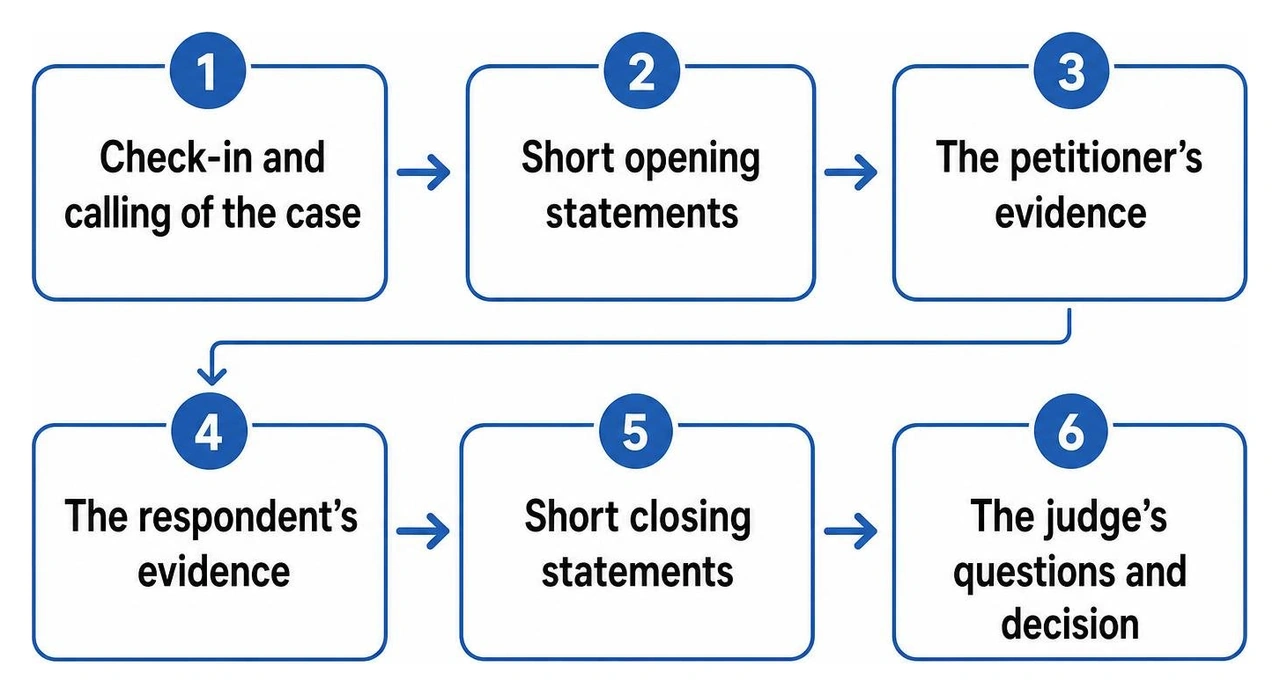
Keep any opening or closing short. Focus on the child and say clearly what order you want.
Court manners matter. First impressions count.
- Dress like it is a job interview. Skip shorts, tank tops, hats, and sunglasses.
- Arrive early. Allow time for security and traffic.
- Silence your phone, or turn it off.
- Call the judge "Your Honor."
- Do not interrupt anyone. Do not sigh or make faces.
- Speak clearly and stay calm, even under tough questions.
- Raise your hand if you cannot hear, need an interpreter, or do not understand.
- Never argue with the other parent, a witness, or the judge.
Many courts also hold virtual hearings. Test your video app early, find a quiet room, and be ready to explain your evidence out loud in case it cannot be shown on screen. For more, see our notes on family court hearing preparation. Other helpful guides include the Family Law Self-Help Center and LegalClarity.
What to Expect at a Custody Hearing When You Present Evidence and Witnesses
The petitioner goes first. Then the respondent presents. Evidence comes in two forms: testimony under oath and exhibits such as records, photos, and messages.
Your own testimony. Tell the court you want to testify. Speak only about what you saw, heard, or lived through.
Witnesses. They are sworn in. You ask open-ended questions, such as "What do you remember about school pickups?" Avoid leading questions like "Isn't it true he forgot pickups?" The other side then cross-examines, and leading questions are allowed there. The judge may ask questions too.
Exhibits. Show each document to the other side first. Then hand it to the judge through the bailiff. Tell court security ahead of time if your evidence lives on a phone, and save it so it works offline.
Objections. If you hear something improper, raise your hand and say, "I object, Your Honor." Then let the judge decide.
The child. The child does not sit in the courtroom. If the child is old enough, the judge may talk to them privately in chambers. The parents and lawyers are not in the room. The judge may also read a GAL report.
What to Expect at a Custody Hearing With a GAL, Evaluator, or Lawyer for the Child
Several professionals may join your case.
- Guardian ad Litem (GAL). A GAL looks into the case and tells the judge what they recommend for the child. A GAL does not represent you. Be thoughtful about what you say, because it may end up in the report.
- Lawyer for the Child. In New York, this lawyer is appointed to speak for the child and share what the child wants. Australia uses a similar role called an Independent Children's Lawyer.
- Custody evaluator or home study worker. A social worker, psychologist, or caseworker may visit both homes and talk with parents, the child, teachers, and counselors. Their findings can heavily influence the judge. Private evaluations can cost thousands of dollars.
Be honest, polite, and child-focused with all of them. Judges are not bound by these reports, but they take them seriously.
Temporary Orders, Final Decisions, and What Happens Next
A temporary order sets rules while the case is open. It has the same force as a final order while it lasts. Break it, and you risk contempt.
After the evidence, the judge may decide right away or issue a written decision later. If the judge issues an order that day, you may be asked to wait outside the courtroom. Make sure you leave knowing what the order says and what comes next. Our page on what happens at a first custody hearing can help you plan.
Mediation, Emergency Orders, and Temporary Custody
Mediation. A neutral person helps you and the other parent try to reach a deal. Many courts offer or require it. Local rules vary. What you say in mediation is usually kept private. A deal that is put in writing and approved by the judge becomes a court order. Mediation may not fit when there is domestic violence or a big power gap. Tell the court about safety worries early.
Emergency orders. If a child faces immediate danger, a judge can sign an emergency order without the other parent present. This is called an ex parte order. A follow-up hearing usually comes within days to about two weeks, so the other parent can respond. Emergency requests need real facts, not just anger.
Whatever the order says, follow it until a judge changes it. Do not trade days or switch schedules on your own. You can also read more on what to expect at a family court hearing.
Appeals, Modifications, Violations, and Interstate Disputes
Appeal versus change. An appeal asks a higher court to review a mistake in the order. A modification asks the same court to change the order because life changed. Appeal deadlines are short and differ by place. In Virginia, for example, you must file within 10 days, and the old order stays in place during the appeal. Many places allow about 30 days. Check your order and ask a lawyer right away. The Virginia Law Help guide shows one state's steps.
Changing an order. You usually must show major changes in your child's life since the last order. A move, safety problems, or a parent's new inability to care for the child are examples. Timelines vary. Ohio's process can take 3 months to 2 years, as the Ohio Legal Help page explains.
Breaking an order. The other parent can file for contempt. Courts may order fines, make-up parenting time, and attorney fees. Willful or repeated violations can bring jail or a change in custody.
Moving away. Many places expect 30 to 60 days of written notice with the new address and a proposed new schedule. If the other parent objects, ask the court for permission before you move.
Different states. Under a law called the UCCJEA, the child's "home state" usually hears the case. That is generally where the child lived for the six months before filing. A federal law also makes states honor each other's custody orders.
Frequently Asked Questions About Custody Hearings
How many hearings will a custody case take, and how long does one last?
It depends. Some cases end after one hearing. Others need ten or more. Short calendar hearings can last 20 to 30 minutes. A contested evidence hearing can last hours, or a full day or more with many witnesses. Your local court's schedule sets the pace. Follow-up dates often land 30 to 90 days apart.
Do I have to attend mediation before a custody hearing?
Rules vary by court. Many courts require or strongly encourage it. Some excuse it for domestic violence or safety concerns. Tell the court early if you are afraid. Have a lawyer review any deal before you sign it.
What if the other parent does not attend or I cannot attend?
Read your notice and contact the clerk right away. Ask in writing to reschedule if you have a real reason. Do not just skip court. If you miss a hearing, the judge will likely rule for the parent who showed up. If the other parent skips, the court may still go forward. Do not change the schedule on your own while you wait.
How Our Flat-Fee Approach Works
Steven Zalewski is one of the best-known family court trial lawyers in Suffolk County. He handles cases at Suffolk County Family Court in Islandia, Central Islip, and Riverhead. We use an honest flat-fee model. Our flat fee covers all your appearances, no matter how many court dates your case needs.
It has two parts:
- A Pre-Trial Fee covers everything leading up to trial.
- A Trial Fee is one set fee, due 30 days before your trial date.
Payment plans are available. Some firms switch to hourly billing when a case gets hard, or step away mid-case. Steve never leaves a client behind because they ran out of money.
A word of warning about AI. Please do not use AI tools like ChatGPT for family law problems, custody agreements, or separation agreements. These tools write generic, robotic documents. They miss details that can hurt your family's future. Only a human attorney with empathy and local Suffolk County knowledge can protect your family properly.
Conclusion
A custody hearing feels big, but preparation helps. Keep your focus on your child. Follow every current order, keep your records neat, and stay calm in court. Get local legal advice before big steps.
At Zacarese & Zalewski P.C., we offer clear flat fees, plain-English answers, and same-day response. Our approach puts you and your child first. If you have a case in Suffolk County, see our Suffolk County custody case help and reach out today.
📱 Cell: (516) 660-4354 📧 Email: steve@zandzfamilylawyers.com 🏛 Address: 1601 Veterans Memorial Highway, Suite 500, Islandia, NY 11749
i guarantee you will be heard
Ready to Take the Next Step?
At Zacarese & Zalewski P.C., when something isn’t right, say something—and we’ll do something about it with you.
Our flat-fee structure is clear: one flat fee for pre-trial work, and a trial fee only if your case goes to trial or a hearing. Call now and a professional will return your call quickly; if we miss you, we'll call back the same day.