
When you speak, I guarantee you will be heard
Zacarese & Zalewski P.C.
Domestic Violence Injunctions and How They Work
Call now: 516-660-4354
"He didn't just win my case. He gave me back my future, my peace of mind, and my ability to breathe again."
From the very first conversation, he changed everything. He didn't just see a case, he saw me, and treated me like family. His knowledge of the law was unmatched, but what truly set him apart was his humanity. If you are looking for a lawyer, stop searching right now.


Florida Domestic Violence Injunctions: Fast Court Protection When You Need It
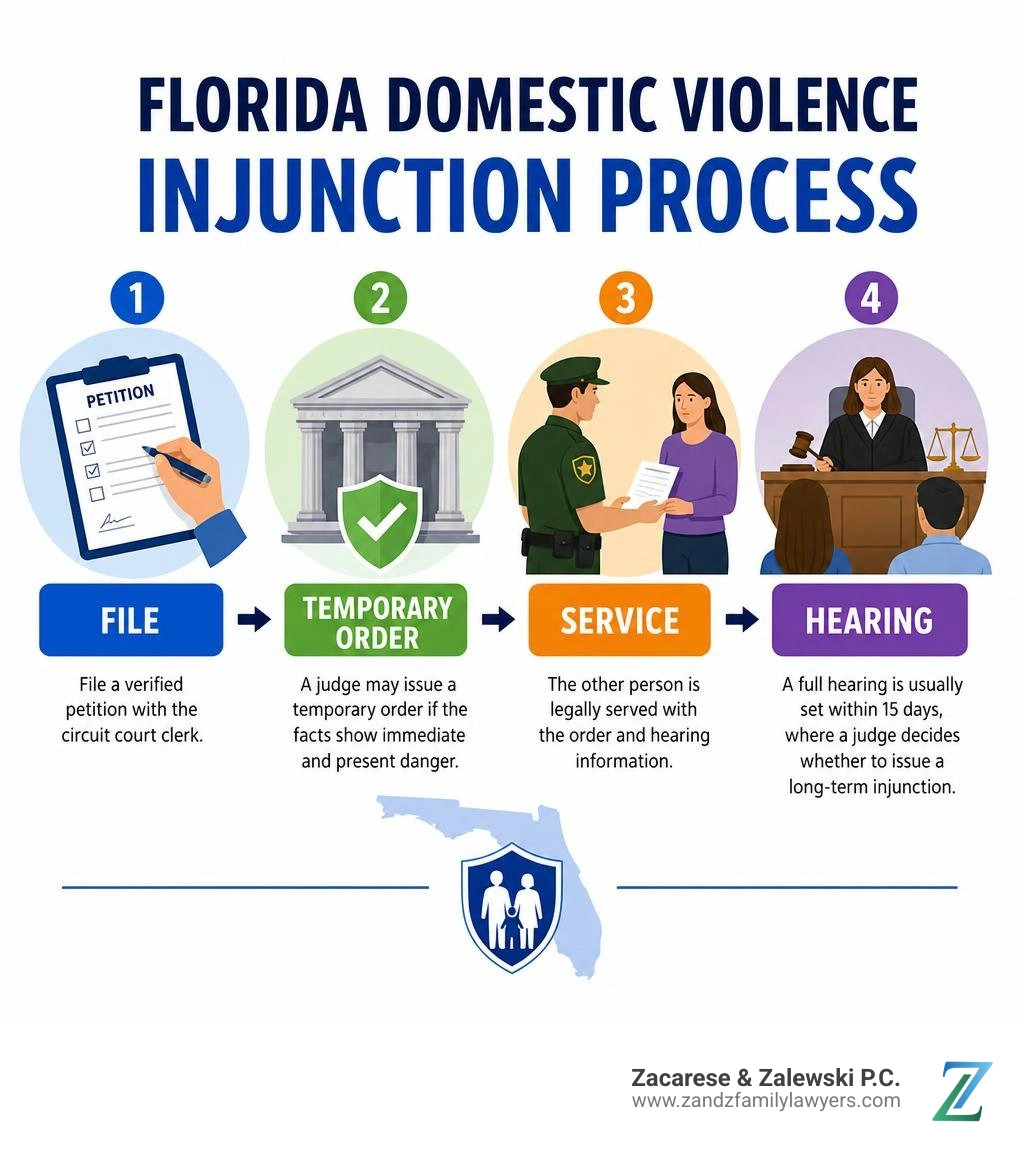
A domestic violence injunction is a Florida civil court order that can require an abusive family or household member to stay away from you, stop contacting you, and surrender firearms when required. If you are in immediate danger, file a verified petition with the circuit court clerk where you live, where the other person lives, or where the violence happened. There is no filing fee for a domestic violence injunction petition.
A judge may issue a temporary order without first hearing from the other person if the facts show immediate and present danger. A full hearing is then usually set within 15 days. Bring clear details about what happened, including dates, threats, injuries, police reports, photos, or messages when available.
Florida law covers more than physical assault. Domestic violence may include battery, stalking, kidnapping, false imprisonment, sexual violence, or another crime that causes physical injury or death within a qualifying family or household relationship.
This process can also affect urgent family issues. A court may order no contact, give one person temporary use of a shared home, set temporary parenting terms, and protect pets.
For Suffolk County families dealing with safety concerns alongside custody or support issues, Steven Zalewski is one of the most well-known family court trial lawyers in Suffolk County. Zacarese & Zalewski P.C. can help explain how protection-order rules may apply to your situation.
Terms related to domestic violence injunction:
What Is a Florida Domestic Violence Injunction?
A domestic violence injunction is a civil order from a judge. Its main goal is to stop abuse quickly. In America, 1 in 4 women and 1 in 7 men suffer physical violence at the hands of a loved one every day. Because of this harsh reality, the law gives people a clear path to safety.
Under the 2025 Statutes 0741.30 | Florida House of Representatives, any person who is a victim of domestic violence or believes they are in imminent danger can ask the court for help. You do not need to wait for a criminal trial to finish. You can ask for civil protection right away.
To qualify for this specific type of injunction, you and the abuser must be family or household members. This includes:
- Spouses or former spouses
- People related by blood or marriage
- People who currently live together as a family or who have lived together in the past
- Parents who share a child together, even if they were never married and never lived together
If you do not share a child, you must have lived together in the same home in the past or present to file under the domestic violence statute.
| Injunction Type | Who Qualifies? | Key Requirement |
|---|---|---|
| Domestic Violence | Spouses, cohabitants, family, parents of a shared child | Past violence or reasonable fear of imminent violence |
| Dating Violence | People in an intimate, continuing dating relationship within past 6 months | Past violence or reasonable fear of imminent danger |
| Repeat Violence | Anyone (neighbors, coworkers, acquaintances) | At least 2 incidents of violence, 1 within the last 6 months |
| Sexual Violence | Survivors of sexual crimes | Must report crime to police or perpetrator served prison time |
| Stalking | Anyone being stalked or cyberstalked | At least 2 separate incidents of willful, repeated harassment |
Eligibility and Types of Protective Injunctions
Not every harmful situation fits into the domestic category. Florida law provides five distinct civil protection paths. Many people ask, can an order of protection be filed regardless of the relationship? The answer is yes, but the type of petition you choose depends on how you know the person:
- Dating Violence Injunction: For people who had an intimate dating relationship within the last six months. It does not require you to have lived together.
- Repeat Violence Injunction: For people with no intimate or household connection, such as neighbors or coworkers. You must show at least two violent acts or threats, with one happening in the last six months.
- Sexual Violence Injunction: Protects victims of sexual battery, lewd acts on children, or other sexual offenses. You must report the crime to law enforcement or the abuser must have been in prison for it.
- Stalking Injunction: Covers repeated following, harassing, or cyberstalking that causes emotional distress and serves no good purpose.
Key Differences Between Civil Injunctions and Restraining Orders
People often use words like restraining order, order of protection, and injunction interchangeably. In Florida, the legal term is an "injunction for protection." In other states like New York, people use the term personal protection order or order of protection.
A civil injunction differs from a criminal stay-away order:
- Who files it: You file a civil petition yourself in family or civil court. A criminal order is requested by a prosecutor after an arrest.
- Standard of proof: Civil orders require clear facts showing reasonable cause or imminent danger. Criminal cases require proof beyond a reasonable doubt.
- Control: You have control over your civil petition. In criminal cases, the state attorney decides whether to drop or push forward with charges.
How to File a Petition for Protection Against Domestic Violence
Filing for safety is a direct legal process. You do not have to pay a court fee. Florida law strictly bans filing fees for domestic violence petitions so that cost is never a barrier to safety.
You can file your petition at the circuit court clerk's office in the county where:
- You live permanently or temporarily
- The abuser lives
- The violence took place
Clerks have packets of forms ready to use. Many counties also allow you to fill out forms online through self-help tools before you head to court.
Step-by-Step Filing Process for a Domestic Violence Injunction
Here is how the filing process works from start to finish:
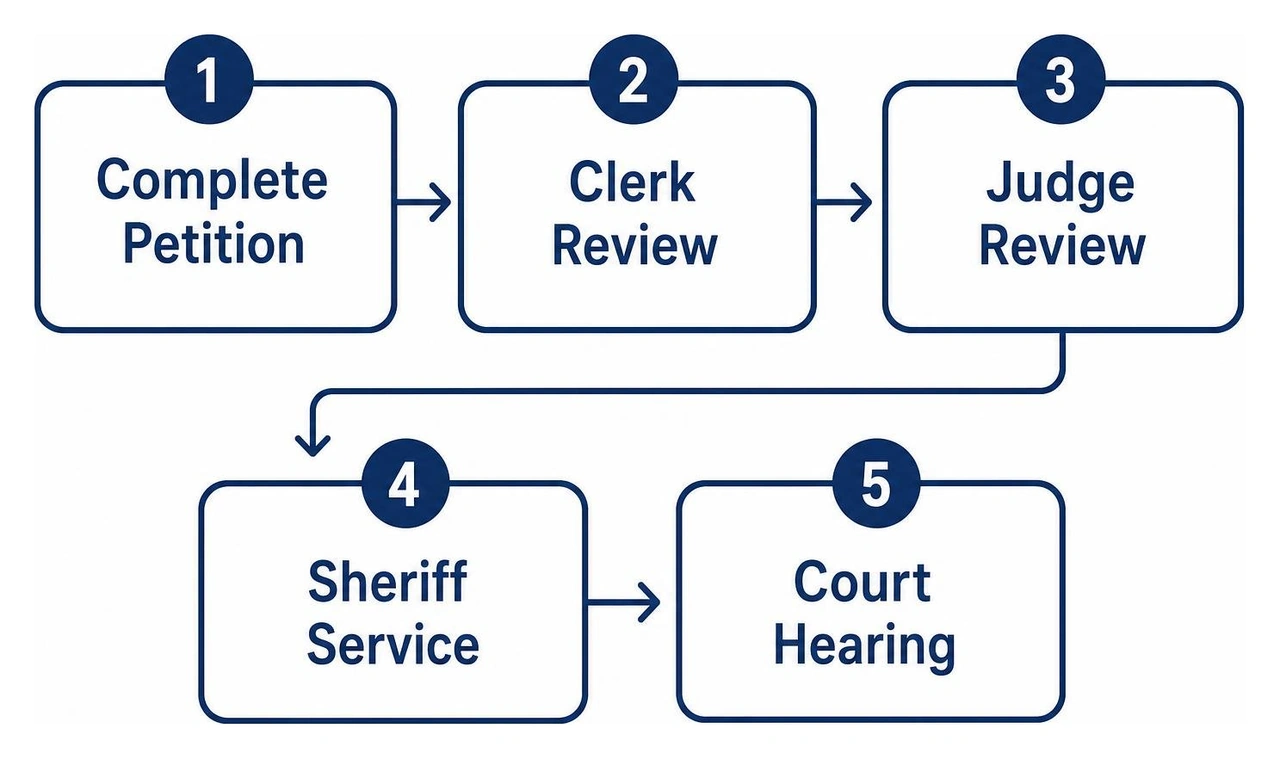
- Go to the Clerk’s Office: Ask for a domestic violence petition packet. Clerk staff can help explain the paperwork, but they cannot give formal legal advice.
- Complete the Sworn Statement: You will write down the facts of your situation. You must sign this under penalty of perjury.
- Judge Reviews the File: The clerk brings your sworn petition to a judge right away on the same day.
- Immediate Temporary Decision: The judge decides whether to grant a temporary order based only on your paperwork.
- Sheriff Serves Papers: The clerk sends the paperwork to the sheriff, who finds the abuser and serves them the legal papers in person.
- Attend the Final Hearing: Both parties go to court so the judge can hear testimony and make a final ruling.
If you are dealing with cross-state custody or safety matters, working with an experienced attorney makes sure every step is handled properly. Learning about a domestic violence protective order can help you prepare for court rules.
Required Court Forms, Evidence, and Address Confidentiality
To file, you will fill out Florida Supreme Court approved forms, such as Form 12.980. The judge needs clear, exact facts. Avoid general statements like "he is mean." Instead, write: "On August 12, he grabbed my arm, left a bruise, and stated he would break my phone if I called for help."
Bring supporting evidence to back up your petition:
- Color photos of bruises, cuts, or damaged items
- Printouts of threatening text messages, emails, or call logs
- Police reports and incident numbers
- Medical treatment records from urgent care or the emergency room
- Statements from eyewitnesses
If you had to move to an emergency shelter or a friend's house, you do not have to disclose your new location to the abuser. You can ask for address confidentiality on a separate court form. The clerk will seal your home address so the abuser cannot see it.
For judicial guidance on these filings, see the Florida’s Domestic Violence Benchbook.
Temporary Relief, Hearing Procedures, and Final Judgments

When you hand in your petition, the judge reviews it immediately without waiting for the abuser to be present. This is called an ex parte review. If your statement shows immediate danger, the judge signs a temporary injunction.
This temporary order lasts up to 15 days. It gives you immediate legal protection while the court sets up a full hearing date where both sides can speak.
Temporary Ex Parte Orders vs. Final Injunction Hearings
The temporary order is a short-term shield. The final hearing is where the long-term decision is made.
At the final hearing:
- Both you and the other person have the right to attend.
- You will testify under oath about what happened.
- Both sides can show evidence and call witnesses.
- Cross-examination takes place, meaning each party or their lawyer can ask questions about the testimony.
Because family disputes can become heated and complicated, having strong legal counsel matters. When handling complex domestic violence cases, having a lawyer who knows how to cross-examine witnesses makes a big difference.
Never use AI tools to write your legal court filings or family agreements. Computer programs do not understand human feelings or court rules. A robotic template misses critical facts, misstates legal standards, and can ruin a family's life for years. Only a human attorney with local Suffolk County legal insight and empathy can protect a family's future.
Protections Granted in a Final Domestic Violence Injunction
If the judge finds that domestic violence happened or that real danger exists, the court enters a final judgment. This judgment can last for a set period, like one year, or remain permanent until modified.
The judge can order strong relief, including terms found in the FINAL JUDGMENT OF INJUNCTION FOR PROTECTION AGAINST DOMESTIC VIOLENCE WITHOUT MINOR CHILD(REN) (AFTER NOTICE):
- No Contact: Banning all calls, texts, emails, social media messages, and third-party contact.
- Stay-Away Zones: Ordering the abuser to stay 500 feet away from your home, school, workplace, or daycare, and 100 feet away from your car.
- Exclusive Home Use: Giving you sole use of a shared residence and forcing the abuser to move out with police escort.
- Temporary Custody and Support: Setting temporary parenting schedules, safe child exchange spots, or temporary child support.
- Firearm Surrender: Ordering the abuser to hand over all guns and ammunition to law enforcement.
- Pet Protection: Awarding you full care and control of family pets and banning the abuser from touching or taking them.
- Counseling: Ordering the abuser to complete a 29-week Batterers' Intervention Program or substance abuse counseling.
Enforcement, Violations, and Safety Resources
A protective order is not just a piece of paper. It gives law enforcement the power to step in immediately if the other person breaks the rules.
When a judge signs an injunction, the clerk enters it into a statewide computer system. Police officers can look up the order in seconds during a traffic stop or emergency call.
Under federal law (18 U.S.C. § 2265), every state and tribal territory must honor protection orders issued by other states. A Florida injunction remains valid if you travel or move to New York, and a New York order is valid in Florida under full faith and credit rules.
Criminal Penalties and Contempt for Injunction Violations
Violating an injunction is a serious crime. If the respondent sends a text, shows up at your work, refuses to give up guns, or comes within 500 feet of your house, you should call 911 immediately.
Under Florida Statute § 901.15, police officers can make a warrantless arrest if they have reason to believe an injunction was broken.
Penalties include:
- First-Degree Misdemeanor: Punishable by up to 1 year in jail and a $1,000 fine for a first willful violation.
- Third-Degree Felony: Applied if the person has prior violation convictions or commits aggravated stalking while under the order.
- Contempt of Court: The judge can issue fines or jail time for disobeying court instructions.
If you are facing repeat issues, read about breaking an order of protection in family court. If someone accuses you of a violation or you need to enforce an order, consulting an order of protection violation lawyer is an important step.
Statewide Enforcement, Hope Cards, and Victim Support
Survivors have access to support tools to stay safe:
- The Hope Card Program: A free, durable, wallet-sized card issued by the court clerk. It lists the injunction details, names, and expiration date so you do not have to carry around bulky paperwork.
- Certified Domestic Violence Centers: Florida has certified centers across the state offering emergency shelter, food, counseling, and legal safety planning.
- Victim Advocates: Advocates can stand beside you in the courtroom, help you fill out forms, and create a custom safety plan for home and work.
- Legal Hotlines: The Florida Domestic Violence Legal Hotline (1-800-500-1119) provides free legal information and advice.
You can learn more by reviewing the state Protection Orders Brochure.
Frequently Asked Questions About Domestic Violence Injunctions
How long does a temporary ex parte injunction last before the hearing?
A temporary ex parte injunction lasts up to 15 days. The judge sets a full hearing within this 15-day window so the sheriff can serve the other party. If the sheriff cannot find the person in time to serve them, the judge can extend the temporary order until service is complete.
Are there any filing fees to petition for a protective order?
No. Florida law strictly bans all filing fees, court costs, and service fees for domestic violence petitions. The state reimburses court clerks and sheriffs directly. You will never be turned away from filing a protective petition because of money.
What happens if the respondent violates the terms of the injunction?
If the respondent violates any term of the injunction, call 911 immediately. Police can arrest the person on the spot without needing an arrest warrant first. The State Attorney can file criminal misdemeanor or felony charges, and the family court judge can hold the violator in contempt of court with immediate jail time.
Conclusion
Facing threats or abuse is terrifying, but the legal system gives you fast, strong tools to keep yourself and your children safe. A civil injunction stops abuse, establishes boundaries, and gives police the immediate authority to protect your family.
When legal battles get tough, you need an attorney who stands by you without unpredictable bills. At Zacarese & Zalewski P.C., we do things differently. Many law firms charge high hourly rates that climb whenever a case gets complicated, or they abandon clients when their retainers run out. We believe that is wrong.
Steven Zalewski is one of the most well-known family court trial lawyers in Suffolk County. We use a transparent flat-fee pricing model. Our flat fee includes a Pre-Trial Fee that covers all legal work leading to trial, and a set Trial Fee due 30 days before trial. Most importantly, our flat fee covers all court appearances, no matter how many times you must appear before the judge. Payment plans are always available to help families manage costs.
Whether your case is in Suffolk County Family Court or you live in Islandia, Central Islip, or Riverhead, our firm is ready to help. If you need dedicated legal counsel for orders of protection, reach out to our team today for clear answers and rapid support.
i guarantee you will be heard
Ready to Take the Next Step?
At Zacarese & Zalewski P.C., when something isn’t right, say something—and we’ll do something about it with you.
Our flat-fee structure is clear: one flat fee for pre-trial work, and a trial fee only if your case goes to trial or a hearing. Call now and a professional will return your call quickly; if we miss you, we'll call back the same day.