
When you speak, I guarantee you will be heard
Zacarese & Zalewski P.C.
How a Domestic Violence No Contact Order Actually Works
Call now: 516-660-4354
"He didn't just win my case. He gave me back my future, my peace of mind, and my ability to breathe again."
From the very first conversation, he changed everything. He didn't just see a case, he saw me, and treated me like family. His knowledge of the law was unmatched, but what truly set him apart was his humanity. If you are looking for a lawyer, stop searching right now.


Introduction
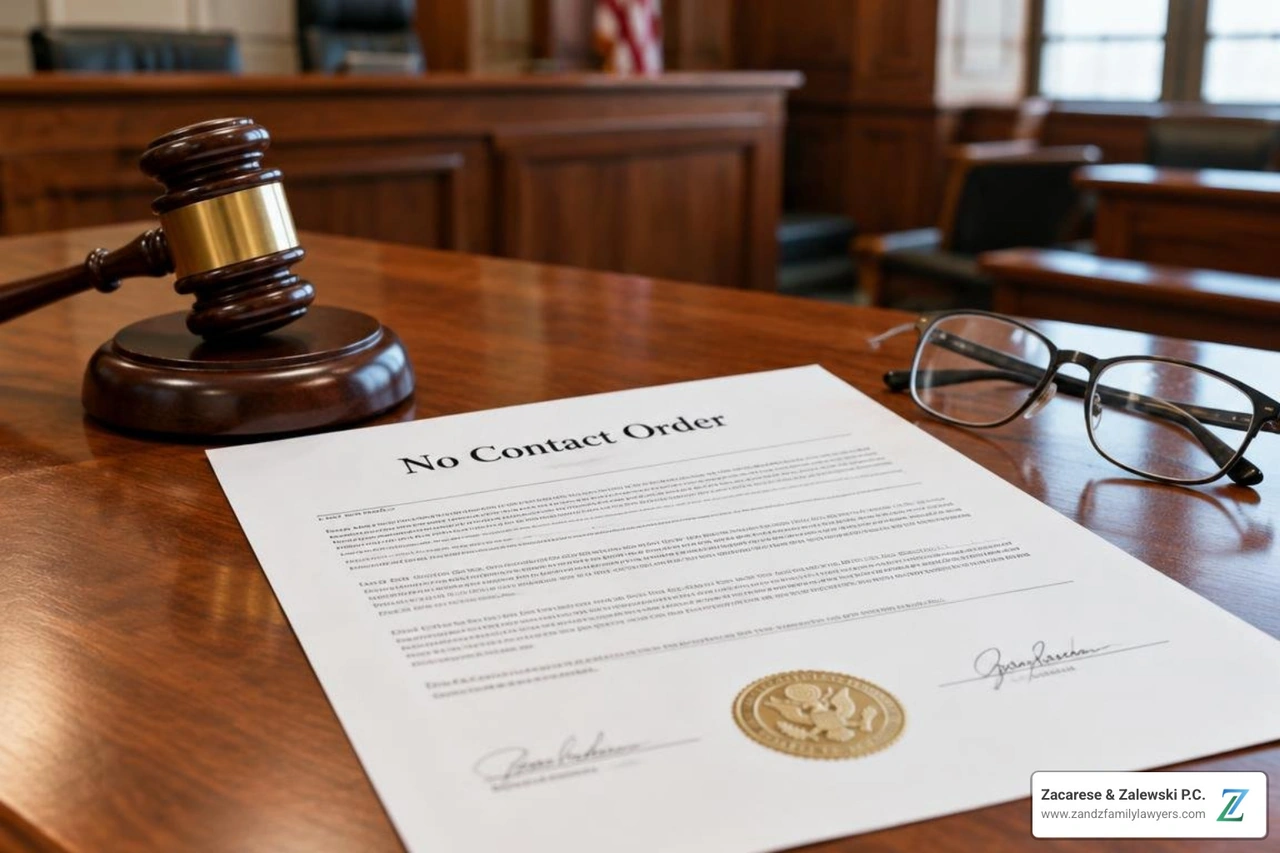
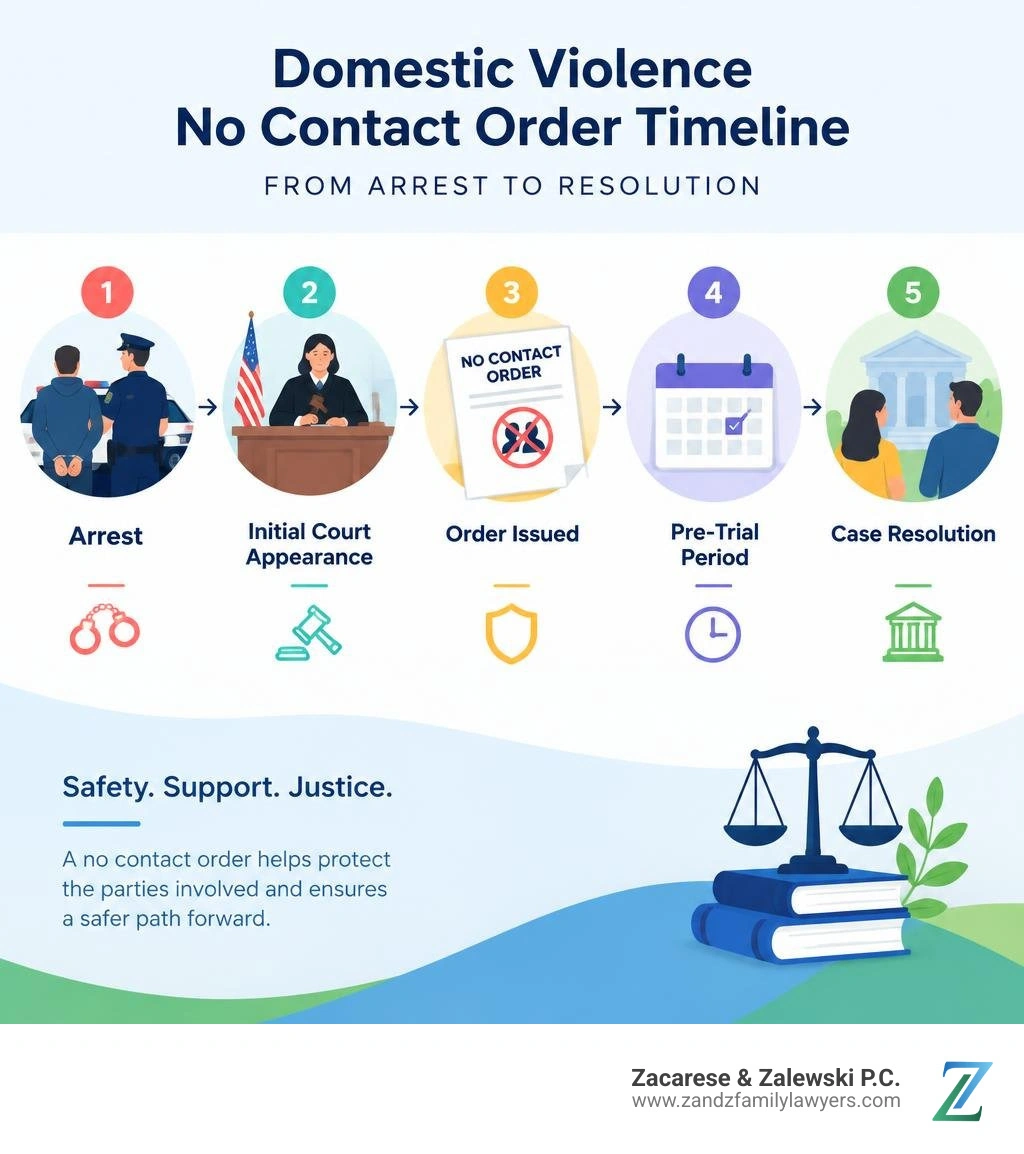
A domestic violence no contact order is a judge's immediate command that stops you from contacting the protected person in any way. It usually bans phone calls, texts, social media messages, and even messages sent through friends or family. It also sets distance rules, often requiring you to stay 500 or 1,000 feet away from the person's home, car, school, and workplace. In many cases, the order also forces you to move out of a shared home right away. These rules start at the arraignment, which is the first court appearance after an arrest, and they stay in place as a condition of pre-trial release.
Domestic violence touches far too many lives across our communities. Every day, people—mostly women—lose their lives to domestic abuse. About 1.2 million people reach out to the National Domestic Violence Hotline each year for help. Over a lifetime, around 25% of women and 17% of men will experience some form of domestic violence.
In our 2026 legal framework, courts take allegations of family violence very seriously. When police make an arrest following a domestic dispute, the criminal court steps in right away to safeguard the alleged victim. The judge often issues a pre-trial release condition barring any contact between the parties involved. Navigating this legal maze requires a clear understanding of how these rules work on the ground.
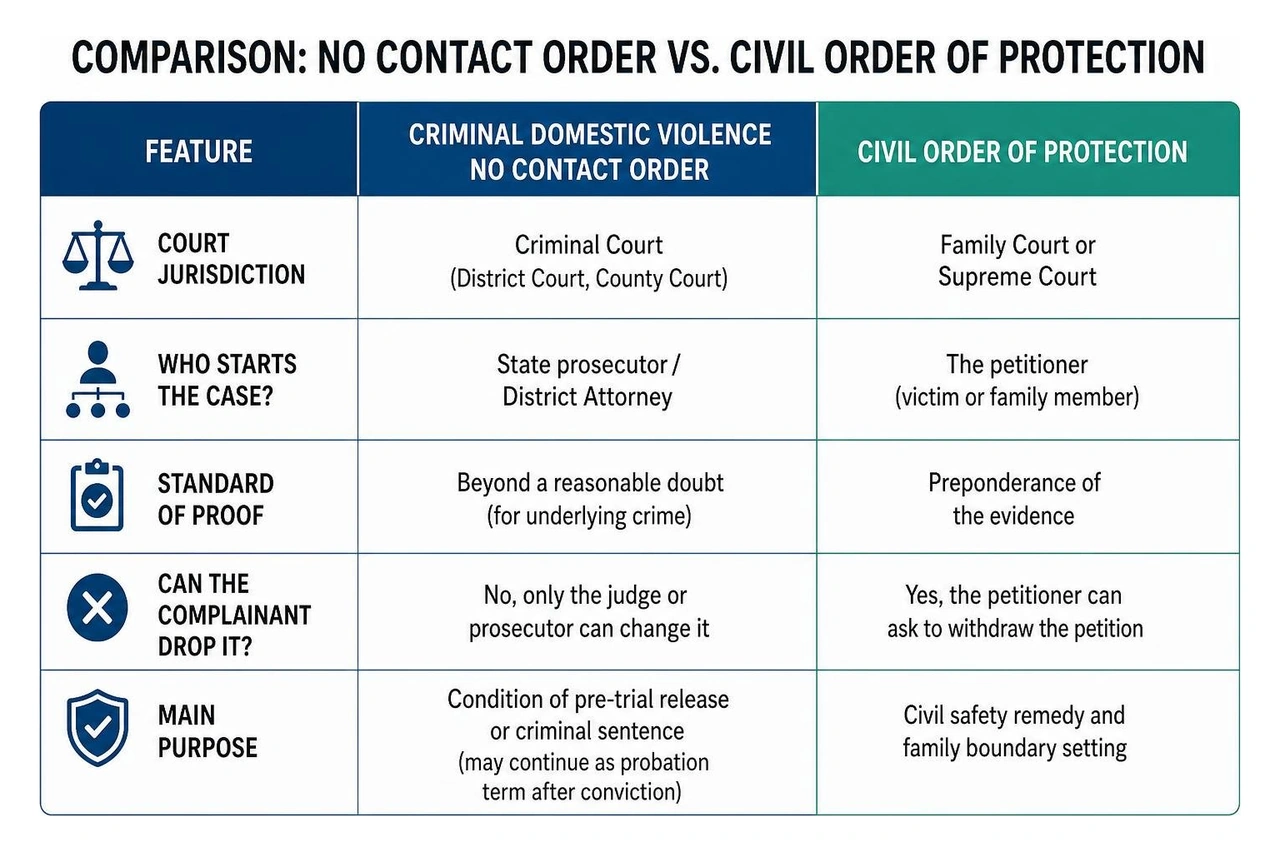
Understanding the Domestic Violence No Contact Order vs. Civil Protective Orders
It is easy to mix up criminal orders and civil protection papers because they seem to do similar things. However, their legal roots and rules are very different.
Criminal courts operate under a criminal court jurisdiction. In domestic incidents, police departments enforce mandatory arrest policies if they see physical evidence of harm or probable cause that a crime took place. Once an arrest happens, the state takes over. The district attorney or prosecutor drives the criminal charges—not the victim. This means a complainant cannot simply walk in the next morning and "drop the charges."
Civil protection orders work differently. In civil courts, a person asks a judge directly for safety rules through a family offense petition.
| Feature | Criminal Domestic Violence No Contact Order | Civil Order of Protection |
|---|---|---|
| Court Jurisdiction | Criminal Court (District Court, County Court) | Family Court or Supreme Court |
| Who Starts the Case? | State prosecutor / District Attorney | The petitioner (victim or family member) |
| Standard of Proof | Beyond a reasonable doubt (for underlying crime) | Preponderance of the evidence |
| Can the Complainant Drop It? | No, only the judge or prosecutor can change it | Yes, the petitioner can ask to withdraw the petition |
| Main Purpose | Condition of pre-trial release or criminal sentence | Civil safety remedy and family boundary setting |
Criminal No Contact Order Basics
A criminal judge usually signs a no contact order at the arraignment. This is the very first court appearance after an arrest. The order serves as a strict condition of pre-trial release or bail. If the case ends in a plea or conviction, the court can keep the order in place as a post-conviction probation term for several years.
Sometimes, early emergency orders are issued without both parties present in an ex parte domestic violence order of protection. If you need help sorting out the differences between these actions, looking at how a Domestic Restraining Order operates will give you a clearer picture of your rights.
Civil Restraining Orders and Family Court Injunctions
Civil orders are filed directly by an individual known as the petitioner. In civil court, the case uses a lower standard of proof called the preponderance of the evidence. This simply means showing that it is "more likely than not" that the wrongful conduct happened.
The petitioner retains much more autonomy in family court. They can choose to settle, adjust terms, or ask to withdraw their petition. To understand how these family court tools work, read our guide on Orders of Protection What They Can and Cant Do in New York Family Court, or review the basics of a Domestic Violence Protective Order.
Core Restrictions: Housing, Firearms, and Communication Mandates

A domestic violence order puts hard boundaries on where you can go and what you can do. Most orders set strict distance limits—often requiring the restrained person to stay at least 500 or 1,000 feet away from the protected person, their vehicle, their school, and their workplace.
These rules apply even if you own the family home or pay the entire lease. A residential vacate mandate forces the restrained party to move out immediately, often with nothing more than the clothes on their back.
To get your clothes, work tools, or medication, you cannot just stop by. You must arrange a "civil standby," where local police escort you to the home for a brief 10-to-15-minute window to pick up essential personal property.
Under both federal law and state rules, these orders also trigger strict firearm restrictions and surrender requirements. You must turn over all firearms, pistols, and hunting rifles to local law enforcement, and your carry licenses are suspended right away.
Direct, Indirect, and Third-Party Communication Prohibitions
The core rule of a no contact order is absolute silence. You cannot make phone calls, send text messages, mail letters, or drop off flowers.
Indirect contact is also illegal. You cannot ask mutual friends, cousins, or neighbors to send messages like, "Tell her I'm sorry" or "Ask him if I can grab my boots." That counts as third-party contact and will result in your arrest. When civil legal issues pop up under Family Offense Proceedings Under Article 8, all legitimate messages must flow exclusively through licensed attorneys.
Social Media and Digital Restrictions Under a Domestic Violence No Contact Order
In our modern world, courts treat digital messages just like spoken words. Prohibited digital actions include:
- Direct messaging on Instagram, Facebook, TikTok, or X.
- Tagging the protected person in photos or status updates.
- Liking, reacting to, or commenting on their old or new posts.
- Checking in at their exact digital locations or using GPS tracking tools.
- Logging into shared cloud storage, family calendars, or smart home security apps.
- Creating fake social media profiles to view their stories or activity.
Sending an innocent "thumbs up" emoji on a shared family album or sending money with a note on Venmo is considered a direct criminal violation.
Impact on Family Dynamics, Child Custody, and Parenting Time
When an order is signed, everyday parenting changes immediately. If the court order lists your children as protected parties, you cannot call them, visit their schools, or pick them up from daycare.
If the children are not listed on the order, you still cannot use parenting exchanges as an excuse to see the other parent. Parents must arrange neutral exchange locations—such as a local precinct lobby or a public library—handled entirely by an approved third party, like a grandparent.
In high-conflict situations, the court may order temporary custody and require supervised visitation at a licensed facility. The court can also award temporary care of domestic pets to ensure family animals are protected. Managing these hurdles is a central part of handling complex Domestic Violence Cases.
Managing Accidental Encounters in Public Spaces

Accidental run-ins happen, especially if you live in the same neighborhood or shop at the same stores. If you walk into a grocery store or gym and spot the protected person, the legal burden falls entirely on you to leave immediately.
Follow this step-by-step protocol:
- Turn around at once. Do not wave, nod, speak, or make eye contact.
- Leave the building or area immediately. Put physical distance between yourself and the other person.
- Keep your receipt or timestamp. If you made a purchase, keep the receipt showing when you were there.
- Write down the details. Note the date, exact time, witnesses, and how quickly you left.
- Call your attorney right away. Notify your legal team so they have a contemporaneous record in case a false violation report is filed.
How to Modify or Lift a Domestic Violence No Contact Order
Only the judge who issued the order has the power to change or dismiss it. You cannot change the terms through a private text conversation or a handshake agreement.
To change an order, you must file a formal written motion with the court. When reviewing motion to modify or rescind procedures, judges look closely at several factors:
- A track record of total compliance with all court rules.
- Participation in voluntary anger management or certified batterer intervention programs.
- The status of the underlying criminal or family court charges.
- The protected person's input, wishes, and safety plan.
For details on timelines, review How Long Does an Order of Protection Last in New York Family Court.
Strategic Legal Representation in Suffolk County
Facing a domestic violence case or an emergency order of protection can turn your world upside down overnight. In these high-stakes moments, having the right legal advocate by your side makes all the difference.
Steven Zalewski is widely recognized as one of the most well-known family court trial lawyers in Suffolk County. He brings decades of courtroom experience to every case, fighting tirelessly for parents and spouses in the Suffolk County Family Court and local courthouses across Islandia, Central Islip, and Riverhead.
At Zacarese & Zalewski P.C., we believe you deserve total honesty and clarity from your legal team. That is why we use an honest flat-fee model. When you work with us, your flat fee covers every single appearance required for that stage of your case, no matter how many times we have to stand before the judge.
Our transparent pricing uses a straightforward two-part structure:
- Pre-Trial Fee: A single fee that covers everything from our first meeting, discovery review, court conferences, motions, and negotiations leading up to trial.
- Trial Fee: A separate, single set fee due 30 days before your scheduled trial date if a full trial becomes necessary.
Unlike other law firms that switch to expensive hourly bills when a case gets difficult—or drop clients mid-case when retainers run dry—Steve never leaves a client behind because they ran out of money. We stand with you from start to finish, and we always offer flexible payment plans to fit your family's budget.
A Warning on Using AI for Family Legal Matters:
When you are stressed, it can be tempting to turn to computer tools like ChatGPT to draft custody agreements, separation paperwork, or court responses. Please be careful. Generic AI tools do not understand the local court rules of Suffolk County. They miss critical nuances, leave out key parenting protections, and generate robotic documents that can permanently hurt your family's future. Only a real human attorney with genuine empathy and deep local legal experience can properly safeguard your rights and your children.
Violations, Penalties, and Enforcement Realities
Violating a court order is not treated as a minor disagreement—it is a brand-new crime. Police officers who confirm that an order is active in the state database will make a mandatory warrantless arrest if there is probable cause of a violation.
Under state laws, such as criminal violation penalties under state statutes, penalties escalate quickly:
- Misdemeanor Contempt: A first-time non-violent breach (like sending a text or walking onto the property) carries fines and up to a year in county jail.
- Felony Enhancements: If the violation involves threats, physical harm, weapon possession, or happens after prior contempt convictions, prosecutors can file serious felony charges carrying multi-year state prison sentences.
If you are accused of breaking a court mandate, you should immediately speak with an experienced Order of Protection Violation Lawyer Suffolk County to protect your freedom.
Can a Protected Person Cancel the Order or Initiate Contact?
This is one of the most common traps in domestic violence law. Many defendants receive a friendly call or text from the protected party saying, "I miss you, please come home, I asked the judge to drop the order."
If you answer that call or go to the house, you are committing a crime.
The order restricts the defendant, not the protected person. A protected person cannot give you legal permission to break a judge's direct order. There is no legal defense of "entrapment" or "she invited me over." Until a judge formally signs an order dismissing the case on the record, any contact initiated by the defendant remains an arrestable offense. To learn more about these risks, check our guide on What Happens if Someone Violates an Order of Protection in Family Court.
Frequently Asked Questions About Domestic Violence No Contact Orders
Can a no contact order be dropped if both parties agree?
No, an order does not automatically disappear just because both individuals agree. In criminal cases, the prosecutor represents the state and may object to dropping the order if they believe there is a continuing safety risk. The judge makes the final decision after reviewing the defendant's compliance record, past offenses, and the overall circumstances.
What should someone do immediately after being served with a no contact order?
Follow the written terms strictly. Secure a safe, alternative place to live, avoid all direct and digital communication, and gather any receipts or records that establish your timeline. Most importantly, consult an experienced lawyer before taking steps that involve your belongings, children, or home. Reviewing Breaking an Order of Protection What Happens in Family Court will help you avoid costly mistakes.
Does a domestic violence no contact order appear on background checks?
Active orders are entered into statewide and national law enforcement databases, such as the National Crime Information Center (NCIC). While an active civil order may show up in background checks, an arrest and criminal no contact order will create a public criminal record that employers, landlords, and professional licensing boards can see.
Conclusion
A domestic violence no contact order can turn your daily routine upside down, impacting your housing, your digital life, and your relationship with your children. Strict compliance is essential to avoid new criminal charges and safeguard your future. Navigating the family and criminal court systems requires steady guidance, local experience, and a clear defense strategy. If you need dedicated legal representation, explore our comprehensive services for Orders of Protection.
📱 Cell: (516) 660-4354
📧 Email: steve@zandzfamilylawyers.com
🏛 Address: 1601 Veterans Memorial Highway, Suite 500, Islandia, NY 11749
i guarantee you will be heard
Ready to Take the Next Step?
At Zacarese & Zalewski P.C., when something isn’t right, say something—and we’ll do something about it with you.
Our flat-fee structure is clear: one flat fee for pre-trial work, and a trial fee only if your case goes to trial or a hearing. Call now and a professional will return your call quickly; if we miss you, we'll call back the same day.