
When you speak, I guarantee you will be heard
Zacarese & Zalewski P.C.
Understand Family Law Grandparent Rights Before You Head to Court
Call now: 516-660-4354
"He didn't just win my case. He gave me back my future, my peace of mind, and my ability to breathe again."
From the very first conversation, he changed everything. He didn't just see a case, he saw me, and treated me like family. His knowledge of the law was unmatched, but what truly set him apart was his humanity. If you are looking for a lawyer, stop searching right now.


Family Law Grandparents' Rights: What to Know Before Court

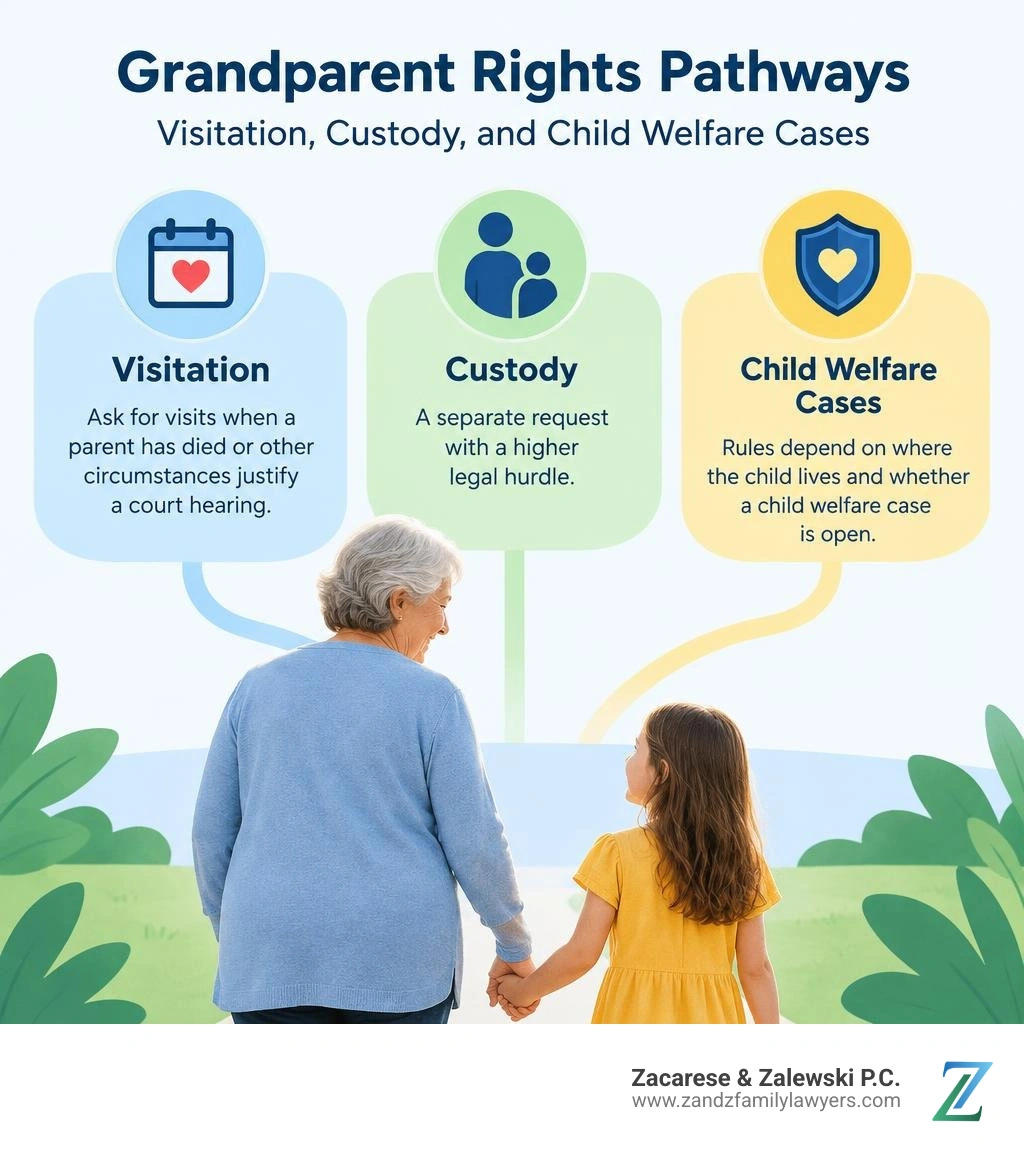
Grandparents do not have an automatic right to visits or custody. In New York, a grandparent may ask for visitation if a parent has died or if other circumstances justify a court hearing. The court then considers the child's best interests while giving weight to a fit parent's decision. Custody is a separate request, with a higher legal hurdle.
Understanding family law grandparents' rights starts with knowing which request fits your situation. The rules depend on where the child lives and whether a child welfare case is open. Florida, for example, has a separate visitation law for children in dependency cases. Before filing, find out which law applies and whether you need visits or the right to care for the child.
Family law grandparents rights definitions:
Constitutional Foundations of Family Law Grandparents Rights
Families come in all shapes and sizes. In 1996, children living with only one parent accounted for 28 percent of all kids under age 18 in the United States. By 1998, about 4 million children lived in the homes of their grandparents. Today in October 2026, grandparents remain a major source of love and stability across the country.
All fifty states have statutes that allow grandparents to ask for visitation. However, state laws must follow the United States Constitution. Under the Fourteenth Amendment, parents have a fundamental right to raise their children without government interference.

When a dispute arises between a parent and a grandparent, the court must balance the parent's constitutional authority against the child's need for family bonds. In leading rulings such as BLIXT v. BLIXT (2002) | FindLaw, high courts have confirmed that laws must be carefully tailored to protect parental autonomy. Understanding how courts balance parents' rights over grandparents helps set realistic expectations before stepping into a courtroom.
The Fit Parent Presumption in Family Law Grandparents' Rights Disputes
The cornerstone of modern family law is the landmark U.S. Supreme Court decision in Troxel v. Granville. This case established the "fit parent presumption."
The law presumes that a fit parent acts in the best interest of their child. If a capable mother or father decides to limit or stop grandparent visits, a judge cannot simply overrule that choice because the judge thinks visits would be nice. To understand this legal reality, it helps to review whether grandparent visitation is an absolute legal right. Grandparents must overcome this presumption with clear evidence showing why the court must intervene.
Overcoming Parental Objections in Visitation Disputes
How does a grandparent overcome a parent's objection? In general non-dependency cases, you must show that cutting off contact will cause real emotional or developmental harm to the child.
Courts look closely at the depth of the established relationship. Longstanding legal decisions, such as Mimkon v. Ford, Supreme Court of New Jersey, 1975, show that maintaining extended family ties can be vital for a child's psychological health, especially after a parent passes away or a divorce occurs. If you are facing a sudden cutoff of contact with your grandchild, you must show the judge that the child will suffer genuine harm without your presence.
Grandparent Visitation vs. Legal Custody: Key Distinctions
Many people confuse visitation with legal custody. They are two very different legal requests under family law.
- Visitation gives you the right to spend scheduled time with your grandchild. The parents keep all legal authority over the child's schooling, medical care, and day-to-day life.
- Legal Custody gives you the power to make major life choices for the child.
- Physical Custody means the child lives in your home full-time.

For a deeper dive into these options, read our complete 2026 grandparent rights overview.
| Feature | Grandparent Visitation | Legal Custody | Guardianship |
|---|---|---|---|
| Living Arrangement | Child lives with parent; visits grandparent | Child lives with grandparent | Child lives with appointed guardian |
| Major Decisions | Made solely by parents | Made by grandparent | Made by guardian (under court oversight) |
| Legal Threshold | Best interests and showing harm/standing | Extraordinary circumstances or unfitness | Parental unavailability, incapacity, or death |
| Parental Rights | Remain fully intact | Suspended or shared by court order | Limited or transferred by court decree |
Extraordinary Circumstances and Parental Unfitness
A judge will not take custody away from a parent simply because a grandparent can provide a larger house or better toys. To seek custody, a grandparent must first prove "extraordinary circumstances."
Extraordinary circumstances include:
- Severe neglect or abandonment
- Domestic violence in the home
- Untreated substance abuse or severe mental health crises
- Prolonged disruption of custody where the grandparent became the primary caregiver
You can learn more about proving extraordinary circumstances for grandparent custody in NY. When grandma and grandpa have taken on the daily parenting role for an extended time, our guide on legal custody options when grandparents act as primary caregivers explains how to protect that caregiving bond.
Emergency Custody and Temporary Protective Relief
If a child is in immediate danger, you do not have time for standard court delays. In cases of sudden abandonment, severe drug overdose in the home, or violence, grandparents can file emergency motions for immediate temporary custody.
Review our step-by-step advice on filing for emergency custody as a grandparent in New York to see how courts handle emergency petitions to keep children safe.
Grandparent Rights in Dependency and Child Welfare Cases
When child protective services steps in and a child is placed in foster care, the legal framework changes dramatically. For example, in states like Florida, Florida Statute Section 39.509 specifically governs grandparent visitation when a grandchild is adjudicated dependent.
Under dependency statutes like Section 39.509:
- Grandparents are entitled to reasonable visitation unless the court finds it is not in the child's best interests or would interfere with the family's case plan.
- The state child welfare agency (such as DCF in Florida or CPS in New York) must evaluate maternal and paternal grandparents for placement priority and help arrange visits.
- Grandparents are given preference over non-relatives for kinship care placements when parents cannot care for the child.
This differs greatly from non-dependency cases. In private family disputes, the parent holds constitutional authority. In dependency cases, the state has already stepped in due to safety concerns, making it easier for loving grandparents to secure court-ordered contact.
The Role of Child Protective Services and Case Plans
When child welfare agencies are involved, caseworkers manage home studies, background checks, and visit logistics. Grandparents can be disqualified from visits or placement if they have convictions for child abuse, sexual offenses, or violent crimes, or if they have their own substantiated reports of abuse or neglect.
While the state cannot charge fees to set up visits, grandparents are typically responsible for providing transportation or paying travel costs if visits take place at their home. Grandparents must also respect all safety rules; attempting unauthorized contact between the child and the struggling parents can result in immediate loss of visitation rights.
Impact of Termination of Parental Rights and Adoption
When parental rights are legally terminated (TPR), the legal bond between the biological parent and the child is permanently cut. What happens to the grandparents?
- TPR alone does not automatically end grandparent visitation if a court has already granted it or finds that visits serve the child's best interests.
- Stepparent or Kinship Adoption: In many states, if a relative or stepparent adopts the child, courts can allow grandparent visits to continue so long-standing family bonds remain intact.
- Third-Party Adoption: If the child is adopted by complete strangers, grandparent visitation rights are usually severed to give the new adoptive family a fresh start.
Determining the Best Interests of the Child in Custody and Visitation
Once a grandparent establishes the legal right to ask for visits or custody, the judge turns to the "best interests of the child" standard.
Courts carefully examine:
- The emotional bond and affection between the grandparent and the child.
- The child's developmental, educational, and medical needs.
- The moral fitness, physical health, and mental stability of all parties.
- The willingness of the grandparent to encourage a loving relationship between the child and the parents.
- The child's wishes, if the child is old enough and mature enough to express them.
For a closer look at these factors, read our guide on what the court considers when grandparents become the primary option.
Key Factors in Family Law Grandparents Rights Evaluations
Judges want to maintain continuity in a young person's life. If you have been packing school lunches, attending parent-teacher conferences, and providing a stable home, judges take that caregiving history seriously. Check out our resource on asserting your rights as an established caregiver to learn how to present evidence of daily care.

A Warning About Using AI for Family Court Matters
When family relationships break down, it can be tempting to turn to internet tools or artificial intelligence (such as ChatGPT) to draft custody agreements, visitation schedules, or court forms.
Please be very careful. Generic, robotic AI software does not understand the nuanced rules of local family courts. AI frequently misses critical legal language, misinterprets state-specific statutes, and produces documents that can permanently damage your legal standing. A computer program cannot offer empathy, evaluate personal dynamics, or stand before a judge to protect your grandchild. Only an experienced human lawyer with deep local knowledge can guide you safely through the family court system.
Step-by-Step Procedure: How to File a Grandparent Petition
Filing a petition in family court requires following strict legal steps:
- Confirm Standing: Verify that you meet state requirements (such as a deceased parent, extraordinary circumstances, or an existing dependency matter).
- Draft the Petition: Clearly state the facts, your relationship with the child, and why court intervention is necessary.
- File with the Clerk: Submit the petition in the circuit or family court located in the county where the child resides.
- Serve Legal Notice: Ensure both parents (or legal guardians) receive formal personal service of the court papers.
- Participate in Mediation: Many courts require parents and grandparents to attend mediation to see if a fair schedule can be resolved peacefully without a trial.
- Attend the Evidentiary Hearing: If no agreement is reached, present witnesses, school records, photos, and medical logs before the judge.
If you need help in New York, you can speak with our grandparents visitation attorney in Suffolk County or connect with our grandparents rights and custody lawyer in Suffolk County NY.
Transparent, Flat-Fee Legal Representation You Can Trust
At Zacarese & Zalewski P.C., we know that family court disputes are emotionally draining. The last thing you need is the stress of unpredictable hourly legal bills.
Led by Steven Zalewski, one of the most well-known family court trial lawyers in Suffolk County, our firm uses an honest flat-fee model. When you work with us:
- Your flat fee covers all appearances, no matter how many court dates are required in Suffolk County Family Court, whether in Islandia, Central Islip, or Riverhead.
- Two-Part Clear Structure: We charge a Pre-Trial Fee that covers all discovery, motions, conferences, and negotiations leading up to trial. If a trial becomes necessary, a single Trial Fee is set and due 30 days before the scheduled trial date.
- No Surprises or Hidden Costs: Unlike other firms that switch to expensive hourly billing or drop clients mid-case when the legal issues get tough, Steve never abandons a client because funds are running low.
- Payment plans are always available so every family can get the dedicated advocacy they deserve.
Frequently Asked Questions About Grandparent Rights
Can grandparents obtain court-ordered visitation if a fit parent objects?
Yes, but only under very limited conditions. Because fit parents have a constitutional right to raise their children, grandparents must prove by clear evidence that cutting off contact will cause tangible harm to the child's health or emotional well-being.
How does child dependency affect a grandparent's right to contact?
When a child is adjudicated dependent due to abuse or neglect by parents, dependency laws grant grandparents a statutory right to reasonable visits and placement priority, provided visits are safe and align with the state case plan.
What happens to grandparent visitation rights after parental rights are terminated?
Termination of parental rights does not automatically end grandparent visitation. If visits continue to serve the child's best interests—especially in cases of kinship or stepparent adoption—judges have the authority to maintain that connection.
Conclusion
Navigating the family court system requires clear strategy, thorough evidence, and steady legal support. You do not have to walk this path alone. To take the next step and protect your family, consider initiating a legal petition with our grandparent custody lawyers.
📱 Cell: (516) 660-4354
📧 Email: steve@zandzfamilylawyers.com
🏛 Address: 1601 Veterans Memorial Highway, Suite 500, Islandia, NY 11749
i guarantee you will be heard
Ready to Take the Next Step?
At Zacarese & Zalewski P.C., when something isn’t right, say something—and we’ll do something about it with you.
Our flat-fee structure is clear: one flat fee for pre-trial work, and a trial fee only if your case goes to trial or a hearing. Call now and a professional will return your call quickly; if we miss you, we'll call back the same day.