
When you speak, I guarantee you will be heard
Zacarese & Zalewski P.C.
Grandparents Parental Rights and How to Navigate Custody Disputes
Call now: 516-660-4354
"He didn't just win my case. He gave me back my future, my peace of mind, and my ability to breathe again."
From the very first conversation, he changed everything. He didn't just see a case, he saw me, and treated me like family. His knowledge of the law was unmatched, but what truly set him apart was his humanity. If you are looking for a lawyer, stop searching right now.


When Can Grandparents Seek Visitation or Custody?

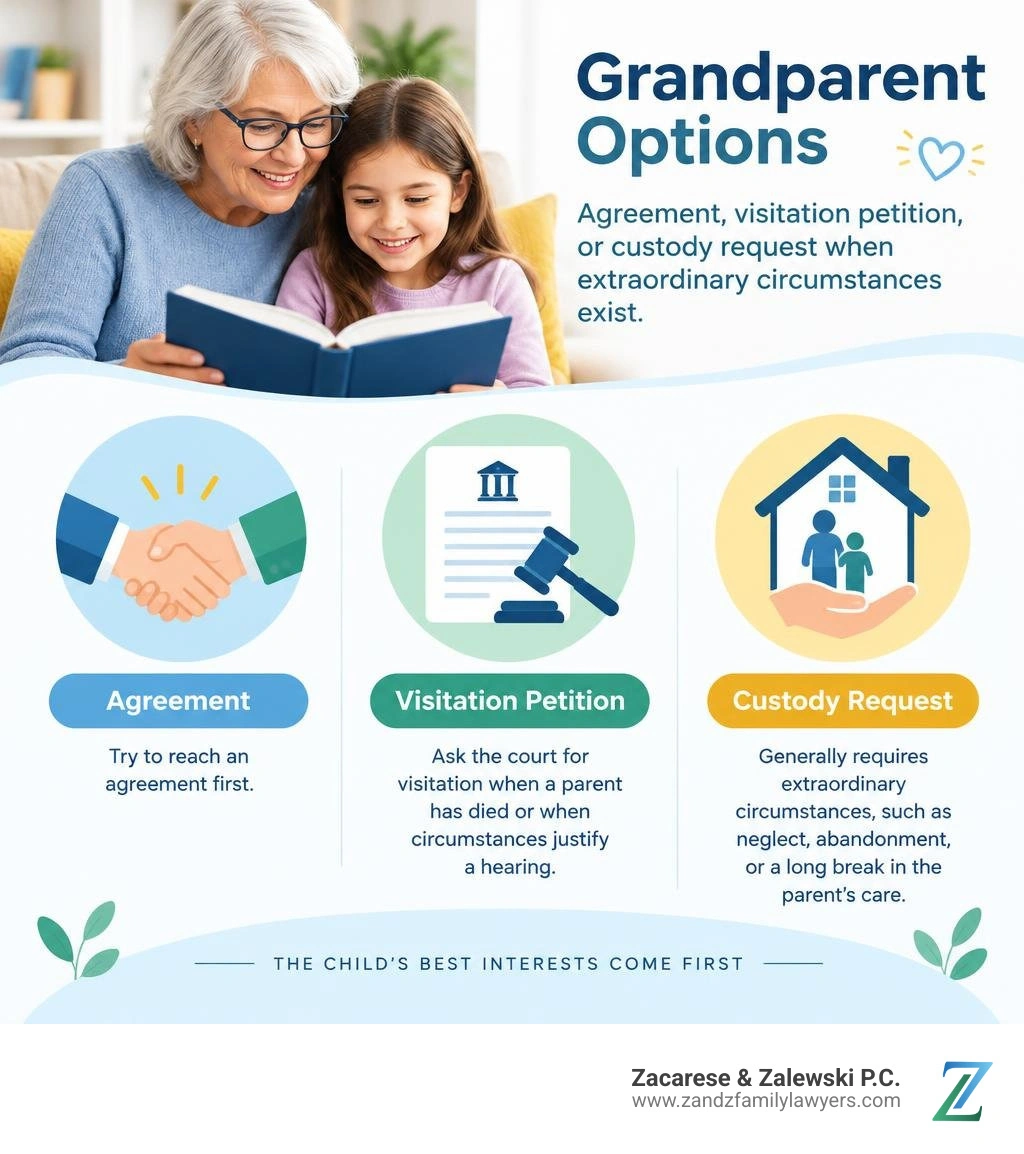
Grandparents can ask a court for visitation or custody, but they do not have the same rights as parents. In New York, a grandparent may seek visitation when a parent has died or when circumstances justify a court hearing. The judge then considers the child's best interests and gives weight to the parent's wishes. Custody is harder to obtain: a grandparent generally must first show extraordinary circumstances, such as neglect, abandonment, or a long break in the parent's care. Understanding grandparents parental rights is the first step toward knowing what a court can and cannot do for your family.
If you're losing contact with a grandchild, try to reach an agreement first. Keep records of the time you've spent caring for the child and any safety concerns. The right legal step depends on whether you seek visits, a stable home for the child, or urgent protection.
Learning the basics of grandparents rights helps you make informed choices. By reviewing common grandparents rights cases, you can better understand how courts evaluate parents rights over grandparents.
Understanding Grandparents Parental Rights vs. Legal Parents' Rights

When family problems happen, many grandparents step up to help. You might cook dinner every night, pick the kids up from school, or tuck them into bed. But in the eyes of the law, parents and grandparents have very different roles.
The law gives fit legal parents a special shield. Under major court rulings like Troxel v. Granville, the United States Constitution protects a parent's right to raise their child. Courts assume that fit parents make good choices for their children. Because of this, parents' rights over grandparents are very strong in family court.
When you go to court, you are usually asking the judge to step in and make a choice against the parent's wishes. That is why grandparents have a higher hill to climb. You cannot simply ask for time because you love your grandchild; you must prove to the judge why court intervention is necessary.
How Courts Balance Parental Autonomy and Grandparents Parental Rights
Judges take the Fourteenth Amendment seriously. This part of the Constitution gives parents the freedom to guide their children's lives without the government telling them what to do.
To balance these rules, family courts look closely at:
- Parental Fitness: Is the parent taking proper care of the child's basic physical and emotional needs?
- Child Welfare: Is the child safe, fed, and going to school?
- State Limits: Can the court step in without violating the parent's rights?
A judge will not overrule a parent just because a grandparent has a nicer house or more money. If you want visits, you must learn about grandparent visitation and third-party rights to understand how the court views your request.
Third-Party Status vs. De Facto Grandparents Parental Rights
In most court battles, a grandparent is treated as a "third party." This means you are on the outside looking in, while the legal parents stand on the inside.
However, some grandparents become what courts call a "de facto parent" or psychological parent. This happens when you step into the shoes of a parent for a long time with the parent's consent. In places like Maryland, courts use a four-part test to see if you qualify:
- Did the biological or legal parent allow and encourage you to act like a parent?
- Did you live in the same home as the child?
- Did you take on real parental duties (like paying for food, taking them to the doctor, and helping with homework) without expecting pay?
- Did you do this long enough to build a deep, parent-like bond?
When de facto caregivers step in, the court gives them more standing than a normal third party.
Grounds for Seeking Custody vs. Visitation: Legal Standards and Extraordinary Circumstances

Asking to visit your grandchild is very different from asking to raise them full-time. The law sets separate hurdles for each request.
| Legal Goal | What You Ask For | What You Must Prove in Court |
|---|---|---|
| Visitation | Scheduled time to see, call, or host the child | You have an established bond, and visits serve the child's best interests. In many states, you must show the child will suffer harm without visits. |
| Legal Custody | The legal power to raise the child and make major life choices | You must first prove extraordinary circumstances (like severe neglect, abandonment, or unfitness), and then prove custody with you is best for the child. |
Overcoming Parental Presumption Through Exceptional Circumstances and Unfitness
To win custody over a biological parent, you must overcome the legal presumption favoring parents. You must show the court that the parent cannot safely care for the child.
Common examples include:
- Major drug or alcohol abuse that leaves the child unsupervised.
- Severe physical, verbal, or emotional neglect.
- Abandonment, such as leaving the child with you for months without calling or sending money.
- Complete disruption of the child's daily life.
To understand how local judges handle these heavy burdens, read our guide on what extraordinary circumstances mean for grandparent custody.
Securing Emergency Custody and Temporary Kinship Guardianship
When a child is in immediate physical danger, you cannot wait months for a standard trial. You may need to file an emergency petition.
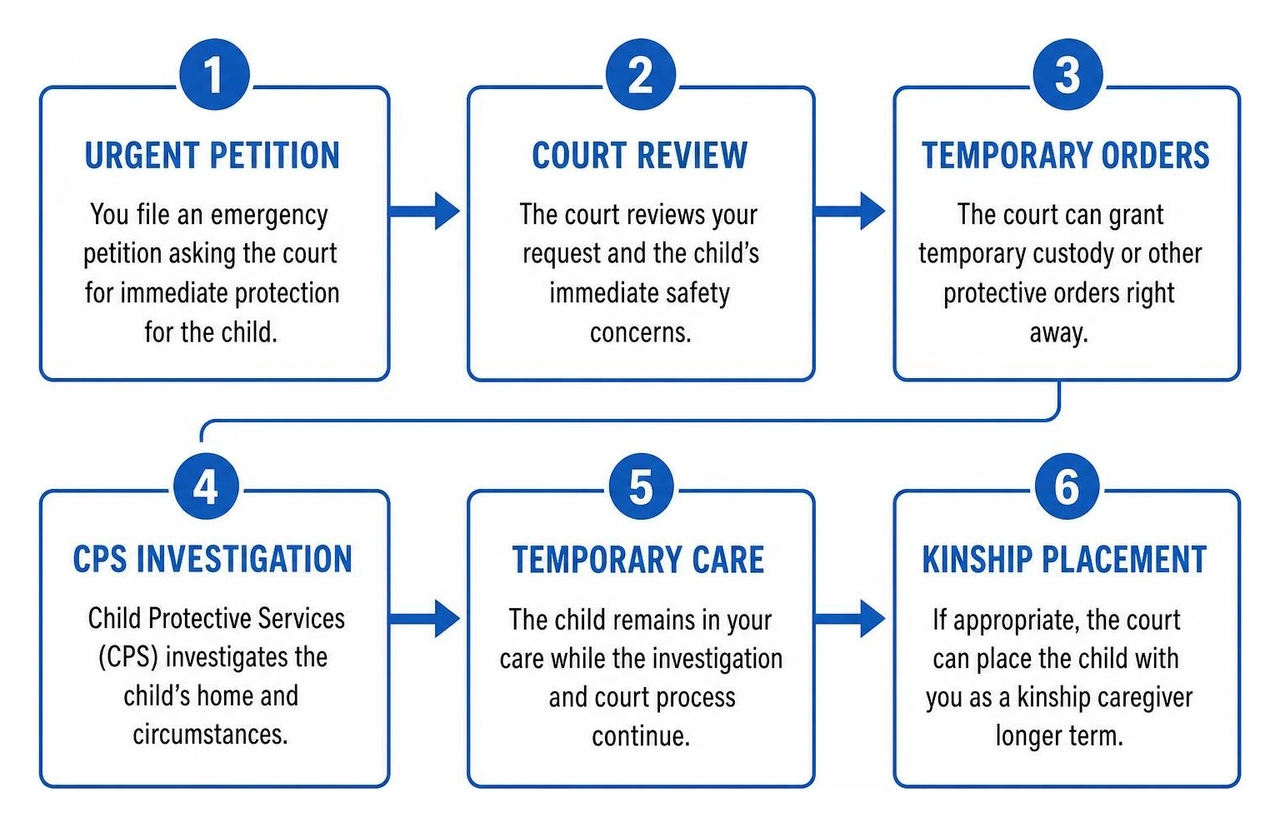
In urgent cases, you can ask for immediate protective relief. The court can grant temporary custody while Child Protective Services (CPS) investigates the home. If you are facing an urgent crisis, review the steps for emergency custody petitions in NY.
How Grandparent Custody and Visitation Laws Vary by Jurisdiction
Every state and country handles extended family rights differently. Where the child lives determines what rules apply.
| Location | Standing Rules | What Grandparents Must Prove |
|---|---|---|
| New York | Allowed if a parent died or if equity allows | Standing first, then best interests for visits; extraordinary circumstances for custody. |
| Maryland | Treated as third parties unless de facto status applies | Parental unfitness or exceptional circumstances. |
| California | Parents must be unmarried, living apart, or parent incarcerated | Strong existing bond; visits must outweigh parental objections. |
| New Jersey | Grandparents can file directly | Clear proof that the child will suffer real harm without contact. |
| Georgia | Can file an original action every 2 years | Clear and convincing proof of harm under Georgia Code Title 19. Domestic Relations § 19-7-3. |
| Scotland | No automatic legal rights | Must petition for a court order under Scottish family rules. |
| France | Child has an explicit right to contact | Article 371-4 protects grandparent bonds unless harmful to the child. |
| Australia | No automatic rights under Family Law Act 1975 | Must apply for a parenting order based on best interests. |
State-by-State Rules: New York, Maryland, California, New Jersey, and Georgia
In New York, grandparents can seek visitation if one parent has passed away or if circumstances give them standing. In Maryland, you must prove the parents are unfit or prove exceptional circumstances.
California only lets grandparents ask for visits if the parents are unmarried, living apart, or if a parent is in prison. In New Jersey and Georgia, the law focuses on preventing harm to the child.
International Perspectives: Scotland, France, and Australia
Across the ocean, laws vary just as widely:
- In Scotland, family rules follow the One Parent Families Scotland guidance on parental responsibilities, meaning grandparents hold no automatic rights and must seek a court order.
- In France, as noted in the EU e-Justice Portal parental responsibility overview, Article 371-4 of the Civil Code states that the child has a right to maintain personal relationships with their grandparents.
- In Australia, the Family Law Act 1975 does not grant automatic rights, but grandparents can apply for parenting orders to keep children connected to extended family.
Step-by-Step Strategy: Preparing for Court, Gathering Evidence, and Mediation
Taking your child or their partner to court can be emotionally painful. Before you file a petition, take smart steps outside the courtroom with trusted grandparents' rights and custody legal guidance.
Pre-Court Actions: Negotiation, Documentation, and Family Mediation
Going straight to court often pushes parents away. Try these friendly steps first:
- Calm Conversations: Ask for simple, low-pressure visits, like an afternoon at the park.
- Family Mediation: Sit down with a neutral professional to build a workable visitation plan without judges.
- Communication Logs: Keep a notebook of every call, text, birthday card, and gift you send.
Gathering Compelling Evidence to Prove Best Interests and Parental Harm
If court is your only choice, you will need clear proof:
- School & Daycare Records: Report cards, attendance logs, and notes listing you as the emergency contact.
- Medical Documents: Doctor visits where you took the child or paid medical bills.
- Financial Receipts: Bank statements showing you bought clothes, food, or school supplies.
- Photos & Messages: Pictures showing your close relationship and text messages showing when you cared for the child.
- Witness Notes: Statements from neighbors, teachers, or babysitters who saw you caring for the child daily.
Why You Need a Real Attorney (And Not AI)
When family ties are on the line, some people turn to AI tools like ChatGPT to write custody petitions or separation agreements. Please do not do this.
AI programs generate robotic, one-size-fits-all forms. They do not know local courtroom practices, and they miss critical legal details. A small mistake in your paperwork can cause a judge to dismiss your case completely. Only a compassionate human attorney who knows local family court rules can tell your story and protect your grandchild's future.
Working with Steven Zalewski in Suffolk County
Steven Zalewski is one of the most well-known family court trial lawyers in Suffolk County. He regularly advocates for families in Suffolk County Family Court, handling cases across Islandia, Central Islip, and Riverhead.
When you hire our firm, you get total peace of mind through Steven Zalewski's honest flat-fee model:
- All Court Dates Included: Your flat fee covers all your appearances, no matter how many times the judge calls us back to court.
- Clear Two-Part Structure: You pay a single Pre-Trial Fee that covers all work leading up to trial. If your case goes all the way to a hearing, a single Trial Fee is due 30 days before your scheduled trial date.
- No Surprise Hourly Bills: Other law firms bill by the minute or drop clients when retainers run dry. Steve never leaves a client behind because they ran out of money.
- Payment Plans Available: We offer flexible payment plans to keep quality legal help affordable.
Frequently Asked Questions About Grandparents Parental Rights
Can grandparents file for custody if parents are fit but refusing contact?
No. If the parents are fit, take good care of the child, and simply do not want contact, you cannot win custody. You may be able to ask for visitation, but you must prove that missing visits will harm your grandchild.
What qualifies as extraordinary circumstances for grandparent custody?
Extraordinary circumstances include long periods of abandonment, active drug or alcohol abuse, untreated mental health crises, severe neglect, or a parent voluntarily leaving a child with you for a prolonged period.
How can grandparents get emergency temporary custody?
You must file an emergency petition in family court showing the child faces immediate physical danger. You will need clear evidence, such as police reports, photos of unsafe living conditions, or medical records.
Conclusion: Protecting Your Grandchild’s Future and Securing Legal Stability
Grandparents give children safety, love, and stability when the world feels stormy. If family disputes are keeping you from your grandchild, or if you need to step in to keep them safe, you do not have to walk this path alone.
Explore your grandparent custody legal options with an experienced advocate who will stand by your side from start to finish. Contact Zacarese & Zalewski P.C. today for honest guidance and dependable flat-fee representation.
📱 Cell: (516) 660-4354
📧 Email: steve@zandzfamilylawyers.com
🏛 Address: 1601 Veterans Memorial Highway, Suite 500, Islandia, NY 11749
i guarantee you will be heard
Ready to Take the Next Step?
At Zacarese & Zalewski P.C., when something isn’t right, say something—and we’ll do something about it with you.
Our flat-fee structure is clear: one flat fee for pre-trial work, and a trial fee only if your case goes to trial or a hearing. Call now and a professional will return your call quickly; if we miss you, we'll call back the same day.