
When you speak, I guarantee you will be heard
Zacarese & Zalewski P.C.
The Complete Process of Filing for Sole Child Custody
Call now: 516-660-4354
"He didn't just win my case. He gave me back my future, my peace of mind, and my ability to breathe again."
From the very first conversation, he changed everything. He didn't just see a case, he saw me, and treated me like family. His knowledge of the law was unmatched, but what truly set him apart was his humanity. If you are looking for a lawyer, stop searching right now.


How to Start Filing for Full Custody

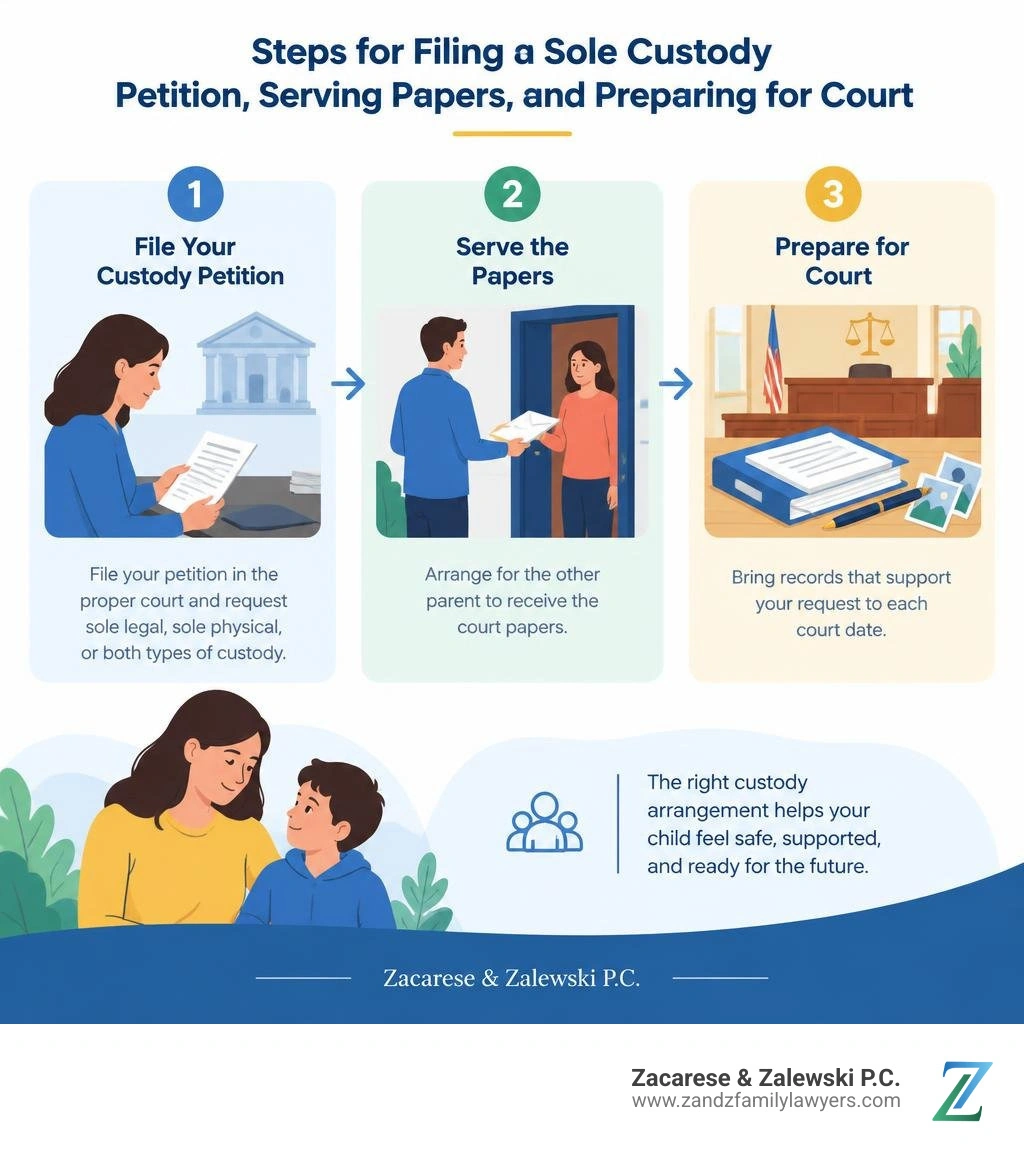
To start filing for full custody, check that New York is the right state for your case. Then file a custody petition in the proper court, ask for sole legal custody, sole physical custody, or both, and explain why your request is best for your child. Arrange for the other parent to receive the court papers, and bring records that support your request to each court date.
“Full custody” is not one fixed legal term. Sole legal custody usually means one parent makes major decisions. Sole physical custody means the child lives primarily with that parent. The court can grant one without the other, so be clear about what you need.
What Sole Custody Legally Means and Who Can File
When you walk into family court, using the right words matters. Many people say "full custody" when they want their child to live with them full-time and make all the big life choices. Legally, custody breaks down into two distinct parts: legal custody and physical custody.

Legal custody covers major life decisions. These include where your child goes to school, their religious upbringing, and medical treatments. Physical custody (often called residential custody) refers to where your child actually sleeps at night.
To see how these concepts work in everyday life, review our breakdown on understanding joint vs sole custody in New York. When a judge awards sole legal and sole physical custody to one person, that parent has full daily care and the final say on all major decisions.
| Custody Type | What It Means | Everyday Impact |
|---|---|---|
| Sole Legal Custody | One parent makes all major decisions alone. | You decide on schools, doctors, and treatments without needing the other parent's sign-off. |
| Joint Legal Custody | Both parents must agree on major decisions. | Both parents have equal input on education, healthcare, and religion. |
| Sole Physical Custody | The child lives primarily with one parent. | The child resides with you; the other parent may receive scheduled visitation. |
| Shared Physical Custody | The child splits living time between homes. | The child spends substantial, often equal, time living with each parent. |
State-by-State Custody Terminology and Legal Standards
Different states use distinct legal words for custody:
- Texas: The law refers to custody as conservatorship. Courts presume parents should share rights under a Joint Managing Conservatorship. To win what people call full custody—known as Sole Managing Conservatorship—you must prove that joint decision-making would significantly harm your child's physical health or emotional growth.
- Colorado: The court system has retired words like "custody" altogether. Judges allocate "parenting time" and "decision-making responsibilities."
- Pennsylvania: Courts divide terms into physical custody (sole, primary, shared, partial, or supervised) and legal custody.
- Oklahoma: Judges weigh 16 distinct statutory factors to decide sole or joint custody.
- New York: Family courts focus on the best interests of the child, looking closely at which home offers the most stability and care.
Eligibility and Third-Party Standing for Grandparents
Biological and legal parents always have the right to file for custody. Legal parentage comes from being listed on the birth certificate, signing a voluntary acknowledgment of paternity, or securing a court order.
Non-parents, such as grandparents or close relatives, can also step forward under special conditions:
- In Loco Parentis: This applies when a non-parent has taken on daily parenting duties with the parent's consent.
- Grandparent Rights: In Pennsylvania, for example, a grandparent can seek custody if the child lived with them for at least 12 months in a row and was then removed by a parent. The grandparent must file within six months of that removal.
- Extraordinary Circumstances: In New York, non-parents must prove surrender, severe neglect, extended abandonment, or unfitness before a judge will consider giving them custody over a parent.
Step-by-Step Procedures for Filing for Full Custody
Filing a case requires following strict court rules. Doing things in the wrong order can cause serious delays.

Here is how the filing process moves forward:
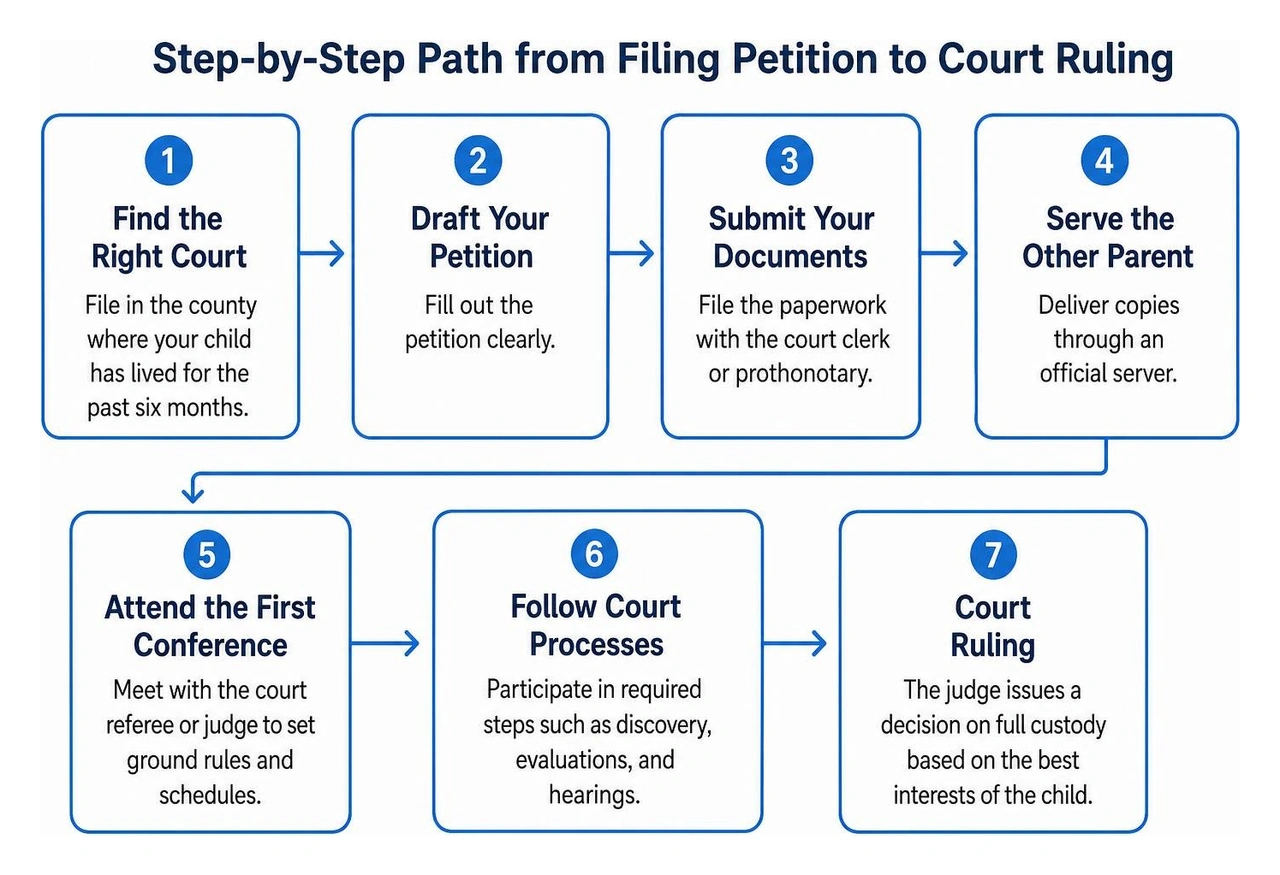
- Find the Right Court: File in the county where your child has lived for the past six months.
- Draft Your Petition: Fill out the petition clearly. For a deeper look at the whole court journey, read our custody cases guide 2026.
- Submit Your Documents: File the paperwork with the court clerk or prothonotary.
- Serve the Other Parent: Deliver copies through an official server.
- Attend the First Conference: Meet with the court referee or judge to set ground rules and schedules.
Establishing Home State Jurisdiction When Filing for Full Custody
Under the Uniform Child Custody Jurisdiction and Enforcement Act (UCCJEA), you must file in your child's legal "home state." This is where your child has lived for at least six straight months before filing. If your child is younger than six months, it is where they have lived since birth.
You will file a petition tailored to your marital status:
- Married parents often file through a divorce action.
- Unmarried parents file a standalone custody petition.
- Parents can review official court resources on filing for custody to understand local requirements.
Serving Court Papers and Handling Non-Responsive Co-Parents
You cannot hand the court papers to the other parent yourself. You must use an adult not involved in the case, a private process server, or your local county sheriff.
Once served, the other parent usually has 20 to 30 days to file an Answer. If they ignore the summons or skip court:
- The judge can issue a default judgment, granting your custody request because the other parent failed to show up.
- In places like Pennsylvania, a judge can even issue a bench warrant for a parent who refuses to appear after proper notice.
Requesting Temporary and Emergency Ex Parte Orders
If your child faces immediate danger, abuse, or neglect, you cannot wait months for a trial. You can ask for an emergency ex parte order. "Ex parte" means the judge hears your request immediately, even before the other parent is notified, to keep your child safe.
These orders establish safety rules until everyone can appear in court. Learn what to expect at your first appearance by reading about what happens at first custody hearing.
A quick word of warning: please do not rely on AI tools like ChatGPT to draft your emergency orders or custody agreements. Generic, robotic AI forms miss critical local court rules, overlook key safety protections, and can harm your family's future. Only a real human lawyer who knows the local courtrooms can protect your rights.
Essential Evidence and Judicial Best Interest Factors
Judges do not make custody choices based on gut feelings or angry accusations. They demand real, documented evidence.
To discover how judges make these tough choices, read our guide on what judges actually look for in a custody case.
Documenting Parental Unfitness and Compiling Evidence When Filing for Full Custody
If you are asking for sole custody because the other parent is unsafe, you must prove your concerns with facts:
- Police Reports: Official incident logs of domestic disturbances or safety calls.
- Child Protective Services (CPS) Records: Official findings of neglect or abuse.
- Medical and Therapy Notes: Documentation from doctors or child therapists.
- School Attendance and Grade Records: Proof of who helps with homework and gets the child to class on time.
- Communication Logs: Time-stamped text messages and emails showing hostile behavior or missed visits. Using specialized co-parenting apps creates clean records that judges trust.
Statutory Best Interest of the Child Criteria
When family courts review custody requests, they focus on several key factors:
- The child's emotional ties with each parent.
- Which parent has served as the primary daily caregiver.
- Each parent's mental, emotional, and physical health.
- Any history of domestic violence or substance abuse.
- The child's preference, if the child is old and mature enough.
Learn more about these local standards in our article explaining how custody is decided in Suffolk County family court.
Modifying Existing Custody Orders and Managing Court Costs
Life changes over time. When an existing custody order no longer works, you can ask the court for a modification.
To win a modification, you must prove there have been major changes in your child's life since the last order. Examples include a parent relocating, a serious decline in a parent's mental health, or an older child needing a new schedule. If you need help updating an order, speak with a custody modification lawyer in Suffolk County NY.
Filing Fees, Incidental Expenses, and Fee Waiver Applications
Court cases involve standard costs, but help is available if money is tight:
- Initial Filing Fees: In states like California, filing costs range from $435 to $450. In New York Family Court, there is no fee to file a custody petition.
- Fee Waivers: If you have a low income, you can file a fee waiver (known as an In Forma Pauperis petition) so court fees are waived.
- Service Fees: Process servers typically charge $50 to $100 per delivery.
When it comes to legal representation, unpredictable hourly billing can cause unnecessary stress. Steven Zalewski is one of the most well-known family court trial lawyers in Suffolk County, regularly fighting for clients in Suffolk County Family Court in Central Islip and Riverhead, with our main office in Islandia.
We use an honest flat-fee model. Your flat fee covers all your appearances—no matter how many court dates your case takes. Our clear two-part structure features:
- Pre-Trial Fee: A single set rate covering everything from your initial filing up to the trial date.
- Trial Fee: A single set fee due 30 days before your scheduled trial.
While other firms switch back to high hourly rates or abandon clients when cases become complex, Steve never leaves a client behind because they ran out of money. We also offer manageable payment plans to ensure quality representation remains accessible.
Frequently Asked Questions About Filing for Full Custody
Can a father successfully obtain full custody in family court?
Yes. The law is strictly gender-neutral. Courts do not give mothers an automatic advantage. A father who demonstrates that he provides a stable, loving, and supportive home has an equal right to sole custody. For practical examples, see our articles on can a father get full custody in New York family court and how dads succeed when winning custody.
What happens if the other parent refuses to participate or attend court?
If the other parent is properly served and refuses to file a response or appear in court, the judge will proceed without them. This allows the court to enter a default order granting your requested custody arrangement.
How long does the full custody legal process usually take?
An uncontested custody case can wrap up in two to three months. A contested case involving forensic evaluations, home visits, and a full trial can take anywhere from six months to over a year, depending on the court's calendar backlog.
Conclusion
Securing sole custody requires clear legal grounds, organized evidence, and careful attention to court rules. Whether you are dealing with an emergency safety issue or building long-term stability for your child, having dedicated trial lawyers by your side makes all the difference.
For complete guidance on protecting your family, explore our resource on understanding joint vs sole custody in New York and reach out to our team today.
📱 Cell: (516) 660-4354
📧 Email: steve@zandzfamilylawyers.com
🏛 Address: 1601 Veterans Memorial Highway, Suite 500, Islandia, NY 11749
i guarantee you will be heard
Ready to Take the Next Step?
At Zacarese & Zalewski P.C., when something isn’t right, say something—and we’ll do something about it with you.
Our flat-fee structure is clear: one flat fee for pre-trial work, and a trial fee only if your case goes to trial or a hearing. Call now and a professional will return your call quickly; if we miss you, we'll call back the same day.