
When you speak, I guarantee you will be heard
Zacarese & Zalewski P.C.
Drawing Boundaries: The Legal Way to Keep Your Ex Far Away
Call now: 516-660-4354
"He didn't just win my case. He gave me back my future, my peace of mind, and my ability to breathe again."
From the very first conversation, he changed everything. He didn't just see a case, he saw me, and treated me like family. His knowledge of the law was unmatched, but what truly set him apart was his humanity. If you are looking for a lawyer, stop searching right now.


How to Get a Restraining Order Against an Ex

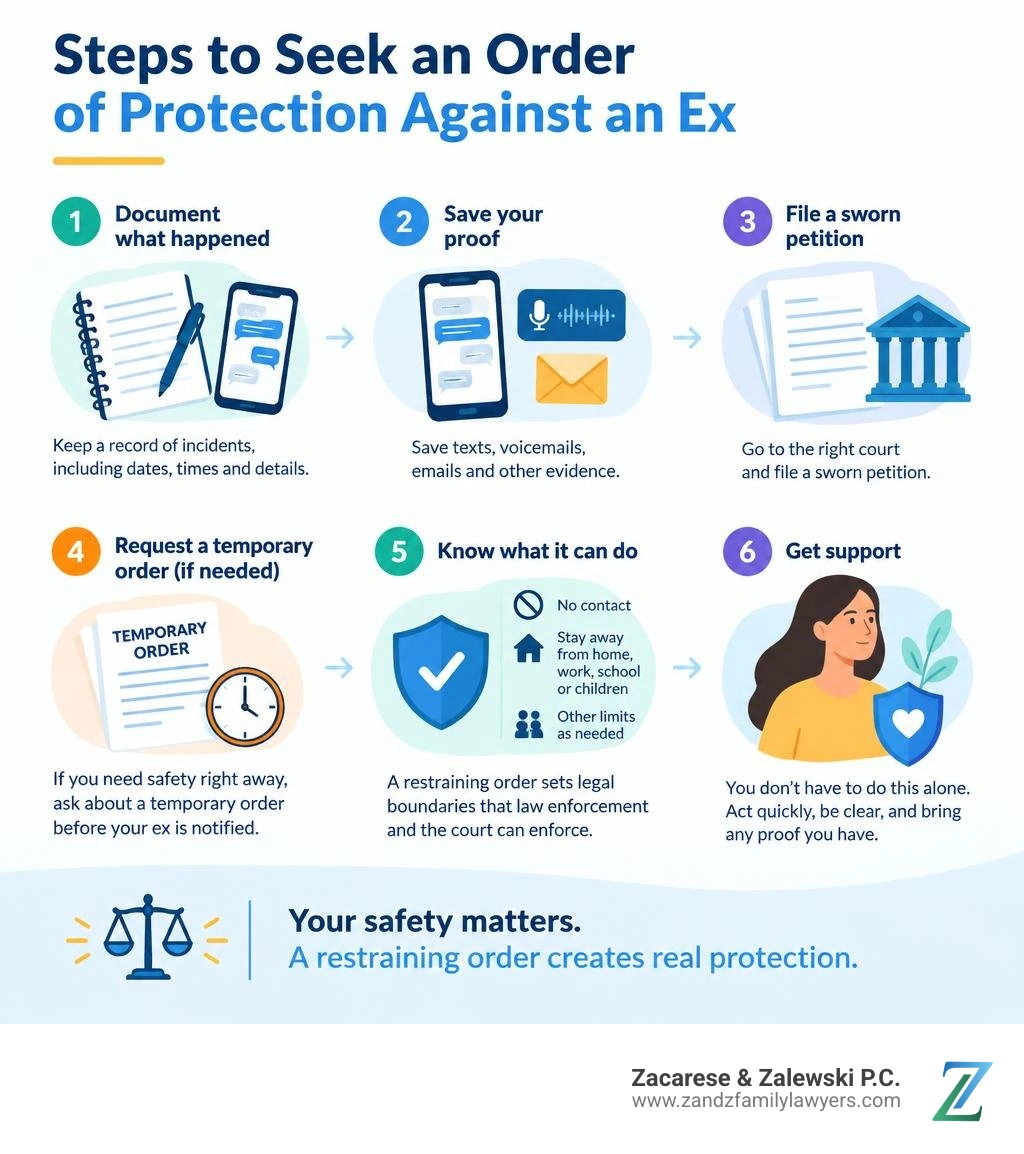
If your ex is threatening, stalking, hurting, or repeatedly harassing you, you may be able to ask the court for an order of protection. In Suffolk County, start by documenting what happened, saving texts and voicemails, and filing a sworn petition in the right court. If you need safety right away, ask about a temporary order that can be issued before your ex is notified.
A restraining order against an ex can require them to stop contact, stay away from your home, job, school, or children, and follow other limits the judge finds necessary. It may also address temporary custody or safe parenting-time exchanges when children are involved.
You do not need to figure this out alone. The key is to act quickly, describe each incident clearly, and bring any proof you have. A court order is not just a request for space. It creates legal boundaries that law enforcement and the court can enforce.
Basic restraining order against ex terms:
Grounds and Eligibility for a Restraining Order Against Ex

When you need legal space from someone you used to date or live with, you must show the court that you qualify under the law. You cannot just file against a stranger in family court. You need a specific relationship and a legal reason to ask a judge for help. Knowing your rights helps you take the right steps to stay safe when filing a domestic violence protective order.
Qualifying Relationships and Family Court Jurisdiction
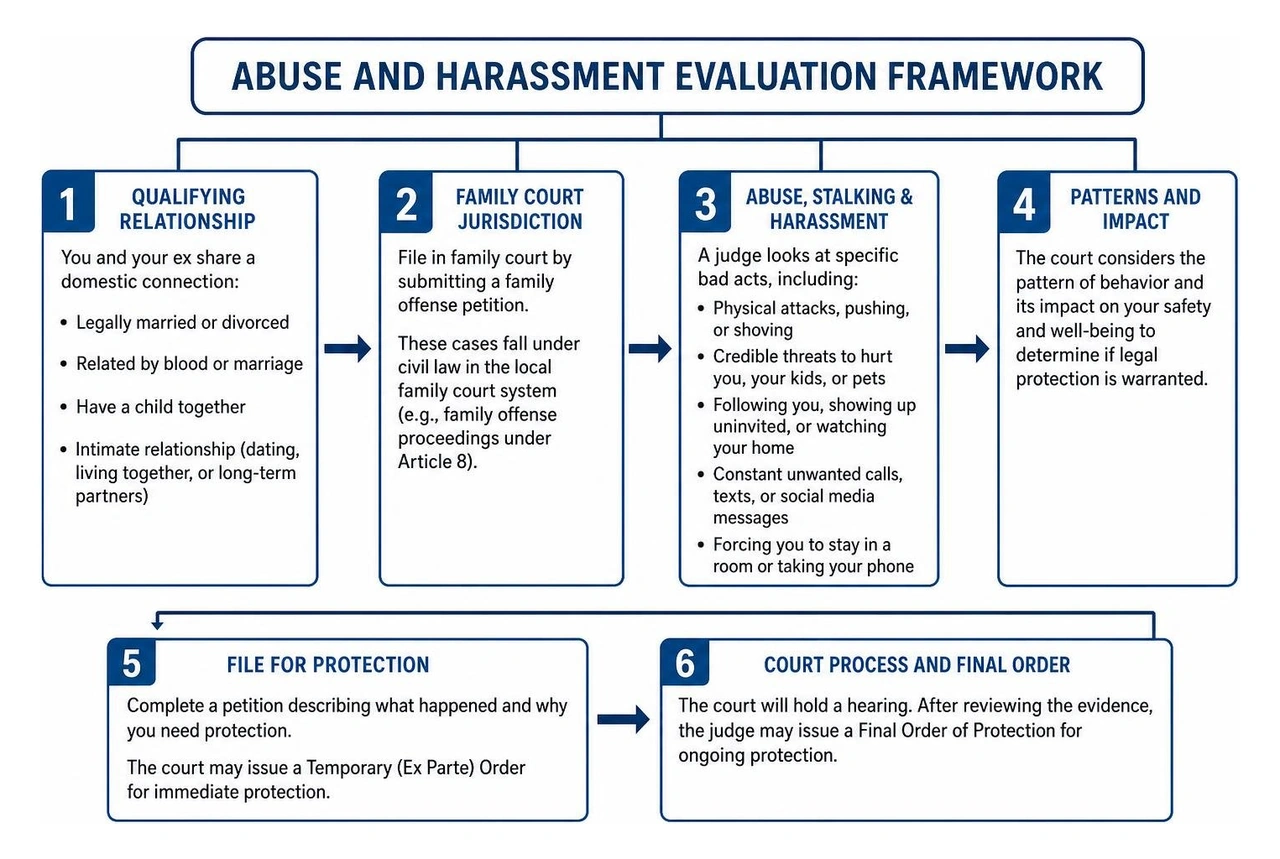
To file in family court, you and your ex must share a recognized domestic connection. Under the law, this includes:
- People legally married or divorced
- People related by blood or marriage
- People who have a child together
- People who are or were in an intimate relationship (dating, living together, or long-term partners)
You do not have to live together or share a child to qualify. A serious dating relationship is enough. When you bring your case, you file what the court calls a family offense petition. These cases fall under civil law in the local family court system, such as family offense proceedings under Article 8. If your situation involves someone you never dated, you might need a different court, making understanding personal protection orders and civil harassment rules essential.
Recognizing Abuse, Stalking, and Harassment
A judge will look at the specific bad acts committed by your ex. Abuse is not only physical hitting. It includes many behaviors meant to scare, track, or control you:
- Physical attacks, pushing, or shoving
- Credible threats to hurt you, your kids, or your pets
- Following you, showing up uninvited, or watching your home (stalking)
- Constant, unwanted calls, texts, or social media messages (digital harassment)
- Forcing you to stay in a room or taking your phone
Reviewing our domestic violence no contact guide 2026 can help you identify these harmful patterns. Other states also set clear standards for these behaviors; for instance, you can review Domestic Violence Restraining Orders in California to see how courts across the country identify intimate partner abuse.
How to File for Protection and Navigate the Court Process
Filing court paperwork can feel scary, but the process is designed to protect you quickly. You start by filling out a petition that details what happened.
| Feature | Temporary (Ex Parte) Order | Final Order of Protection |
|---|---|---|
| Notice to Ex | Issued without ex present | Ex has right to be in court |
| How Long It Lasts | Until the next court date | Usually 1 to 5 years (depending on state) |
| Standard of Proof | Immediate risk shown on paper | Preponderance of the evidence at hearing |
| Main Goal | Urgent emergency safety | Long-term safety and stability |
To start, you must know how to file for an order of protection in family court.
Filing an Emergency Restraining Order Against Ex and Ex Parte Relief
When you are in immediate danger, you cannot wait weeks for a full trial. You can ask for an emergency temporary order. This is called an ex parte order because the judge issues it right away, before your ex even knows you filed.
The judge listens to your sworn statement and reads your petition. If they see immediate danger, they sign the order on the spot. Similar urgent procedures exist nationwide, as seen in Rule 24 ex parte temporary restraining orders or these ex parte domestic violence order of protection guidelines. If courts are closed at night or on weekends, you can call the police to reach an on-call judge for emergency protection.
Service of Process and Gathering Compelling Evidence
An order only protects you after your ex receives legal notice. This is called service of process. You must never hand the papers to your ex yourself. A police officer, county sheriff, or professional process server must deliver them.
To win a lasting order, you must back up your words with solid proof. Useful evidence includes:
- Screenshots of threatening text messages, emails, or call logs
- Clear photos of injuries, bruises, or damaged property
- Police incident reports and 911 call recordings
- Medical records from doctor or hospital visits
- Eyewitness statements from neighbors, friends, or coworkers
Working alongside an orders of protection attorney for family offense cases ensures your evidence is properly prepared and presented to the judge.
A Warning About Artificial Intelligence (AI):
Please do not rely on AI tools like ChatGPT to draft your custody agreements, separation papers, or court petitions. Generic computer programs do not know local court rules, and robotic text often misses critical details. A simple computer mistake can harm your safety and your children's future. Only a real human attorney with local knowledge can protect your family.
Attending the Hearing for Final Legal Relief
At the final hearing, both you and your ex have the right to speak. Your ex can bring a lawyer and argue against the order. This is why having skilled representation matters.
At our firm, Steven Zalewski is known as one of the most trusted family court trial lawyers in Suffolk County. Whether your case is heard at the Suffolk County Family Court in Central Islip or Riverhead, Steve knows how local judges work. We use a transparent flat-fee system that keeps your legal costs predictable:
- Pre-Trial Fee: A set flat fee covering every phone call, document, negotiation, and court appearance leading up to trial—no matter how many court dates it takes.
- Trial Fee: A single, clear fee due 30 days before your trial begins.
Unlike other firms that switch to expensive hourly bills or quit mid-case when things get tough, Steve never abandons a client because they ran out of money. We also offer payment plans to help you afford the help you need.
With experienced trial counsel, you can present your proof, cross-examine your ex, and work toward securing a domestic violence injunction. You can also look at standard FAPA restraining order provisions to see the long-term protections available.
Provisions, Scope, and Duration of Court Orders

A protective order is tailored to fit your safety needs. It sets strict rules that your ex must follow or face arrest. Understanding how long an order of protection lasts in family court helps you plan your safety for the future.
Stay-Away Zones, Firearm Surrender, and Home Exclusion
Judges can add many protections to an order, including:
- Stay-Away Rules: Ordering your ex to stay a set distance (often 100 to 500 feet) from you, your home, job, vehicle, and your kids' school.
- Home Exclusion: Ordering your ex to move out of a shared house or apartment immediately.
- No-Contact Orders: Banning all texts, calls, letters, social media DMs, and messages sent through third parties.
- Firearm Surrender: Requiring your ex to turn in all guns and weapons to local police.
- Pet Safety: Giving you sole care of family pets to keep them safe from harm.
For a detailed look at what a judge can do, read about what orders of protection can and cannot do. Specific distance rules and weapon surrenders are common across states, such as under Washington State restraining order standards and statutory protections under ORS 107.718.
Managing Child Custody and Modifying a Restraining Order Against Ex
If you and your ex share children, the court can address parenting issues inside the order. The judge can grant you temporary child custody and order child support payments. If the ex poses a risk to the children, the judge may stop visits entirely or require supervised visits at an official center.
When safe contact is allowed for parenting time, the order can specify peaceful drop-offs at a police station or public spot. If life changes, either parent can ask the court to modify the terms. Having legal support for handling complex domestic violence cases or working with an orders of protection lawyer in Smithtown ensures your children remain safe throughout the process.
Enforcing Protection and Handling Contempt of Court
A court order is only as strong as its enforcement. If your ex ignores the judge's rules, they face immediate legal trouble. You should review the consequences of breaking an order of protection so you know what happens next.
Immediate Arrest, Criminal Penalties, and Family Court Violations
Violating an order of protection is a crime. If your ex calls you, drives by your house, or approaches you when ordered not to:
- Call 911 right away.
- Show responding police officers your certified copy of the order.
- Police must make a mandatory arrest if they find probable cause that the order was broken.
Your ex can be charged with criminal contempt, which can lead to jail time, probation, and heavy fines. You can also file a violation petition in family court. If you need help holding your ex accountable, our order of protection violation representation can guide you through what happens when an order is violated.
Digital Protection Tracking and Hope Cards
Many courts now use digital tools to help keep you safe. One great tool is the Hope Card.
A Hope Card is a small, durable card (or digital pass on your smartphone) that summarizes your active protective order. It includes your ex's photo, details, stay-away terms, and a secure QR code.
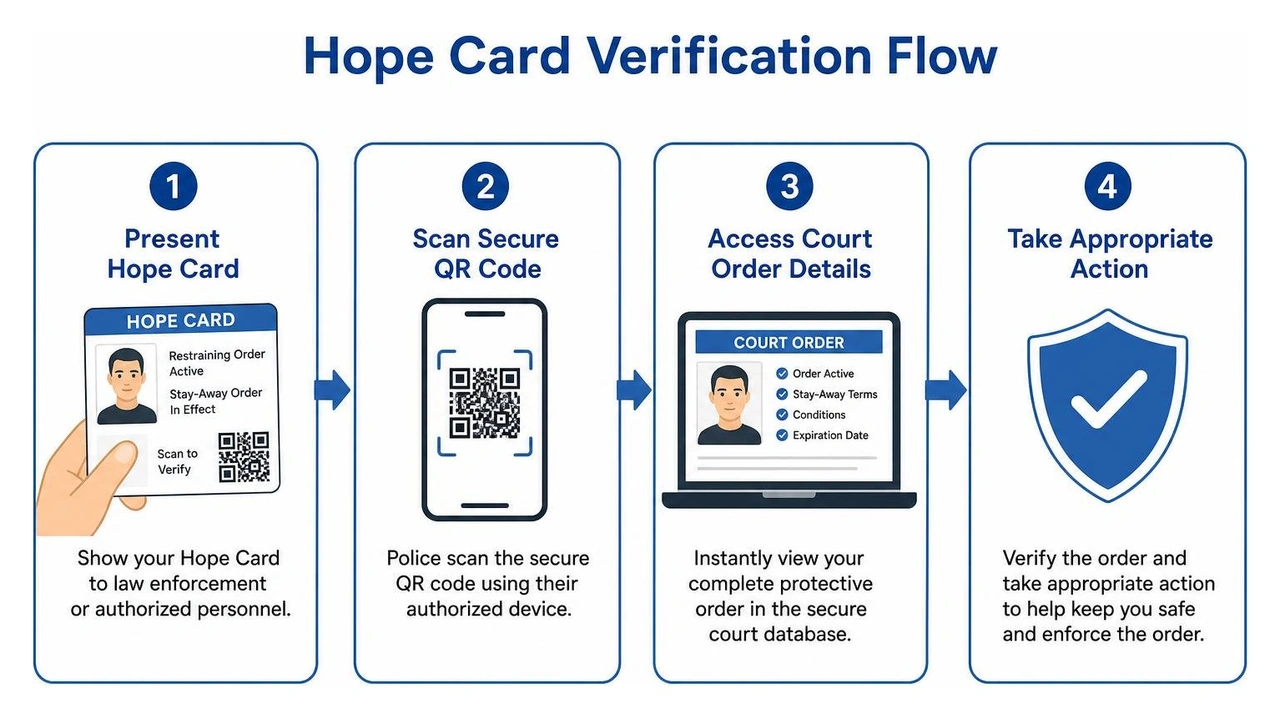
When police scan the card, they can view your complete court order instantly in their database. You can also show it to your child's school, daycare, or your workplace security team so they know your ex is legally barred from coming near. This digital tracking makes securing a domestic restraining order more effective than ever.
Frequently Asked Questions About Orders of Protection
How long can an order of protection stay in effect?
In New York family court, a standard final order usually lasts up to 2 years. If the court finds "aggravating circumstances"—such as weapon use, serious physical harm, or repeated order violations—the judge can extend the order up to 5 years. In other states, rules vary. For example, New Jersey final restraining orders can last indefinitely, while Oregon orders last 2 years. Learn more about state rules by reading how long can an order of protection last.
Can an order of protection be filed if we never lived together or married?
Yes. As long as you were in an intimate dating relationship, you can file in family court. You do not need to have shared a home, been married, or had children together. For non-dating situations (like a hostile neighbor or coworker), you can file for protection through criminal or civil court. Learn more about relationship rules by reading about filing an order of protection regardless of relationship.
What happens if an ex violates a stay-away order?
If your ex violates the order, call 911 immediately. Save every text, voicemail, or security camera clip showing the breach. The police can arrest your ex for criminal contempt. You can also bring a violation petition in family court, which creates a special court record. You can learn more about this by understanding the O docket process.
Conclusion
Your safety and peace of mind should always come first. Establishing legal boundaries through an order of protection gives you the legal power to keep an abusive or harassing ex away for good.
At Zacarese & Zalewski P.C., we serve families across Long Island, including Islandia, Central Islip, Riverhead, and surrounding towns. With our flat-fee pricing, plain-English advice, and fast same-day response, we ensure you never face the court alone.
If you need legal help setting boundaries today, schedule a consultation for comprehensive orders of protection assistance.
📱 Cell: (516) 660-4354
📧 Email: steve@zandzfamilylawyers.com
🏛 Address: 1601 Veterans Memorial Highway, Suite 500, Islandia, NY 11749
i guarantee you will be heard
Ready to Take the Next Step?
At Zacarese & Zalewski P.C., when something isn’t right, say something—and we’ll do something about it with you.
Our flat-fee structure is clear: one flat fee for pre-trial work, and a trial fee only if your case goes to trial or a hearing. Call now and a professional will return your call quickly; if we miss you, we'll call back the same day.